




Key Takeaways
- Start with the biggest shapes: Thick outlines and wide open areas give your child a win before you move on to anything detailed.
- Coloring builds hand strength more reliably than it calms: The research behind hand-skill practice is stronger than the case for coloring as a calming tool.
- A child who refuses to color isn't failing at anything: Sometimes the crayon texture is the problem, sometimes the grip is, and sometimes they would rather be doing something else.
- You don't have to work this out alone: Alpaca Health matches families with a board certified behavior analyst who can look at hand skills and daily routines together, and there's no waitlist to sit on first. Get matched today.
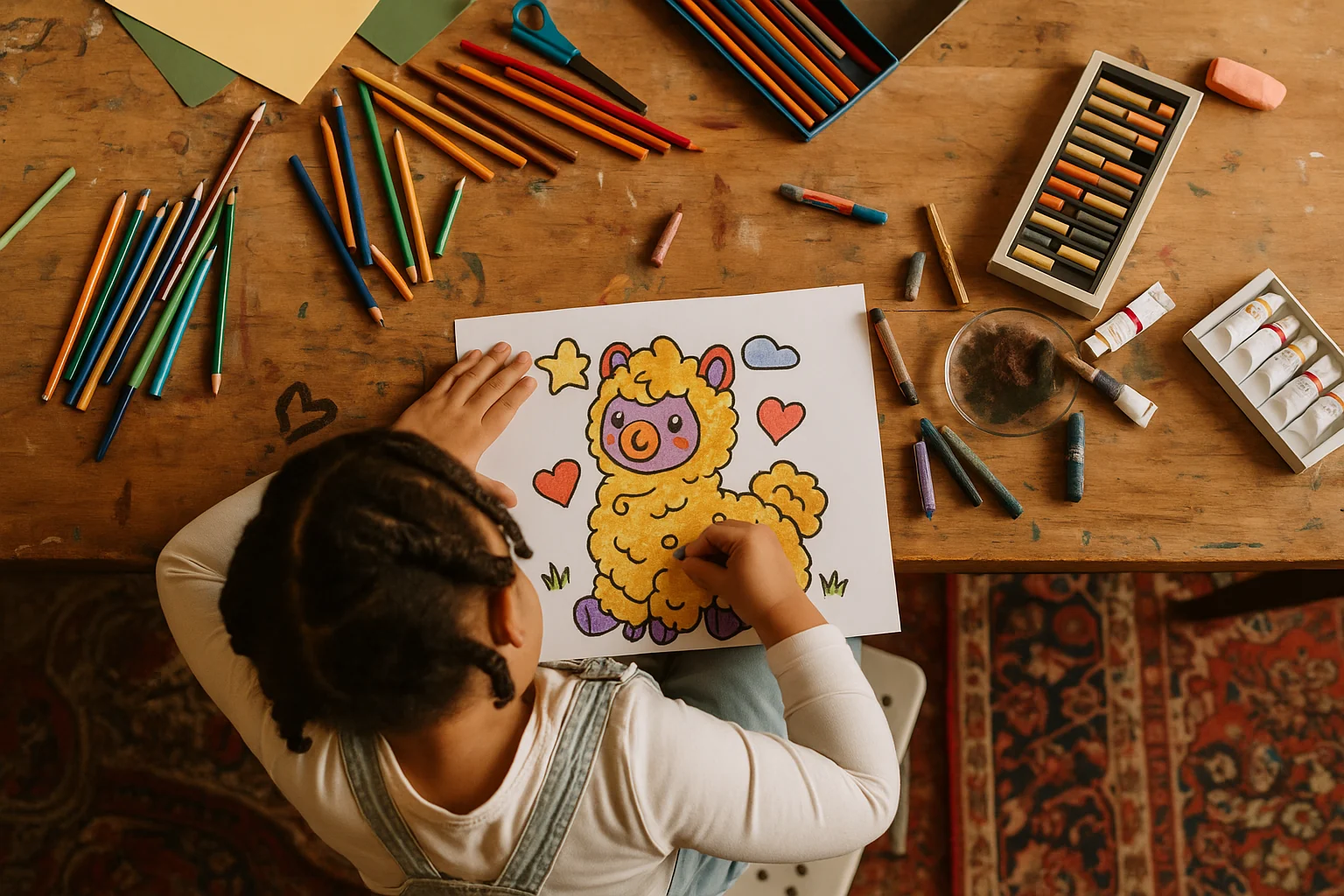
The twelve coloring sheets below were drawn for autistic kids and sorted by how much detail each page asks for, starting with thick simple outlines and ending in fine repeating patterns. Sorting them that way means you can match a page to where your child is today instead of working down a pile. Print the two or three that fit and leave the rest.
Most of what turns up in a search was made for Autism Acceptance Month, covered in ribbons and slogans written for adults. That works on a bulletin board in April, but it doesn't help on a Tuesday afternoon when your kid needs something to do at the kitchen table.
Download the free printable autism coloring pages
All twelve print on standard US Letter paper in black and white, so any home printer handles them without special settings.
Coloring a sheet also enters your child in the Alpaca Health Coloring Contest. It runs through November 30, 2026, one winner is drawn every week, and each winner receives a prize gift bag. A parent or legal guardian submits the entry.
The sheets come sorted into three groups, so you aren't left guessing which one to hand over.
| Group | What the lines look like | Where it fits |
|---|---|---|
| Big shapes, bold lines | Thick outlines, few areas | Start here |
| A little more detail | Smaller spaces, more pieces | Once shapes get filled in |
| Lots of small spaces | Fine repeating pattern | Older kids and adults |
Choose fit-to-page in your printer settings, since the artwork sits inside a safe margin on purpose and borderless printing will crop the edges off.
If your child works through these quickly, there's an ABA activity kit drawn from applied behavior analysis, the therapy most autistic kids get referred to, and a set of visual schedule templates for daily routines.
Does coloring help autistic children?
Yes, though for a narrower reason than most coloring-book pages suggest. The case for hand-skill practice is solid, while the case for calming rests on adult studies that haven't held up as well as people assume.
Fine motor and sitting tolerance
Trouble with movement is close to universal in autism, and it's easy to miss. One large study of 13,887 autistic children put 88.2% of them at risk for motor problems, which is 22.2 times the rate in other kids. Weaker hand skills, meaning the small movements behind writing and buttons, also track with language scores. That makes this more than a side issue.
Coloring rehearses what handwriting needs later, since your child has to hold a tool, keep the forearm down, and move from the wrist. Sitting still long enough to fill one shape is its own skill, and often the harder of the two.
Calm-down time
Coloring as a calming tool has less behind it than you'd think. Everyone cites one 2005 study of 84 college students, where the ones who colored a set pattern felt calmer than the ones handed blank paper, and a 2012 repeat found the same.
Since then it has gotten murkier. A 2021 review found pattern coloring no better than free drawing, and a review of art programs for autistic kids left drawing out of its 15 studies, because the available ones were too small.
So if coloring settles your child, keep going. Just don't lean on it during overwhelming moments, when a sensory strategy they already know tends to land better.
Do colors matter?
A little, though not the way color-psychology posts claim. One study compared 29 autistic boys with 38 others and found the autistic boys picked yellow less and green or brown more, which the authors put down to yellow reading as too bright. That's a single small study, so treat it as a reason to put out a wide set of colors and not to take any away.
How to pick the right sheet for your child's skill level
Start with large spaces and shrink them over time. Small, clearly bounded shapes get filled all the way in, and finishing one is what makes a child willing to try another. A detailed page handed over too early usually gets a few marks before your child loses interest.
So when do you move up a group? Watch whether your child fills a shape edge to edge, since staying inside the lines was never the goal.
It also helps to let your child pick which sheet, since giving kids a choice lifts engagement and cuts difficult behavior. Two options is enough to count.
Turn colouring time into a plan built for your child.
Printables are a good start, and a Board Certified Behavior Analyst can shape hand skills and table time into a program around your child’s real goals. Alpaca Health matches you with one, often within days.
Get matched with a BCBA →
What to do when your child won't color
This comes up constantly. One autism parenting thread titled "Child won't draw, color, or write" drew 52 replies, and another called "No Interest in Coloring?" drew 26 more. It's common enough to be worth sorting into one of three causes before you push harder.
When it's a fine motor problem
If your child holds the crayon in a fist, presses hard enough to tear paper, or tires within seconds, the hand is doing too much work. Breaking the crayons short helps, because there's nothing left to wrap a fist around and the thumb and finger have to take over. Taping the page to a wall asks the wrist for the same thing.
When it's a sensory problem
When the refusal comes instantly, it's usually about the tool. How touch registers differs a lot in autism, and those differences tie back to core features of it. A waxy crayon has a squeak and a smell that a marker doesn't, so swap the supplies before you swap the activity.
If food and clothing textures are a battle too, a sensory diet plans for all of it across the day.
When coloring just isn't their thing
Some kids never take to it, and that's a real answer. Tearing paper, rolling playdough, and threading beads all build the same hand strength without a page involved, so there are plenty of ways round it. Coloring isn't a milestone your child owes anyone.
Five ways to make coloring easier, from an occupational therapist
Katie McKenna, an occupational therapist who works on hand skills and daily tasks, sets out five adjustments that change how reachable coloring feels.
- Check the form first: The forearm rests on the table and the movement comes from the wrist, not the shoulder.
- Color your own sheet beside them: Showing the motion works better than describing it.
- Begin with small simple shapes: A small area gets filled completely, and finishing is what brings a child back.
- Make the borders louder: Trace the outline in bold marker, or raise it with hot glue so the edge can be felt.
- Move it somewhere new: Tape paper under a table, or switch to fingerpaint or chalk.
The way you help matters as much as how your child sits. Guiding their hand feels supportive, but it's the heaviest kind of help there is, and stepping back again takes a plan, which is the point of a prompt hierarchy. If the barrier is motivation instead of skill, token boards give your child something to work toward. Coloring sits between two fields, so it also helps to know how ABA and OT split the work.
Choosing crayons, markers, and paper for sensory needs
The supplies decide more of this than the picture does. How autistic children take in sensory information can shape daily life enough that one child settles in with markers while another only uses chalk outside. None of it is fussiness, and changing the supplies is usually easier than talking your child into the ones you've already got.
A few swaps worth keeping in the drawer:
- Chunky or broken crayons for a fisted grip
- Twistable crayons if wrappers bother them
- Washable markers when drag is the issue
- Paint sticks for anyone avoiding waxy textures
- Heavier paper, around 32 lb, if pressing tears sheets
Print two copies of any sheet your child likes, so a ruined page just means starting again.
When to expect coloring skills by age
Drawing follows a rough order. The CDC puts scribbling at around 18 months, and by three most children can draw a circle and copy simple shapes. That same page tells parents to keep paper and crayons within reach, which is about as uncontroversial as child development advice gets.
Autistic children often hit these points on their own schedule, and since motor trouble is common, a lag here on its own doesn't tell you much. A skill your child had and then lost is worth a closer look, and so is a child who's avoiding every table activity rather than this one alone. If your child is under three, the early signs worth raising with a pediatrician are set out separately.
Some days are hard. We can help.
When you’re ready for expert support, Alpaca Health matches your family with a caring BCBA who can help with the moments that feel impossible, at home, in clinic, or online.
Get matched with a BCBA →
Free autism coloring pages for a classroom or Autism Acceptance Month
A lot of autism coloring pages carry ribbons and puzzle pieces, which ties them to April. These twelve have no dates or slogans on them, so they sit just as well in a waiting room in October.
In a classroom, print one group per table instead of one sheet per child, so nobody gets a page well past their level or has to ask for an easier one in front of everyone. Pair them with the visual supports already on your wall, and keep spares of the simplest group, since that one runs out first.
Enter the fall coloring contest
Every sheet in this pack can be entered into the Alpaca Health Coloring Contest, which runs from September 1 to November 30, 2026. Print a sheet, let your child color it however they like, then submit a photo of the finished artwork.
One winner is drawn each week for thirteen weeks, and each winner receives an Alpaca Health prize gift bag. Entries are open to children of any age and must be submitted by a parent or legal guardian. You can enter the contest here or read the official contest rules first.
How Alpaca Health Helps
Maybe your child can't hold a crayon, avoids every table activity, or is losing skills they had. Any of those is worth talking through with a board certified behavior analyst, the clinician who builds and oversees an ABA plan and can look at all of it together.
Alpaca Health matches families with behavior analysts and registered behavior technicians taking new clients, and checks your coverage during intake instead of leaving you to call plans yourself. Sessions run at home or over video, and Medicaid and most major insurance are accepted. If you'd rather start with a conversation than another waitlist, get matched today.
You don’t have to figure this out alone.
Alpaca Health matches your family with a vetted, in-network BCBA, often within days and with no waitlist. We handle the insurance paperwork so you can focus on your child.
Get matched with a BCBA →
Frequently asked questions about autism coloring pages
Why don't autistic kids like to color?
Usually it comes down to the crayon rather than the activity. Waxy crayons have a texture and a smell some kids can't stand, and a weak grip makes even a few seconds tiring. Touch registers differently in autism, so trying markers or chalk answers this faster than encouragement will.
How do you get an autistic child to color?
Give them two sheets to choose between, take a third yourself, and color beside them without asking questions. Pick shapes small enough that they can finish one. If grip or sitting is the barrier and not interest, a behavior analyst can work on both, and Alpaca Health can match you with one.
What is the most calming color for autism?
There isn't one, though blues and greens get suggested most. The single study on this found autistic boys chose yellow less often and green or brown more. Put out the full set and let your child sort it out.
Are there free printable autism coloring pages for toddlers?
The three sheets in the first group suit toddlers best, with thick outlines and few areas per page. Expect scribbling straight over the lines, which is exactly right for two-year-olds. For children under three, therapy for toddlers starts earlier than most families expect.
Do coloring pages work for autistic adults?
Yes, and the detailed patterned sheet in the third group is there for that reason. The calming research was run on adults, not kids, so it applies more to adults than to young children.
RELATED ARTICLES