





Autism elopement is when a child leaves a safe, supervised space without permission. A home, a classroom, a store. Parents also call it wandering or bolting.
It is one of the most urgent safety issues in autism care. It can happen in seconds, and it can put a child near traffic or water before anyone notices they are gone.
Key Takeaways
- Elopement is common, but it isn't universal: in the largest study on this, about half of parents surveyed said their autistic child had tried to leave at least once, with risk peaking in the early school years.
- It's almost always goal-directed: children leave to escape something overwhelming or to reach something they want, not out of defiance.
- Water and traffic are the two dangers that matter most: pool fencing, swim skills, and door alarms address the risks that cause the most harm.
- A BCBA can build a plan around why your child bolts: get matched with a BCBA who starts with an assessment of the cause, not a generic checklist.
What Does Elopement in Autism Mean?
The behavior means leaving a supervised space without permission. Slipping out a front door, running from a parent's side in a parking lot, climbing a playground fence.
It is different from a toddler drifting three feet away to look at something. Elopement carries risk because many autistic children who bolt don't reliably judge danger. They may not answer when called, and they can move fast and quietly.
Researchers describe the behavior as goal-directed rather than random (Anderson and colleagues, 2012). Your child is heading toward something or away from something, even when the destination makes no sense to the adult watching.
How Common Is Elopement, and When Does It Peak?
Researchers at the Interactive Autism Network surveyed the parents of 1,218 autistic children. Nearly half said their child had tried to leave at least once after age four, against 13 percent of their non-autistic siblings (Anderson and colleagues, 2012). That is roughly four times the rate.
Attempts peaked around age five and a half on average. The behavior was more common in children with higher support needs.
The rate drops with age without disappearing. In the same sample, per Anderson and colleagues, it affected 46 percent of four to seven year olds and 27 percent of eight to eleven year olds. This was a survey of parents who chose to join an online research registry, so read the numbers as a large real-world estimate rather than a fixed rule for your own child.
Why Autistic Children Elope
Escape and Avoidance
Some children bolt to get away from something that has become unbearable. A fire alarm, a crowded hallway, a demand they can't process fast enough, or sensory input that has crossed into pain.
When that pressure builds, leaving can look like the only available exit. The same overload that drives a meltdown in one child drives another straight out the door.
Seeking Something Specific
Just as often, elopement is pursuit rather than escape. More than half of children who wandered were described by their parents as happy, playful, or focused while it was happening. They were chasing water, trains, a specific place, or an object of interest (Anderson and colleagues, 2012).
Knowing which pattern fits your child changes the plan. A child escaping sensory overload needs an exit that isn't the street. A child chasing a fascination needs that pull addressed directly, because blocking it alone tends to backfire.
A safety plan built for your child.
Alpaca Health matches your family with a vetted, in-network BCBA, often within days and with no waitlist. We handle the insurance paperwork so you can focus on your child.
Get matched with a BCBA →
The Dangers That Make Elopement Urgent
This is more than a stressful behavior to manage. Of the children in the Anderson study who went missing long enough to cause concern, 24 percent were in danger of drowning and 65 percent were in danger of traffic injury during that incident (Anderson and colleagues, 2012).
A separate six-year review of confirmed wandering deaths found that accidental drowning accounted for 71 percent of those fatalities, according to the National Autism Association.
Those two figures measure different things. The first is danger during an incident, while the second is cause of death among children who did not survive one. Both point the same way. Water is the largest threat once a child is out of sight, which is why the response steps below start there.
What to Do in the First Minutes if Your Child Is Missing
Call 911 immediately. There is no waiting period, and you do not need to wait 24 hours to report a child missing, despite a myth that persists.
Tell the dispatcher two things most families forget under stress. That your child is autistic. And that they may not answer to their name, even with searchers standing beside them.
Search nearby water first, before doors get checked twice or a grid search begins, because drowning happens fast and close to home (a joint NCMEC safety alert).
While police are on the way, call the National Center for Missing and Exploited Children on 1-800-843-5678. Their team runs around the clock, can support the search, and can push information out quickly. Calling them does not replace or delay your 911 call.
Water Safety Steps That Lower the Biggest Risk
Teaching Your Child to Swim
Swim lessons build a real safety skill. The American Academy of Pediatrics does not recommend them as the only method of drowning prevention, as Pennsylvania's autism resource center notes.
Look for an instructor with experience teaching autistic children. A standard group class can work against a child who needs a slower pace or a quieter pool. A child who can swim is safer than one who can't, though swimming doesn't cancel the need for the layers below.
Securing Water at Home and Nearby
If you have a pool, use four-sided fencing with a self-closing, self-latching gate set above your child's reach. Remove pool toys and float mats when the pool isn't in use, so it looks less inviting from a distance.
Empty kiddie pools, buckets, and bathtubs right after use. If you live near a pond, canal, or retention basin, walk that route with your child's risk in mind. Let neighbors know it is a specific concern for your family, not a general safety reminder.
How to Make Your Home and Car Harder to Leave
Door and window alarms that chime when opened give you a warning window a lock doesn't. Deadbolts and chain locks above your child's reach add a second layer.
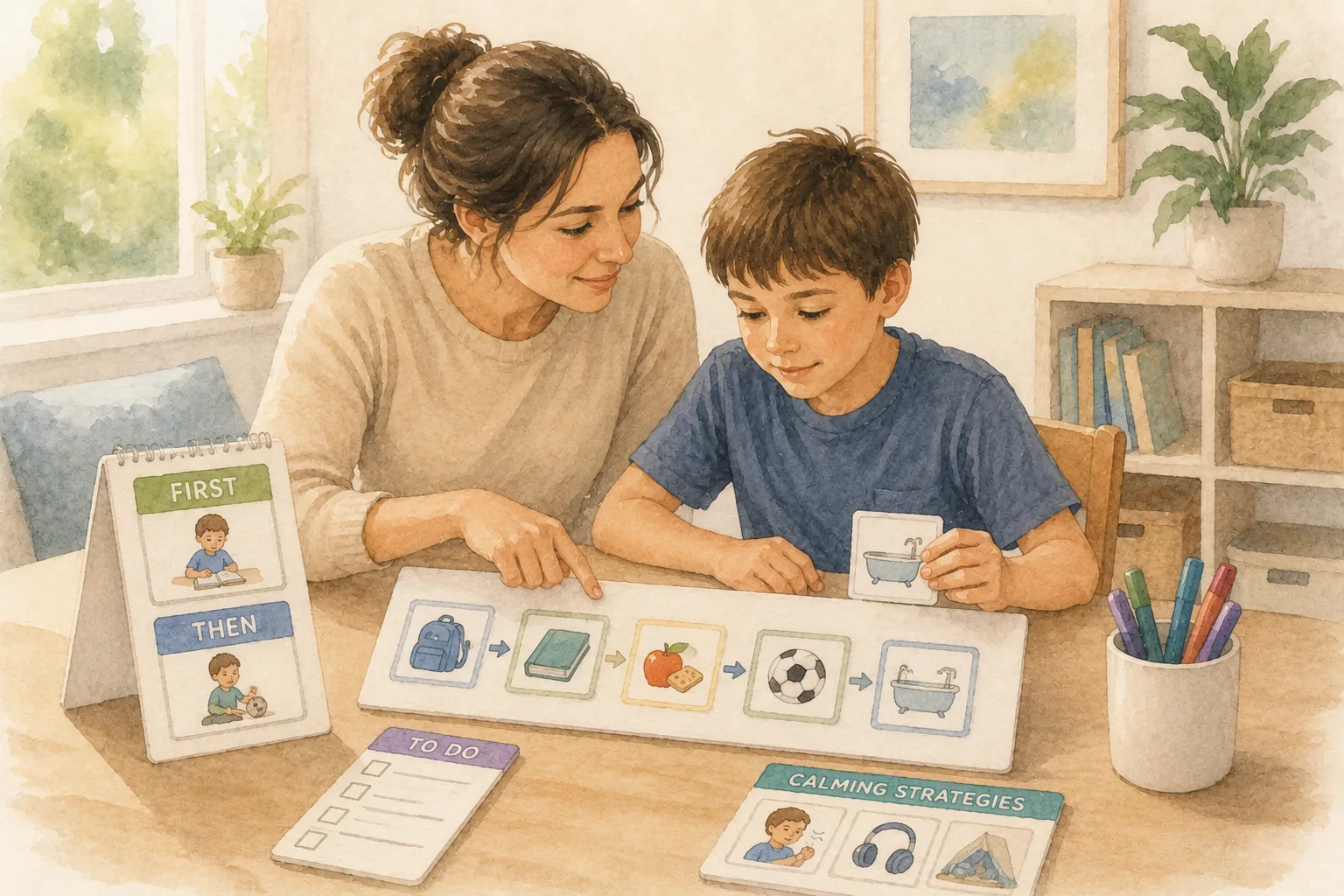
Stop signs at eye level on exit doors work well for children who respond to visual cues. If that helps, the same approach can carry through the day using our free visual schedule templates.
In the car, a seatbelt buckle guard stops a child unbuckling and getting out while you are in traffic or a parking lot. Child safety locks on rear doors add another layer. None of these is foolproof alone, which is why they work stacked rather than singly.
How to Teach the Safety Skills That Reduce Elopement
Skills to Practice at Home
Practice having your child give their name and address, by speech, by a communication device, or on a card they carry. Children who use picture exchange systems can carry the same images for this.
Work on answering to their name, because many missing autistic children don't respond even once found (NCMEC investigative checklist). Teach a specific stop cue tied to curbs and doorways, practiced calmly and often rather than only during a real scare.
A social story can rehearse the same routine in a low-pressure way, and the prompting hierarchy your BCBA uses will show you how much help to give and when to fade it.
How a BCBA Builds an Elopement Plan
A BCBA starts with a functional behavior assessment, which is a structured way of working out what the behavior achieves for your child. The plan then differs by answer.
For escape-driven elopement, it usually teaches a replacement way to ask for a break before overwhelm hits. A sensory diet often sits alongside it to lower the baseline pressure.
For seeking-driven elopement, it builds in scheduled, supervised access to whatever draws your child, so the pull loses urgency. Our guide to the pros and cons of ABA explains how a function-based approach differs from one that only blocks the behavior afterward.
Start with the cause, not a checklist.
A Board Certified Behavior Analyst works out whether your child is escaping or seeking, then builds the plan around that answer.
Get matched with a BCBA →What to Set Up Before an Incident Happens
Free, ready-made forms already exist, so there is no need to build your own. Autism Speaks offers an elopement alert form with fields for your child's triggers, communication ability, and known draws like water or trains.
The National Autism Association's Big Red Safety Toolkit holds a similar first-responder profile plus a family emergency plan. Pathfinders for Autism offers a comparable form built for the same purpose.
Pick one. Fill it out during a calm moment rather than a crisis, and update it once a year or after any real change in your child's communication or description.
People to Tell: Neighbors, School, and First Responders
Give a copy to your local police and fire departments and ask whether they will keep it on file. Repeat that at your child's school, so office staff and the classroom team hold the same information.
Neighbors with pools or ponds should know your child may be drawn to water and may not recognize their property as off-limits.
Registries, Trackers, and ID Options
- Project Lifesaver fits a small radio transmitter: local search teams can track it if your child goes missing. Cost and availability vary by county, so contact your sheriff's office directly rather than assuming a flat fee.
- Smart911 builds a profile your dispatcher sees: it surfaces your child's diagnosis and communication needs the moment you call. It works only in participating areas, so check your county first.
- Take Me Home is a local police registry: officers who encounter your child can look up their details before any 911 call. Availability depends on your city maintaining the program.
What to Change After an Elopement, at Home and at School
Treat every incident, including a near miss, as new information rather than a failure. At home, walk back through exactly how your child got out and close that specific gap. A door left unlocked during a delivery, or a window they worked out how to open.
At school, ask that any history of elopement go into your child's Individualized Education Program directly, not a separate behavior plan nobody outside the classroom reads. Safety belongs in the legal document itself, which our guide to IEP goals for autism sets out, and the IEP meeting checklist will help you raise it.
If your child receives ABA, ask your BCBA to revisit the assessment with the new incident in mind. A plan that worked at four may need updating at seven.
How Alpaca Health Helps Families Managing Elopement
Alpaca Health matches families with local, independent Board Certified Behavior Analysts across Colorado, Texas, North Carolina, Michigan, and Hawaii. When elopement is part of your child's profile, your BCBA starts with a functional behavior assessment to work out whether escape or seeking is driving it.
The plan then follows that answer rather than a one-size-fits-all safety checklist. If you're ready to put something in place, start your intake and we'll match you with a BCBA.
Frequently Asked Questions About Autism Elopement
At what age do autistic kids stop eloping?
There is no fixed age. Risk drops as children get older, from 46 percent of four to seven year olds down to 27 percent of eight to eleven year olds in the same large sample (Anderson and colleagues, 2012). It doesn't vanish for every child, and some autistic teens and adults still wander. Plan around your child's current profile rather than their age.
What are common triggers for elopement?
Sensory overload, an overwhelming demand, transitions, and loud or crowded places drive escape-motivated elopement. Water, trains, a specific location, or another strong interest drive the seeking kind. Most children show one pattern more than the other, and that pattern is what your plan should target.
What does eloping look like in autism?
It often looks sudden and silent. A child who was beside you a moment ago is gone, with no goodbye and no glance back to check whether you are following. Many children don't look both ways at a street or hesitate at an open door the way a typically developing child would.
How do I stop my child from eloping at school?
Get the history written into the IEP directly, with specific steps like door alarms on classroom exits and a named staff member assigned during transitions. Ask that whoever runs your child's behavior plan shares the assessment with the school team, so the same approach runs in both places.
What is the best intervention for elopement?
There isn't a single fix. The strongest approach layers a function-based plan from a BCBA, physical safeguards at home and school, safety skills practiced regularly, and an alert form filed before you need it. Families who put several layers in place at once see the steadiest results. You can talk to a BCBA about which layer to start with.
RELATED ARTICLES