






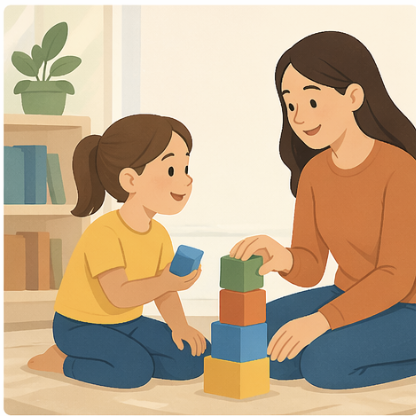
Applied Behavior Analysis (ABA) therapy for toddlers is a play-based support for young autistic children, and it helps them build communication, daily living skills, and ways to participate in their environment. Most programs start between 18 months and 5 years old, with a Registered Behavior Technician (RBT) working one-on-one with your child under a Board Certified Behavior Analyst (BCBA).
A typical toddler session looks like guided play on the floor at home or in a clinic room, not drills at a desk. You don't need to figure everything out at once, and most families try different supports over time based on what helps their child.
This guide covers what ABA for toddlers looks like, signs a BCBA may bring it up, the play-based techniques used, what a session involves, and how to start.
Key Takeaways
- ABA for toddlers is play-based: modern sessions use your child's interests and natural motivation to build communication, social, and daily living skills.
- Signs can appear by 18-24 months: the American Academy of Pediatrics recommends autism-specific screening at the 18- and 24-month visits, so concerns don't need to wait until age 3.
- ABA is one of several support options: families often combine it with speech therapy, occupational therapy, or other developmental supports depending on their child's needs.
- More hours are not automatically better: the right number depends on your child's needs, tolerance, and overall schedule, including school and other therapies.
- Federal and state programs can reduce costs: Early Intervention covers children under 3 at little or no cost, and every state requires private plans to cover some level of ABA.
What Is ABA Therapy for Toddlers?
ABA therapy for toddlers is a play-based support delivered one-on-one by an RBT under BCBA supervision, and it's built around your child's interests. For a two- or three-year-old, most of a session is floor time with toys, snacks, and everyday routines, where the therapist gently shapes interactions rather than running formal lessons.
Skills get broken into small steps, but the wrapping is play. Neurodiversity-affirming ABA respects your child's interests and supports communication and autonomy, so success is measured through meaningful skill development, not compliance alone. It should not suppress harmless autistic traits like stimming, unless a behavior creates clear safety concerns.
Perspectives on ABA vary. Earlier models focused on compliance and behavior reduction, which many autistic adults have criticized, but modern ethical ABA emphasizes communication, autonomy, and consent. A neurodiversity-affirming approach also includes ongoing assent, meaning your toddler has a say in when to pause or take a break.
You don't have to figure this out alone.
Alpaca Health matches your family with a vetted, in-network BCBA, often within days and with no waitlist. We handle the insurance paperwork so you can focus on your child.
Get matched with a BCBA →
Signs Your Toddler May Benefit From ABA Therapy
The CDC estimates that roughly 1 in 31 children in the U.S. are identified with autism by age 8, but the median age of diagnosis is still over four. That's why the American Academy of Pediatrics (AAP) recommends autism-specific screening at the 18- and 24-month visits, plus general developmental screening at 9, 18, and 30 months. Earlier concerns don't have to wait for age 3.
A BCBA may bring up ABA as part of your toddler's support plan when you're noticing patterns like these:
- Limited functional communication: your toddler has few words or signs to request what they want, which can lead to overwhelming moments that feel hard to resolve at home.
- Safety concerns in daily routines: bolting/elopement from a parking lot, climbing on high furniture, or putting non-food items in their mouth during play.
- Specific behaviors that pose safety risks: not harmless stimming, but behaviors that make mealtimes, sleep, or travel very difficult in your current routine.
- Less back-and-forth with caregivers or peers in play: limited turn-taking during familiar games, or more independent play than you might expect at their age.
Any one of these on its own doesn't point to autism, but bring it up at a screening. If a developmental pediatrician, psychologist, or neuropsychologist has given an autism diagnosis, an ABA assessment is one possible next step. A good provider will listen to what you've noticed at home and help you decide whether ABA fits or whether another support is a better starting point.
Core ABA Therapy Techniques Used With Toddlers
For toddlers, a BCBA usually blends a few naturalistic, play-based approaches. Each serves a different purpose, and they often appear within the same session:
- Natural Environment Teaching (NET): teaching happens inside your child's real surroundings, like a high chair, a bath, or the living room floor. If your toddler reaches for a sliced apple, the RBT pauses and models the word or sign for "apple" before handing it over, so skills generalize more easily to home.
- Pivotal Response Treatment (PRT): focuses on motivation, initiation, and responding to multiple cues, so a favorite game becomes a chance to practice initiating. A review of PRT research found meaningful effects on language and communication in young autistic children.
- Discrete Trial Training (DTT): a more structured method where a skill is broken into small steps and practiced in short, repeated moments, like a one-minute practice of matching two red blocks with a favorite toy right after, then back to free play.
Many modern toddler programs sit inside a broader family of Naturalistic Developmental Behavioral Interventions (NDBIs), which include approaches like the Early Start Denver Model (ESDM) and JASPER. They blend behavioral science with developmental, play-based teaching, so toddler sessions can feel more like shared play than formal therapy.
What a Typical ABA Therapy Session Looks Like for a Toddler
Most toddler sessions run two to three hours at a time, a few times a week. The pace is slower than a school day, built around short bursts of activity, snacks, and breaks. You're usually welcome to stay nearby, especially in the early weeks, and sessions follow your toddler's lead rather than directing every interaction.
The first ten minutes often looks like this. The RBT arrives, sits on the floor near a bin of toys, and mirrors what your toddler is doing, so if your child picks up a toy car, the RBT picks one up too. A small teaching moment might follow, like modeling "go" before rolling the car, but the bulk of the opener is low-pressure play.
Assessment and Goal Setting
The first two to four weeks are mostly assessments, where the BCBA watches how your toddler plays, communicates, and handles routines. They then write a therapy plan with specific goals. You'll be asked what matters most at home, like bedtime, mealtimes, or leaving the house, and the goals in the plan should reflect your answers.
Pairing and Play-Based Learning
Before any direct teaching, the RBT spends time "pairing," a clinical term for building a trusting relationship with your toddler. Day 1 can look like the RBT sitting nearby, handing over a favorite snack, and copying your toddler's play, and by day 5, your child might hand them a book or tolerate them in a shared activity. Once your toddler is comfortable, the RBT weaves short teaching moments into play.
Data Collection and Parent Debrief
The RBT logs specific responses: how many times your child used a word, how long they engaged with a task, whether a transition needed one prompt or five. A monthly progress report might show "requested water independently 8 of 12 times this week, up from 2 of 12 last month," and the BCBA reviews that data weekly and adjusts the plan.
You should get a short parent debrief after each session, plus a longer progress meeting with the BCBA every few weeks. If no data shows up after the first month, raise it with the BCBA, because data should adjust support, not pressure your child.
Skills ABA Therapy Helps Toddlers Build
Goals at this age are kept small and practical, so the BCBA picks a few areas at a time. Starting points and pace vary widely, so treat the table below as examples, not benchmarks.
| Skill Area | Common Starting Point | What Early Progress Can Look Like |
|---|---|---|
| Communication | Crying or screaming to express needs; few or no words or signs | Pointing at a desired item, using a picture card, or saying an approximation of a word to request |
| Play and social engagement | Mostly solo play; inconsistent response to their name | Brief back-and-forth with a caregiver, watching a peer, handing a toy back and forth |
| Daily routines | Resistance to dressing, brushing teeth, or the car seat | Completing one or two steps of a routine with a single verbal prompt instead of needing physical help at every step |
| Regulation and safety | Frequent moments of overwhelm, self-injury, or unsafe bolting/elopement | Using a break card or walking to a quiet spot before becoming more overwhelmed |
| Independence | Needing full physical support for most activities | Feeding themselves a few bites with a spoon, pulling off their shoes, handing a plate to the sink |
Well-designed ABA programs focus on reducing behaviors that pose safety risks or make daily routines harder, and they don't aim to eliminate harmless behaviors like stimming, which many autistic people use for self-regulation. The goal is to build skills that support autonomy, communication, and daily life, and the level of support changes over time.
In-Home vs. Clinic-Based ABA Therapy for Toddlers
Most toddlers settle faster in their own living room, with familiar toys and a caregiver nearby, so the in-home vs. clinic decision can matter more at this age than later. Most toddler programs are delivered in-home, at a clinic for young children, or some combination, and the right setting is where your child feels most comfortable and able to engage.
| In-Home ABA | Clinic-Based ABA | |
|---|---|---|
| Best for | Toddlers who find new environments hard; young children working on home routines | Toddlers who may benefit from peer exposure; families who want a dedicated therapy space |
| What sessions look like | Play on the floor, in the kitchen, or during mealtimes and bath | Play in a toddler room with therapy materials, sometimes short group moments |
| Generalization | Skills practiced in the rooms your child uses every day | Skills may take longer to transfer home; BCBA gives take-home strategies |
| Logistics | Therapist travels to you; less disruption to naps and meals | Drop-off and pickup; usually steadier scheduling |
| Parent involvement | Easier to observe sessions and try strategies right away | Often through scheduled parent training or meetings |
Many toddlers do best with a mix: most hours at home for routines, a few hours in a clinic for peer play. Your BCBA can help decide the balance, and it can shift as your child grows, so ask questions and adjust the approach as you learn what works. If your child is in daycare or preschool, some programs send an RBT to those settings once routines are steady.
How to Start ABA Therapy for Your Toddler
Starting ABA can feel like a stack of paperwork, but it usually breaks into five steps. Most families move from diagnosis to first session in four to twelve weeks, depending on waitlists and insurance.
- Get a formal autism diagnosis: a developmental pediatrician, psychologist, or neuropsychologist can complete the evaluation, and your pediatrician can refer you if you don't have one. Some providers, including Alpaca Health, offer insurance-covered Autism Diagnostic Observation Schedule (ADOS-2) assessments.
- Check Early Intervention eligibility: if your child is under 3, federal Early Intervention services under the Individuals with Disabilities Education Act (IDEA) Part C can often start before the diagnosis is final. Your state's program evaluates developmental areas at little or no cost, and sometimes coordinates with an outside ABA provider.
- Verify insurance coverage: every state has autism insurance laws requiring state-regulated private plans to cover some level of ABA, and Medicaid covers it for children under 21 through the EPSDT benefit. Call member services on your card to ask whether ABA is covered, what prior authorization requires, and whether a provider is in-network.
- Choose a BCBA you trust: a good provider tailors goals to your child's needs, and consistent distress in sessions is a signal to reassess the approach. Ask about their experience with toddlers, how they approach stimming, and what parent involvement looks like, or get matched with a BCBA through Alpaca today.
- Plan for home reinforcement: parent training is a regular part of most toddler programs, and a 2023 meta-analysis found parent-implemented strategies are associated with meaningful gains in communication. Simple tools like visual schedules help your toddler predict what happens next and make transitions easier.
More hours are not automatically better if they leave your child exhausted or unable to participate in the rest of their day, so a good BCBA starts at a pace your toddler handles, then adjusts as the plan settles. If you want help with steps three through five, find your BCBA through Alpaca today and skip the typical waitlist.
How Alpaca Health Helps Your Toddler Start Sooner
For most toddler families, the waitlist is the slow part, not the therapy, because evaluation centers can take months and many ABA clinics quote long waitlists. Alpaca matches families with independent BCBAs in 24 hours, offers insurance-covered ADOS-2 assessments, and handles insurance verification before the first session. If waitlists are standing between your toddler and early support, find a BCBA this week.
You don't have to figure this out alone.
Alpaca Health matches your family with a vetted, in-network BCBA, often within days and with no waitlist. We handle the insurance paperwork so you can focus on your child.
Get matched with a BCBA →Frequently Asked Questions About ABA Therapy for Toddlers
At what age can my toddler start ABA therapy?
Most programs accept children as young as 18 months once an autism diagnosis is in place, and federal Early Intervention under IDEA Part C can start even earlier based on developmental concerns alone. Starting at 4 or 5 does not mean missing the window.
How many hours of ABA therapy does a toddler need per week?
ABA is typically delivered one-on-one for 10 to 40 hours per week by a BCBA and an RBT, and younger children needing more support with communication, safety, or routines are often recommended for more hours early on. More hours aren't better if they leave your toddler exhausted, so many BCBAs step hours down as early goals are met.
Does insurance cover ABA therapy for toddlers?
Yes, in most cases. Every state requires state-regulated private plans to cover some level of ABA, and Medicaid covers it for children under 21 through the EPSDT benefit. One exception: self-funded employer plans are governed by federal ERISA law and aren't bound by state mandates, so check with HR if your plan is self-funded.
Can I use ABA techniques with my toddler at home?
Yes. Your BCBA can coach you during a session or through a parent training track, so ask if coaching is scheduled from the start, and start with one routine you pick together, like asking for a snack or getting into the car seat. You can get matched with a BCBA through Alpaca today if you want parent coaching built in from week one.
Can ABA therapy support progress alongside speech or sensory work?
Yes, and many toddler plans do this. A BCBA can coordinate with an ABA speech-focused program so strategies show up across a toddler's day, and if your child sees an outside speech-language pathologist or occupational therapist, a good BCBA shares goals and data with them. The goal is to build supports that fit your toddler.
Some days are hard. We can help.
When you're ready for expert support, Alpaca Health matches your family with a caring BCBA who can help with the moments that feel impossible, at home, in clinic, or online.
Get matched with a BCBA →
RELATED ARTICLES







NEW TO THE TERMS?
ABA glossary for parents →The words you will hear from your child's care team, explained in plain language.