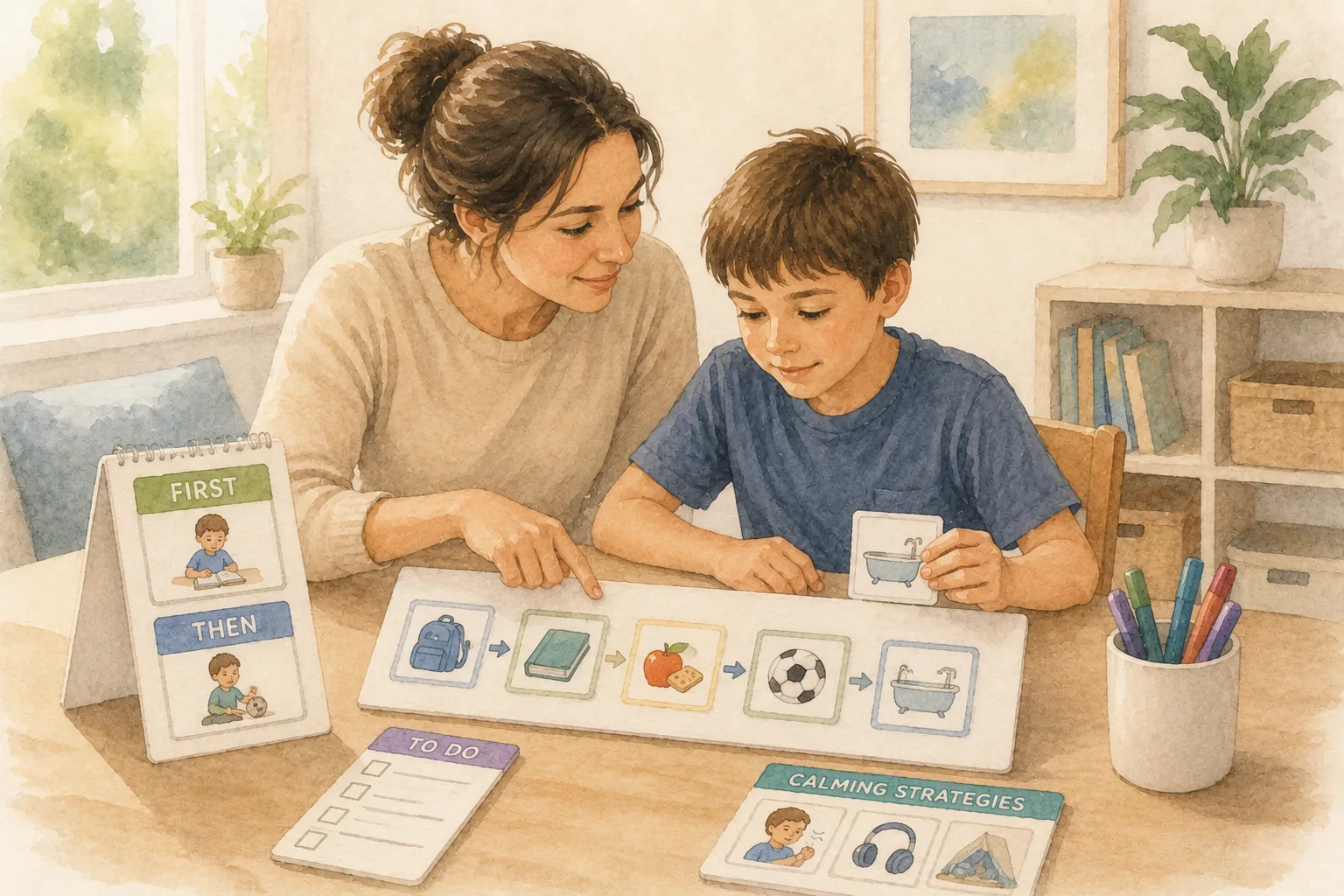







Key Takeaways
- A visual schedule shows the day in pictures: it lays out each step of a routine in order, so your child can see what comes next instead of holding it in memory.
- The research behind it is strong: national reviews of autism studies list visual supports as an evidence-based practice for every age group.
- You can build one today with what you own: a phone camera, a printer or a few drawings, and some tape are enough to start.
- A BCBA can build the next step when a schedule stops being enough: if hard moments stay hard after a few steady weeks, get matched with a BCBA who can shape the plan around your child.

Nine printable schedule boards and cut-out picture cards you can print and use today.
We also sent the link to your email.
What Is a Visual Schedule for Autism?
The plainest version is a row of pictures that shows the steps of an activity in the order they happen. Instead of hearing "get ready for school," your child sees a picture for wake up, bathroom, brush teeth, get dressed, breakfast, shoes, and backpack. Each step stays in view. Your child can move or check off every one as it's done.
That small change does a lot of work. Spoken words vanish the second you say them. A child who's upset or busy has nothing left to check, and has to ask you again. A picture stays put, so your child can look back without waiting for you.
Most families start with the part of the day that goes worst. Mornings and bedtime are the usual picks, because both have a fixed set of steps and a hard deadline at the end.
Why Visual Schedules Work for Autistic Children
Research supports this more strongly than most parents expect. The National Clearinghouse on Autism Evidence and Practice reviewed more than one hundred studies and named visual supports evidence-based. It holds up for every age group, from toddlers to young adults. The National Autism Center reached the same view in its National Standards Project, and a systematic review of visual activity schedules found they meet the same bar.
The reasons show up fast at home:
- Knowing what's next lowers worry: the uncertainty that makes many autistic children tense is worst when one thing ends and another starts.
- Pictures stay put when words are gone: your child can check the board again without waiting for you, which cuts down on repeated prompts.
- Your child needs you less over time: as they learn to read the board alone, they take more of the routine into their own hands.
- Hard moments get smaller: when a child can see that a favorite thing is coming, an unwanted task feels lighter, and meltdowns tend to happen less.
Schools lean on the same idea, which is why teachers build visual supports at school into the classroom day. A board at home and a board in class back each other up.
You don't have to figure this out alone.
Alpaca Health matches your family with a vetted, in-network BCBA. We handle the insurance paperwork so you can focus on your child.
Get matched with a BCBA →
The Types of Visual Schedules and Who They Suit
The right format depends on how your child takes in the world today. It can change as they grow. Five kinds cover almost every family, and you can mix them.
Object Schedules
These use real items that stand for an activity, like a cup for snack or a shoe for going outside. They suit very young children, and those still learning that a picture can stand for a real thing. The objects sit in a row or in small bins. Your child picks up each one as that part of the day arrives.
Picture and Photo Schedules
Photo boards use real photos of your child or your home doing each step, and children tend to know these fastest. Icon boards use simple drawings, and they're quicker to swap and reuse. If your child already uses picture exchange systems to talk, the same images carry straight over. The same is true for a child who uses a speech device (any tool that helps a child communicate without speaking).
Written Schedules
A written list works for readers. A picture-and-word board works for children still learning to read. Pairing an image with a word also helps a strong reader who still reads a picture faster when stressed.
First-Then and Now-Next-Later Boards
These shrink the whole day down to one or two moves. A first-then board shows the current task and the one that follows, which helps when a full-day board is too much to take in. A token board pairs well with either when your child is working toward something.
Digital and App-Based Schedules
Apps let you build a reusable board on a phone or tablet. Some families prefer this out of the house, or for an older child who'd rather use a device than paper. Prices and features change often, so check the current app store listing first.
How to Choose the Right Format for Your Child
Start with whatever your child already knows best, then adjust. A child who lights up at photos of themselves needs a photo board. A child who skips past photos but tracks simple drawings needs icons. Your child's sensory needs matter here too, since a busy, bright board can be too much for a child already taking in a lot.
So which one do you pick when your child sits between two of them? Try both, a week each, and watch which board your child reaches for without being asked. That answer beats any guess made on paper.
You aren't locked in either. Families move from objects to photos to words over a few years, and the board grows with the child. Changing format later isn't starting over, since the routine your child learned carries across.
Download the Free Visual Schedule Templates
The pack is one printable PDF you can use at home right away. Enter your first name and email below and it opens in a new tab, with a copy sent to your inbox so you can find it again. Once you have it, you can also open the templates in Canva to change the wording before you print.
Nine printable schedule boards and cut-out picture cards you can print and use today.
We also sent the link to your email. To change the wording before you print, open the templates in Canva.
Inside you'll find nine templates and a set of picture cards:
- Three ready-to-use routines: morning, bedtime, and after-school boards, each with pictures filled in and a checkbox for every step.
- A blank daily schedule: add your own steps with the cut-out cards, your drawings, or real photos of your child.
- A full-day timetable: plan a whole day in one view, which helps most on appointments and school breaks.
- A first-then board and a now-next-later board: get through a single change, or show three steps at once.
- A choice board and a token board: offer choices without a power struggle, and reward finished steps.
- Cut-out picture cards: common routine steps you can cut out, laminate, and reuse to build any board.
Print the pages in color or black and white. Slipping each one into a page protector turns it into a dry-erase surface you can reuse for months. For more to do once the routine settles, try our printable activity kit, sorted by age.
How to Make a Visual Schedule at Home, Step by Step
You don't need anything special to get going. This version takes about fifteen minutes with what's already in your house.
- Pick one routine and break it into three to seven steps: a morning might run from wake up through shoes and backpack. Fewer, bigger steps beat a long list at the start.
- Get an image for each step: a photo of your own child doing the step is strongest, because children spot themselves right away in a way icons can't match.
- Put the steps in order on something reusable: tape the images down a piece of cardstock, or attach them with velcro so your child can move each one.
- Add a way to mark each step done: a checkbox, a finished pocket to drop each card into, or flipping the card over all work. Marking a step done provides a sense of ownership and accomplishment for your child, and each completed step builds momentum.
- Put it where the routine happens: the morning board lives by the bathroom door, the bedtime one by the bed. Keep it in the same spot every day.
A worked example helps. For a morning, that's wake up, then bathroom, then get dressed with clothes laid out the night before, then breakfast with two familiar choices, then brushing teeth, then shoes and backpack. Walk it together for the first several mornings. Point at each picture and ask what comes next. Once the order feels familiar, step back and let your child lead it.
Turn these ideas into a plan built for your child.
Practicing at home is a strong start, and a Board Certified Behavior Analyst can shape it into a program around your child's real goals. Alpaca Health matches you with one.
Get matched with a BCBA →
How to Introduce the Schedule So Your Child Uses It
Printing the pages is the easy part. A few habits turn a board on the wall into something your child follows without being asked.
- Introduce it during a calm moment: practice when nothing is on the line, so the board feels familiar before you lean on it.
- Use it on good days too: a board works because it's the same every time, so bring it out daily instead of only when a routine falls apart.
- Match your words to the pictures: say the same short phrase for each step, so the words and images back each other up.
- Guide your child through it: use the prompting hierarchy you've set with your BCBA, with the board as the shared reference point.
- Give it two to six weeks: most children warm up in a week or two, then need a few more before it runs on its own.
- Fade it when the routine is solid: retire the boards your child no longer checks and keep the ones they still use. Professionals fade a board in stages, set out in UNC's AFIRM visual-support module.
None of this has to be perfect. Showing up with the same board, used the same way, on most days is what makes it stick.
How to Handle Changes, Surprises, and Days Off the Routine
Weekends, holidays, and appointments break the pattern your child has learned. Those are the days that go worst. A full-day timetable earns its keep here more than on an ordinary Tuesday, because it gives your child a plan for a day with no built-in shape.
For a change you can see coming, put it on the board before it happens rather than in the moment. A social story works well next to the board for bigger disruptions, like a hospital visit or a first day at a new school.
For a surprise you can't prepare for, keep one card that stands for "something different today." Giving the change its own place on the board turns it into part of the plan instead of a break in it.
What to Do When the Schedule Stops Working
Even a well-built board runs into snags. These are the ones parents hit most, with what tends to help:
- Your child ignores it: keep modeling instead of expecting solo use right away. If it lasts past a couple of weeks, the steps may be too big or the images may not mean much to your child.
- Your child skips or rushes steps: cover the later steps and show one at a time, or switch to a first-then board so only the current step and the reward are visible.
- Your child rips or throws the cards: laminate them, attach them with strong velcro, and keep spares. Cutting the board down to two steps lowers the overload that sets this off.
- The board itself causes stress: for some autistic children, heavy structure raises worry instead of easing it. Keep changes gentle and predictable, and get a professional view on the approach.
"Parents sometimes worry a visual schedule will make their child depend on pictures instead of learning to know what's next on their own. In practice I've watched the opposite happen. When we teach a child to check his own schedule and move his icon to finished, within a few weeks he starts making the move himself before anyone prompts him, which wasn't happening when I was giving spoken directions,” says Samantha Ridout, M.Phil., BCBA, Founding BCBA at Alpaca Health.
Samantha adds that visual prompts surround all of us anyway. A childhood board grows into the reminders, lists, and phone alerts adults lean on, which makes it a route to running your own day rather than a crutch.
Most snags ease with a small change. If one keeps coming back after you've tried these fixes, that's a fair point to bring in help. A BCBA teaches these same strategies to parents directly in parent training.
We can help with the moments that feel impossible.
When you're ready for expert support, Alpaca Health matches your family with a caring BCBA, at home, in a clinic, or online.
Get matched with a BCBA →
When a Visual Schedule Is Not Enough
Some situations call for more support than a printout can give. Reach out to a professional when hard moments stay hard after a few steady weeks, when you see new or intense behavior that worries you, when your child was recently diagnosed and you want a plan, or when progress has stalled despite your best effort.
A BCBA can provide an individualized plan tailored to your child's needs in ways a template cannot. They watch where the routine breaks down, try one change at a time, and measure whether it helped. The CDC's overview of autism treatment sets out how structured approaches like this sit alongside speech and occupational therapy.
Asking for help early doesn't mean the board failed. It means you've found the edge of what a board on its own can do, which is useful to know.
How Alpaca Health Helps With Visual Schedules and Daily Routines
Alpaca Health connects families with vetted, in-network Board Certified Behavior Analysts, at home, in clinic, at school, or by telehealth. A BCBA does more than hand you a schedule. They watch how your child moves through the day, find where the routine breaks down, and build supports around your child's real needs, then teach you to carry them at home.
Families work with Alpaca Health BCBAs in cities including Charlotte, Denver, and San Antonio. We accept Medicaid and most insurance and handle the paperwork, so you can focus on your child. If a visual schedule has taken you as far as it can, start your intake and we'll match you with a BCBA.
Nine printable schedule boards and cut-out picture cards you can print and use today.
We also sent the link to your email.
Frequently Asked Questions About Visual Schedules
How long does it take for a visual schedule to work?
Most children need a week or two to get used to a new board, and about four to six weeks before it feels like a natural part of the day. Using it the same way every day, including on days that are going well, is what makes the difference.
What if my child ignores the schedule?
That's common at first, so keep pointing at each step and modeling how the board works instead of expecting your child to follow it alone. If it lasts past a few weeks of steady use, the steps may be too big or the pictures may not mean enough, and switching to photos of your own child helps a lot of families. A BCBA can tailor it further, and you can talk to a BCBA about your child's routine.
Should I use real photos or picture icons?
Both work, and the better choice depends on your child. Photos of your own child doing each step are easiest to know at a first look, especially for younger children, while icons are quicker to swap and reuse. Many families try both and keep whichever one their child responds to.
Do visual schedules work for children who can read?
Yes. Even strong readers take in a picture faster than a sentence during a stressful moment. Picture-and-word boards, where each step carries both an image and a word, suit readers and early readers well.
RELATED ARTICLES