

ABA Therapy Glossaryfor Parents
All termsPivotal response treatment (PRT)
Pivotal response treatment (PRT) is a play-based way of delivering ABA that targets a few key skills, like motivation, that can help many others.
What it means
PRT is a play-based way of delivering applied behavior analysis (ABA). It aims at a few key skills, such as motivation, starting communication and self-management. Progress there can help with many other skills. Your child helps pick what to play and gets rewarded for good tries as well as correct answers.
The Centers for Disease Control and Prevention (CDC) says the T stands for training, while many researchers say treatment. Both names mean the same approach. A 2019 trial found more functional speech with PRT than in a group still waiting for it, while a 2017 review notes that few such trials exist and one found no difference in spoken language. That 2019 trial included children aged 2 to 5 and paired parent training with in-home sessions.
What it looks like for your child
Your child might pick between two toys while the therapist waits for them to ask. If your child says "car," they get the car to play with rather than a candy. PRT happens in natural settings such as home and play, and parent training is a common part of PRT programs. Because PRT is based on ABA, it can be part of an ABA program rather than its own therapy.
What to ask your BCBA
- How PRT fits the plan: Ask your Board Certified Behavior Analyst (BCBA) whether PRT strategies are part of your child's plan, and which key skills they target.
- What counts as a try: Ask how the team decides which attempts to reward, so you can do the same at home.
- Young children: If your child is a toddler or preschooler, ask how play-based teaching would look in ABA for toddlers.
Wondering whether play-based ABA would suit your child?
A BCBA can assess your child and explain which teaching styles fit their goals.

Sources
- Centers for Disease Control and Prevention (2024), Autism treatment and intervention, Behavioral approaches.
- Lei and Ventola (2017), PRT: current perspectives, Neuropsychiatric Disease and Treatment 13.
- Gengoux et al. (2019), PRT package randomized trial, Pediatrics 144(3).
- Schreibman et al. (2015), Naturalistic developmental behavioral interventions, Journal of Autism and Developmental Disorders 45(8).
Related terms
Early Start Denver Model (ESDM)
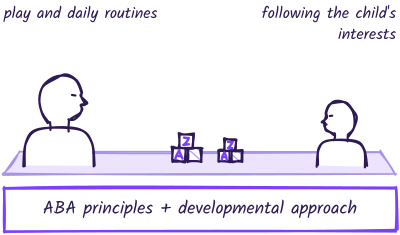
The Early Start Denver Model (ESDM) is a play-based early intervention for young autistic children that blends ABA with developmental, relationship-based methods.
Definition →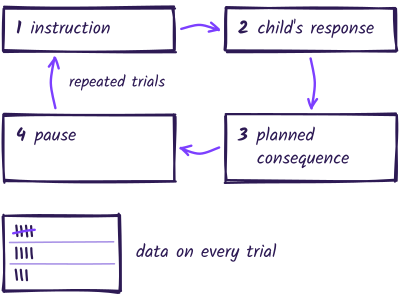
Discrete trial training (DTT)
Discrete trial training (DTT) is a structured ABA teaching style that breaks a skill into small parts and practices them in short, repeated trials.
Definition →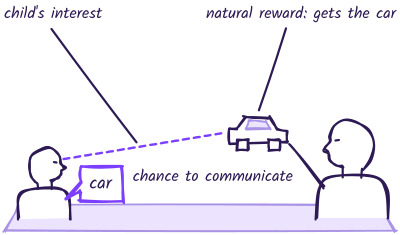
Natural environment teaching (NET)
Natural environment teaching (NET) is ABA teaching built into play and daily routines, using a child's interests and natural rewards.
Definition →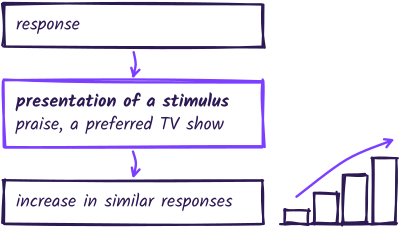
Positive reinforcement
Positive reinforcement happens when something is added after a behavior, like praise or a favorite activity, and the behavior then happens more often.
Definition →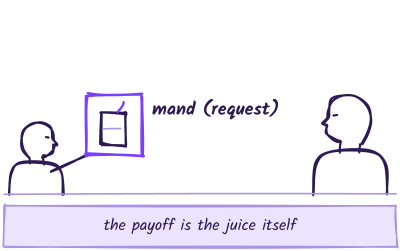
Mand (manding)
A mand is a request: your child communicates what they want right now, and the payoff is getting that exact thing.
Definition →