

ABA Therapy Glossaryfor Parents
All termsMand (manding)
A mand is a request: your child communicates what they want right now, and the payoff is getting that exact thing.
What it means
In applied behavior analysis (ABA), a mand is a request. Your child communicates what they want right now, such as an item, an action, help or a break, and the payoff is getting that exact thing. The term comes from Skinner's 1957 work on language, which sorts what people say by why they say it rather than by how it sounds. So a spoken word, a sign, a picture exchange or a device can all count as mands. Board Certified Behavior Analysts (BCBAs) are tested on telling mands apart from other kinds of language.
Manding depends on your child's motivation in the moment. A child mands for juice when they're thirsty, not right after a full cup, so therapists set up moments when your child wants something. Many ABA language programs teach manding first, since your child gets what they asked for right away. Studies support that order, though it's a recommendation and not a fixed rule.
What it looks like for your child
Your child might say "cookie" when they're hungry, use a sign or hold up a picture of juice. Mands can also replace challenging behavior. If your child screams to get a break, the team might teach them to ask for a break in a way that gets the same result. Asking and naming can be separate skills, so a child who names a cookie on sight may still need to learn to ask for one.
What to ask your BCBA
- How your child asks now: Ask your BCBA which ways of asking your child already uses and which ones the plan will build on.
- Replacing hard behavior: Ask whether any request goal is meant to replace a behavior like screaming, and what the new request will look like.
- Speech therapy and ABA: Ask how the team will line up request goals with your child's speech therapy.
Is your child screaming or grabbing to get what they want?
A BCBA can see how your child asks today and build request goals into their therapy plan.

Sources
- Behavior Analyst Certification Board (2022, updated 2024), BCBA Test Content Outline, 6th ed., task B.19.
- Sautter and LeBlanc (2006), Skinner's verbal behavior research, The Analysis of Verbal Behavior 22(1).
Related terms
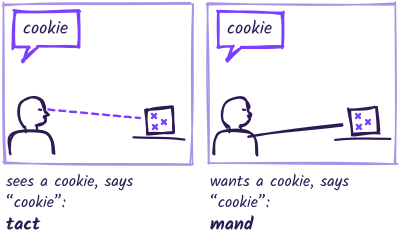
Tact (tacting)
A tact is naming or describing something your child notices, like a dog or a loud noise, for a social payoff such as your smile.
Definition →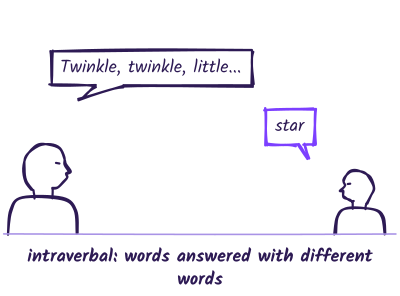
Intraverbal
An intraverbal is answering someone's words with different words, like finishing a song line, answering a question or replying in a conversation.
Definition →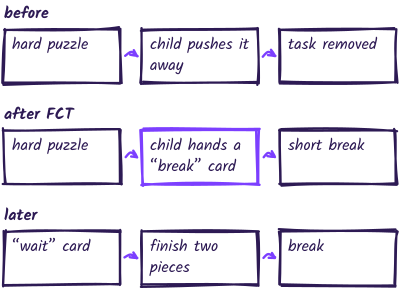
Functional communication training (FCT)
Functional communication training (FCT) teaches a child a clear way to ask for what a challenging behavior was getting them.
Definition →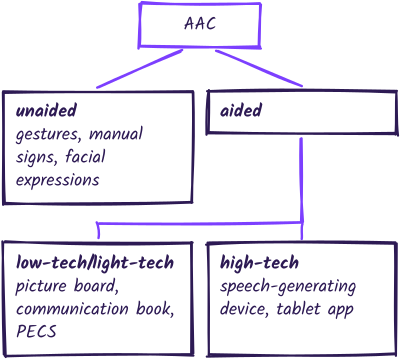
AAC (augmentative and alternative communication)
Augmentative and alternative communication (AAC) is any way of communicating that adds to speech or stands in for it, from gestures to speech devices.
Definition →