

ABA Therapy Glossaryfor Parents
All termsPositive reinforcement
Positive reinforcement happens when something is added after a behavior, like praise or a favorite activity, and the behavior then happens more often.
What it means
Positive reinforcement is when something gets added after a behavior, and the behavior then happens more often. In this case, "positive" means added, not good. A reinforcer is whatever has that effect for your child. So a reward only counts as one if the behavior goes up.
It's at the heart of applied behavior analysis (ABA). Behavior analysts' ethics code tells them to put it first. A large autism report adds that reinforcement is almost always used with other teaching methods.
What it looks like for your child
At home, it might be a favorite TV show after homework or a star on a chart. In sessions, the team gives praise or small rewards after correct answers. The American Academy of Pediatrics says rewards should matter to your child, and that kids should help pick them. ABA teams use preference assessments to find what works for your child.
What to ask your BCBA
- What works for your child: Ask your Board Certified Behavior Analyst (BCBA) which reinforcers the team found and how they found them.
- Using it at home: Ask how you can reinforce the same skills during daily routines.
- When a reward stops working: Ask what the team does if a reward no longer makes a skill more likely.
Want rewards chosen around what your child cares about?
A BCBA runs a preference assessment to find what motivates your child.

Sources
- Behavior Analyst Certification Board (BACB), About Behavior Analysis, and Ethics Code for Behavior Analysts, section 2.14.
- Steinbrenner et al. (2020), UNC Frank Porter Graham Institute (NCAEP), autism practices report, reinforcement fact sheet, p. 112.
- American Psychological Association, APA Dictionary of Psychology, "positive reinforcement" and "reinforcer."
- Leaf et al. (2022), concerns about ABA-based intervention, Journal of Autism and Developmental Disorders 52(6), Table 1.
Related terms
Reinforcement schedules
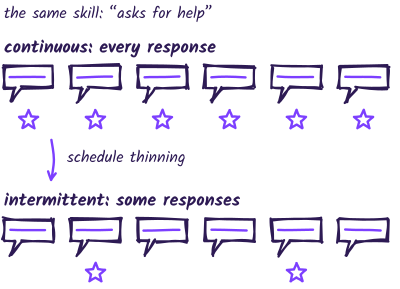
A reinforcement schedule is the rule for which times a behavior earns a reinforcer: every time (continuous) or only some times (intermittent).
Definition →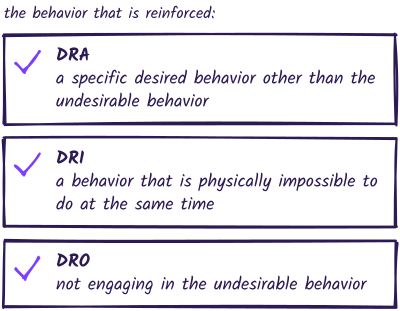
Differential reinforcement
Differential reinforcement means giving positive consequences for a chosen behavior, or for not doing a problem behavior, so the better behavior grows.
Definition →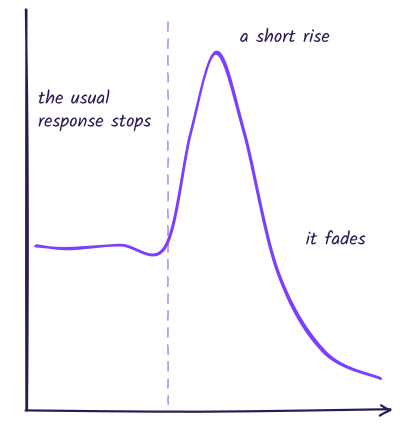
Extinction and extinction burst
Extinction means a behavior stops getting the payoff that kept it going; an extinction burst is a short rise in that behavior before it drops.
Definition →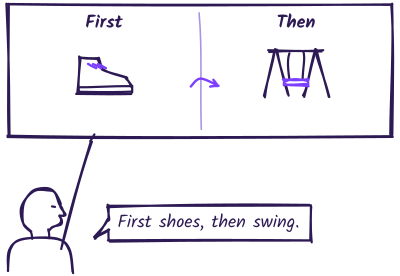
First-then (Premack principle)
First-then pairs a less-liked task with a more-liked activity that comes right after it, such as first shoes, then the swing.
Definition →