

ABA Therapy Glossaryfor Parents
All termsEarly Start Denver Model (ESDM)
The Early Start Denver Model (ESDM) is a play-based early intervention for young autistic children that blends ABA with developmental, relationship-based methods.
What it means
The Early Start Denver Model (ESDM) is a play-based early intervention for young autistic children. It mixes applied behavior analysis (ABA) with methods that focus on how kids grow and bond with people. Parents and therapists use play, back-and-forth and shared attention. The goal is to build your child's language, social and learning skills. Lessons follow what your child likes during games and daily routines.
The Centers for Disease Control and Prevention (CDC) lists ages 12 to 48 months, and a federal Medicaid guide says infants and toddlers. A 2010 trial found bigger gains with ESDM than with usual care, but a larger 2019 trial only partly matched its language results. That trial also found no difference in autism severity or daily skills.
What it looks like for your child
For your child, ESDM happens in play and daily routines, not at a table. It can take place at home or in other everyday places. Parents are part of the model, and in the 2010 trial they also used ESDM at home. That Medicaid guide says providers need ESDM certification. Whether Medicaid pays for it depends on your state.
What to ask your BCBA
- Whether it fits: Ask your Board Certified Behavior Analyst (BCBA) whether a play-based approach like ESDM fits your child's age and goals, and how it compares with other ABA for toddlers.
- Training: Ask whether the people working with your child are trained or certified in ESDM, and whether your insurance or Medicaid plan covers it.
- Your role at home: Ask how you would learn to use play-based strategies in daily routines, such as through parent training.
Trying to choose an approach for your young child?
A BCBA can assess your child and talk through which approaches fit their age and goals.

Sources
- Centers for Disease Control and Prevention (2024), Autism treatment and intervention, Developmental approaches.
- Centers for Medicare and Medicaid Services (2026), Medicaid ABA toolkit, pp. 50-51 and Table 5.
- Dawson et al. (2010), ESDM randomized trial, Pediatrics 125(1).
- Rogers et al. (2019), Multisite ESDM trial, Journal of the American Academy of Child and Adolescent Psychiatry 58(9).
Related terms
Pivotal response treatment (PRT)
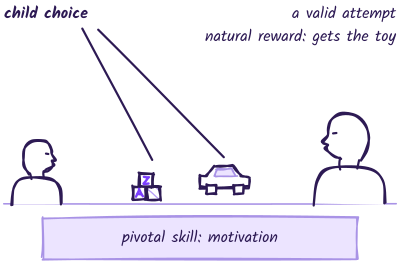
Pivotal response treatment (PRT) is a play-based way of delivering ABA that targets a few key skills, like motivation, that can help many others.
Definition →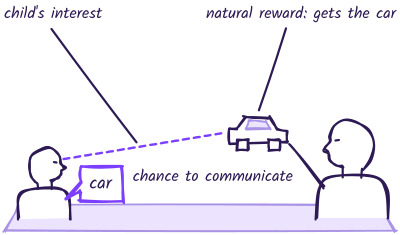
Natural environment teaching (NET)
Natural environment teaching (NET) is ABA teaching built into play and daily routines, using a child's interests and natural rewards.
Definition →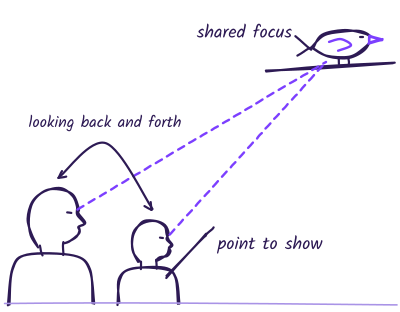
Joint attention
Joint attention is two people sharing focus on the same thing, like a child following a parent's point or pointing to show something.
Definition →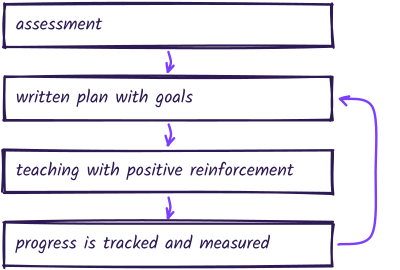
ABA therapy
ABA (applied behavior analysis) therapy uses principles of learning and behavior to teach skills, mainly through positive reinforcement and measured progress.
Definition →