

ABA Therapy Glossaryfor Parents
All termsDiscrete trial training (DTT)
Discrete trial training (DTT) is a structured ABA teaching style that breaks a skill into small parts and practices them in short, repeated trials.
What it means
Discrete trial training (DTT) is one teaching style used in applied behavior analysis (ABA). It breaks a skill into its simplest parts and teaches them one at a time. Each trial has a clear start and end: an instruction, your child's response, a planned consequence and a short pause. Correct answers earn praise or a reward, and the team usually records data on every trial.
The Centers for Disease Control and Prevention says wrong answers in DTT are ignored, while a large autism report lists prompting and time delay as part of it. Many programs now mix DTT with more natural teaching styles, and DTT is only one part of ABA.
What it looks like for your child
At a small table, a behavior technician might hold up a cup and ask your child to touch it. Your child touches the cup and gets a high five, then there's a short pause before the next trial. The technician marks each response on a data sheet. The same skill may come up several times in a row, which the report calls massed trials.
What to ask your BCBA
- How errors are handled: Ask your Board Certified Behavior Analyst (BCBA) what happens when your child gives a wrong answer or doesn't respond.
- How skills carry over: Ask how skills learned at the table will carry over to home and play.
- What the data shows: Ask to see how the trial data tracks your child's progress over time.
Curious how much table time your child's therapy would include?
A BCBA explains when structured trials fit and how skills move into home and play.

Sources
- Centers for Disease Control and Prevention (CDC), autism treatment and intervention, last reviewed May 16, 2024.
- Steinbrenner et al. (2020), UNC Frank Porter Graham Institute (NCAEP), autism practices report, Table 3.1 and DTT fact sheet, p. 80.
- Behavior Analyst Certification Board (BACB), RBT Handbook, p. 16.
- Schreibman et al. (2015), naturalistic developmental behavioral interventions, Journal of Autism and Developmental Disorders 45(8).
Related terms
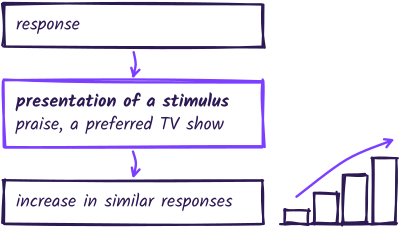
Positive reinforcement
Positive reinforcement happens when something is added after a behavior, like praise or a favorite activity, and the behavior then happens more often.
Definition →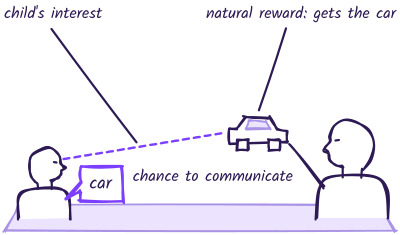
Natural environment teaching (NET)
Natural environment teaching (NET) is ABA teaching built into play and daily routines, using a child's interests and natural rewards.
Definition →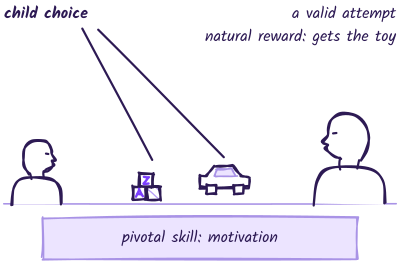
Pivotal response treatment (PRT)
Pivotal response treatment (PRT) is a play-based way of delivering ABA that targets a few key skills, like motivation, that can help many others.
Definition →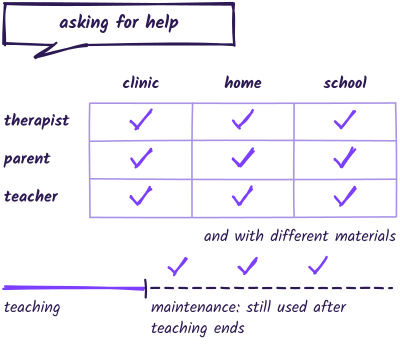
Generalization and maintenance
Generalization means your child uses a skill beyond where it was taught, and maintenance means they keep using it over time after teaching ends.
Definition →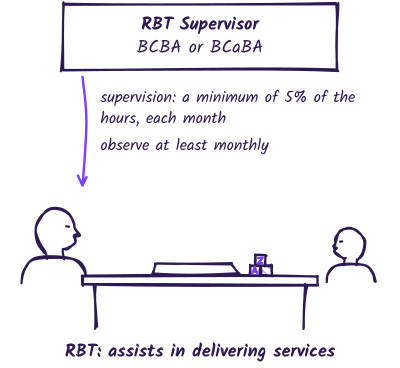
RBT (behavior technician)
An RBT (Registered Behavior Technician) is a certified paraprofessional who delivers day-to-day ABA sessions under close supervision from a BCBA or BCaBA.
Definition →