

ABA Therapy Glossaryfor Parents
All termsFAPE
FAPE (free appropriate public education) is an eligible child's right to special education and related services at public expense, through an individualized education program.
What it means
Free appropriate public education (FAPE) is a core right under the Individuals with Disabilities Education Act (IDEA). It means an eligible child gets special education and related services from the public school system, at public expense and with no charge to you. These come through an individualized education program (IEP). Appropriate means the program fits your child. That doesn't mean the best possible program.
The Supreme Court set today's standard in 2017 in Endrew F., a case about an autistic student. A school must offer an IEP that's reasonably calculated to help a child make progress that's appropriate in light of their circumstances. The goals should be appropriately ambitious. The Court also said parents' input is part of the process. Federal rules make FAPE available from ages 3 through 21, though states don't have to serve ages 3 to 5 or 18 to 21 where that conflicts with state law or practice.
What it looks like for your child
For your child, FAPE comes through the IEP. Your child doesn't have to fail or repeat a grade to qualify for special education. The school's duty starts by your child's third birthday, which is when early intervention ends. FAPE covers what the school provides through the IEP, so private ABA therapy and school services are separate.
What to ask your BCBA
- Ask the school about goals: Ask the IEP team how your child's goals are ambitious in light of their circumstances, and how progress will be measured.
- Ask about ages in your state: Ask your school district which ages it serves, since that depends on state law.
- Ask your behavior analyst: Ask your Board Certified Behavior Analyst (BCBA) what your child's therapy data shows that could help you prepare for the IEP meeting.
Getting ready to ask the school for more support?
A BCBA measures your child's progress in therapy, and you can bring that data to IEP conversations.

Sources
- Cornell Legal Information Institute, 20 U.S. Code 1401 (IDEA definitions).
- Electronic Code of Federal Regulations, 34 CFR 300.101 and 34 CFR 300.102.
- Supreme Court of the United States (2017), Endrew F. v. Douglas County, slip opinion.
Related terms
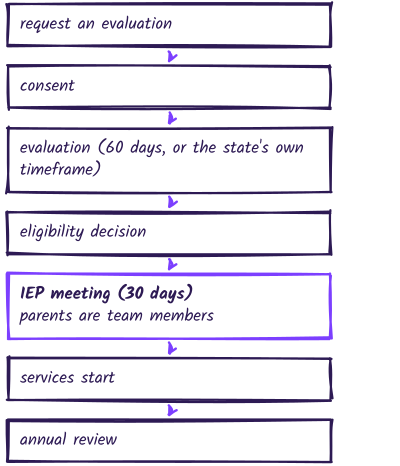
IEP (Individualized Education Program)
An IEP is a written plan for a public school student with a disability who needs special education, setting goals and listing services.
Definition →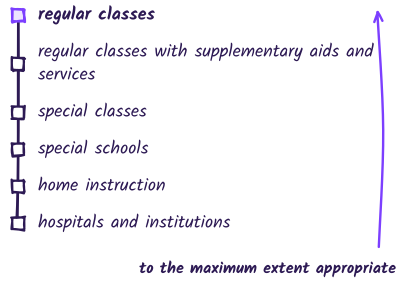
Least restrictive environment (LRE)
Least restrictive environment (LRE) is the special education rule that a child with a disability learns with children without disabilities as much as appropriate.
Definition →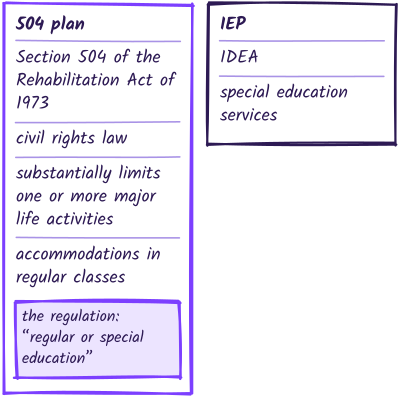
504 plan
A 504 plan sets out the supports a student with a disability needs at school, under Section 504, a federal civil rights law.
Definition →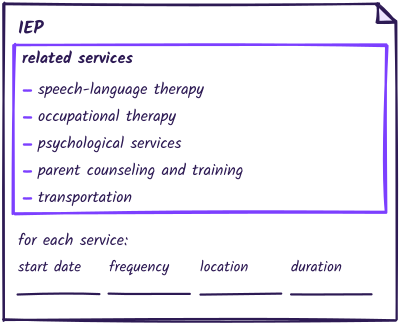
Related services (IEP)
Related services are supports a school provides through an IEP, such as speech or occupational therapy, so a child can benefit from special education.
Definition →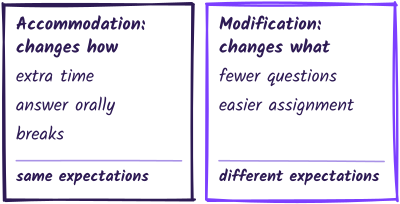
Accommodations vs modifications
Accommodations change how a child learns or shows what they know; modifications change what the child is expected to learn.
Definition →