

ABA Therapy Glossaryfor Parents
All termsJoint attention
Joint attention is two people sharing focus on the same thing, like a child following a parent's point or pointing to show something.
What it means
Joint attention is two people sharing focus on the same object or event. Your child responds to it by following where you look or point. Your child starts it by pointing or showing you something to get your attention. The American Academy of Pediatrics (AAP) describes it as looking back and forth between an object and a person, while the American Speech-Language-Hearing Association notes it may not involve eye contact in autism.
The AAP says delays in joint attention are found in most autistic children. A delay on its own isn't a diagnosis, but it's a good reason to ask about screening.
What it looks like for your child
Say a bird lands outside, and your child points at it, then checks that you saw it too. Per the AAP, by about 12 months most children look where a parent points. By 15 months, most point to things they want, and by 18 months they point at things they find interesting. Pointing to ask for something isn't the same as pointing to share. The AAP notes autistic children often point because they want the parent to get the object.
What to ask your BCBA
- Whether it's a goal: Ask your Board Certified Behavior Analyst (BCBA) whether your child's plan includes joint attention goals and how they'll be taught.
- What counts as sharing: Ask how the team will recognize shared attention if your child makes little eye contact.
- Screening first: If you've noticed fewer points or shows, ask whether a developmental screening makes sense.
Noticed fewer points or shows than you expected?
A short screener helps you decide whether to raise it with your pediatrician.

Sources
- American Academy of Pediatrics, HealthyChildren.org, early signs of autism (updated September 26, 2025).
- American Speech-Language-Hearing Association, autism practice portal, social communication.
- Mundy and Newell (2007), attention and joint attention, Current Directions in Psychological Science 16(5).
Related terms
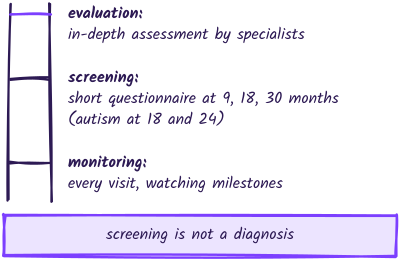
Developmental screening
Developmental screening is a short, standard check, often a parent questionnaire, that shows whether a child's development is on track or needs a closer look.
Definition →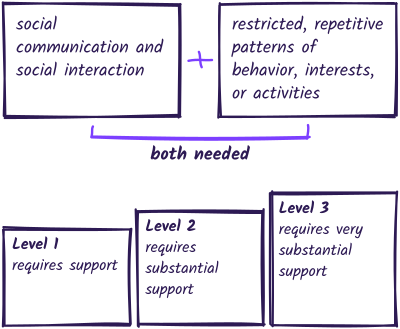
Autism spectrum disorder (ASD)
Autism spectrum disorder (ASD) is a neurological and developmental condition that affects how people communicate, interact with others, learn and behave.
Definition →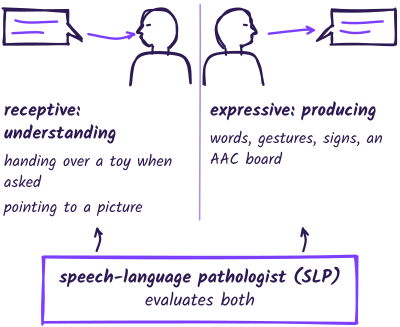
Receptive and expressive language
Receptive language is understanding what others say, and expressive language is sharing thoughts and needs through words, gestures, signs or writing.
Definition →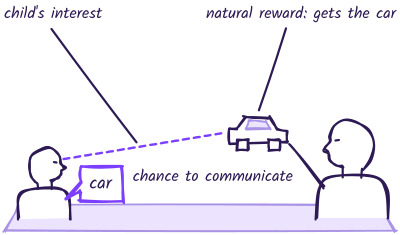
Natural environment teaching (NET)
Natural environment teaching (NET) is ABA teaching built into play and daily routines, using a child's interests and natural rewards.
Definition →