




You may have been watching your baby a little more closely than the parents around you seem to. Maybe your baby rarely looks up when you call their name. Maybe the smiles you keep waiting for feel few and far between. That kind of worry tends to show up at 2 in the morning.
Noticing a difference does not mean your baby is autistic. Babies develop at their own pace, and many early worries turn out to be a phase, a simple delay, or a hearing problem that can be treated. Parents spend more hours with their baby than anyone else, and the concerns they raise early are worth taking seriously.
Key takeaways
- What to watch: Most early signs of autism show up in social interaction and communication, including a baby who does not respond to their name.
- The overall pattern: A baby who smiles and laughs can still be autistic, and one sign on its own rarely tells the story.
- Acting early: You do not need a diagnosis or a doctor's referral to call your state's early intervention program, and the evaluation is free.
- Help after a diagnosis: If your child is later diagnosed with autism, you can start your intake with Alpaca Health, which matches families with an in-network Board Certified Behavior Analyst and takes the insurance paperwork off your plate.
What are the signs of autism in babies?
Autism spectrum disorder (ASD) is a developmental disability caused by differences in the brain. The Centers for Disease Control and Prevention (CDC) groups the signs into two areas. The first is social communication and interaction, which covers how a baby connects with the people around them. The second is restricted or repetitive behavior, which covers repeated movements, strong routines, and unusual reactions to sounds and textures.
In babies, the social signs are usually the first ones parents notice. A baby may make less eye contact, not respond to their name by 9 months, or show fewer facial expressions, such as happy, sad, angry, and surprised. By 12 months, they may not play simple games like pat-a-cake or use gestures such as waving goodbye, and by 18 months they may not point to show you something interesting.
The behavior signs can be harder to spot in the first year. They include flapping hands, rocking, or spinning, a strong focus on parts of objects such as the wheels of a toy car, and getting very upset by small changes in routine.
No baby shows every sign, so what matters is the pattern. A cluster of signs that keeps showing up, alongside late or missing milestones, is worth a conversation with your baby's doctor.
You don't have to figure this out alone.
Alpaca Health matches your family with a vetted, in-network BCBA. We handle the insurance paperwork so you can focus on your child.
Get matched with a BCBA →
When do signs of autism start in babies?
There is no single start date. For babies who are later diagnosed, signs may be present in a subtle way from early on, build gradually, or appear after a stretch of typical development.
At birth and in the newborn weeks
No test or exam in the newborn period can show autism, and there are no reliable signs to spot in the first weeks of life. A newborn who seems sleepy, fussy, or hard to settle is showing you ordinary newborn behavior. For now, watch whether your baby reacts to loud sounds and settles when you speak to them or pick them up. Those responses are among the first milestones on the CDC checklists.
Gradually over the first year or two
The differences build so slowly that many parents only see them in hindsight, looking back at photos and videos. A baby may make eye contact less often over time, babble less, and respond to their name inconsistently. One small study that followed 50 babies found that those later diagnosed with autism looked at faces and shared smiles about as often as other babies at 6 months and less often after that, with clear differences by 12 months.
In a small study of home videos from 37 babies, those who were later diagnosed with autism produced fewer syllable sounds and less babbling overall at 9 to 12 months than babies who developed typically. Differences often become easier to see during the second year, when pointing and first words are expected and their absence is harder to miss.
After months of typical development
Some babies gain skills and then lose them. A baby who babbled may fall silent, or a baby who waved may stop. This pattern is sometimes called regression.
The CDC checklists treat lost skills as a reason to act early at any age. Every checklist asks whether your baby has lost any skills they once had. If your baby stops doing something they used to do, that alone is enough reason to call your baby's doctor promptly.
Signs of autism in babies, month by month
The table below is built from the CDC milestone checklists, which were revised in 2022. Each milestone listed is something at least 75% of babies do by that age, so treat the ages as guideposts. The middle column focuses on the social and communication milestones that matter most for autism.
| Age | What most babies do | Differences worth raising with the doctor |
|---|---|---|
| 2 months | Calms down when spoken to or picked up. Looks at your face. Smiles when you talk or smile at them. Makes sounds other than crying. Reacts to loud sounds. | Rarely looks at your face. Does not smile back. Does not react to loud sounds. |
| 4 months | Smiles on their own to get your attention. Chuckles when you try to make them laugh. Looks, moves, or makes sounds to keep your attention. Coos and makes sounds back when you talk. Turns toward your voice. | Does not try to get or keep your attention. Rarely makes sounds back. Does not turn toward your voice. |
| 6 months | Knows familiar people. Laughs. Takes turns making sounds with you. Blows raspberries and squeals. | Rarely laughs. Does not take turns making sounds. Makes few sounds. |
| 9 months | Shows facial expressions like happy, sad, angry, and surprised. Looks when you call their name. Babbles like "mamamama" and "babababa." Lifts arms to be picked up. | Does not respond to their name. Shows few expressions. Does not react when you leave. Babbles very little. |
| 12 months | Plays games with you, like pat-a-cake. Waves bye-bye. Calls a parent "mama" or "dada." Understands "no." | Does not play simple games. Uses few or no gestures. Does not say "mama" or "dada." |
| 18 months | Points to show you something interesting. Helps dress by pushing an arm through a sleeve. Tries to say three or more words besides "mama" or "dada." Follows one-step directions. | Does not point to show you things. Says fewer than three words. Does not follow simple directions. |
By 2 months
The first connection to watch is face to face. A baby who rarely looks at faces, or does not react to loud sounds, is worth mentioning at this visit.
By 4 months
Babies now start working for your attention, smiling to get it and answering your voice with sounds. If your baby rarely tries to engage you, or does not turn toward your voice, add it to your list.
By 6 months
This is when back-and-forth really begins, in laughter and turn-taking sounds. A baby who laughs rarely or makes few sounds is showing a difference worth raising.
By 9 months
Nine months is a big checkpoint, and it brings the first formal developmental screening, which the American Academy of Pediatrics recommends at the 9-month visit. Not responding to their name by this age is one of the clearest early signs on the CDC's list.
From 12 to 18 months
Games, gestures, and first words take center stage. By 18 months, most babies point to show you something interesting. That kind of pointing matters a great deal, because it shows a baby wants to connect with you, which is a different skill from pointing to get a need met.
If several of these differences sound familiar, you do not have to wait for certainty. An evaluation can sort out what is going on, and support can start while questions remain.
Can a baby who smiles and laughs still be autistic?
Yes. A baby who smiles at you, laughs during play, and enjoys being held can still be autistic. Smiling and laughing are real milestones, and meeting them is a good thing.
Autism is about the overall pattern of social communication, so a baby might smile and laugh with you yet rarely respond to their name or use gestures. The CDC also notes that autistic children may show none of the example behaviors on its list, and signs vary a great deal from one child to the next. If other signs are present alongside the smiles, your baby still deserves the closer look.
Support for the hard days.
When you're ready for expert support, Alpaca Health matches your family with a BCBA who can help with the hardest moments, at home or in a clinic.
Get matched with a BCBA →
Is it autism or typical baby behavior?
Many behaviors that worry parents turn out to be an ordinary part of babyhood. Babies are noisy, wakeful, opinionated little people, and their development rarely runs in a straight line. What separates a passing phase from a sign worth raising is how often a behavior shows up and whether it appears alongside missed social and communication milestones.
Hand flapping and other repeated movements
Babies flap their arms when they are excited, rock when they are tired, and spin once they figure out how. The CDC lists flapping hands, rocking the body, and spinning among the repetitive behaviors linked to autism, so it is understandable to wonder. In an otherwise engaged baby who flaps with excitement and then settles back into play, it is usually just excitement. It is worth raising when the movements happen very often, seem hard to interrupt, or come with differences in how your baby connects with you.
A very fussy baby or one who rarely cries
Fussiness has a long list of ordinary causes, including hunger, reflux, gas, tiredness, and plain temperament. The CDC does list unusual mood or emotional reactions, and stomach issues such as constipation, among the other characteristics that can accompany autism, but neither points to autism by itself. The same goes for a baby who rarely cries, since some babies are simply content. It becomes worth mentioning when that baby also rarely seeks comfort or seems hard to reach.
Trouble with sleep or feeding
Sleep and feeding struggles are among the most common problems of the first year. The CDC includes unusual eating and sleeping habits among the characteristics that can accompany autism, but a baby who will not sleep or eat is showing a symptom with dozens of possible causes, most unrelated to autism. Bring these problems to your doctor because your baby needs relief and so do you. They add to the autism picture only when they travel with missed social milestones or lost skills.
Are there physical signs of autism in a baby?
No physical feature or scan can show that a baby is autistic. There is no medical test, such as a blood test, to diagnose the disorder, and doctors make the diagnosis by looking at a child's developmental history and behavior.
What parents sometimes think of as physical signs are really movements and responses, such as repeated movements or unusual reactions to sounds and textures. They matter as part of the pattern. Your baby's doctor will still check growth, hearing, and vision, because other conditions can look similar and some are very treatable. If anyone offers a paid test that claims to detect autism from blood, hair, or a photograph, treat that claim with real caution.
Which babies are more likely to be autistic?
Autism runs in families, and a few early-life factors raise the chances. None of them decide anything on their own, and none of them is a parent's fault. For context, CDC monitoring identified about 1 in 31 eight-year-olds with autism in 2022 data from communities across the United States.
Babies with an autistic brother or sister
Having an autistic sibling is one of the strongest known factors. In a large international study, researchers followed 1,605 babies who had an older autistic sibling and found that about 1 in 5 of them, or 20.2%, were diagnosed with autism by age 3, which means about 4 in 5 were not.
The study team recommends close developmental monitoring for these babies, with a prompt referral if concerns come up. If you already have an autistic child, tell your baby's doctor at the first visit, and watch milestones together from the start.
Babies born early
The earlier a baby is born, the higher the likelihood. A study of more than 4 million births in Sweden found that about 6.1% of babies born extremely early, at 22 to 27 weeks, were later diagnosed with autism, compared with 1.4% of babies born at full term.
Many practices already follow preterm babies more closely. The CDC notes that extra screening may be needed for children born early or with a low birth weight, so ask at each visit whether a screening is due.
How do doctors check babies for autism?
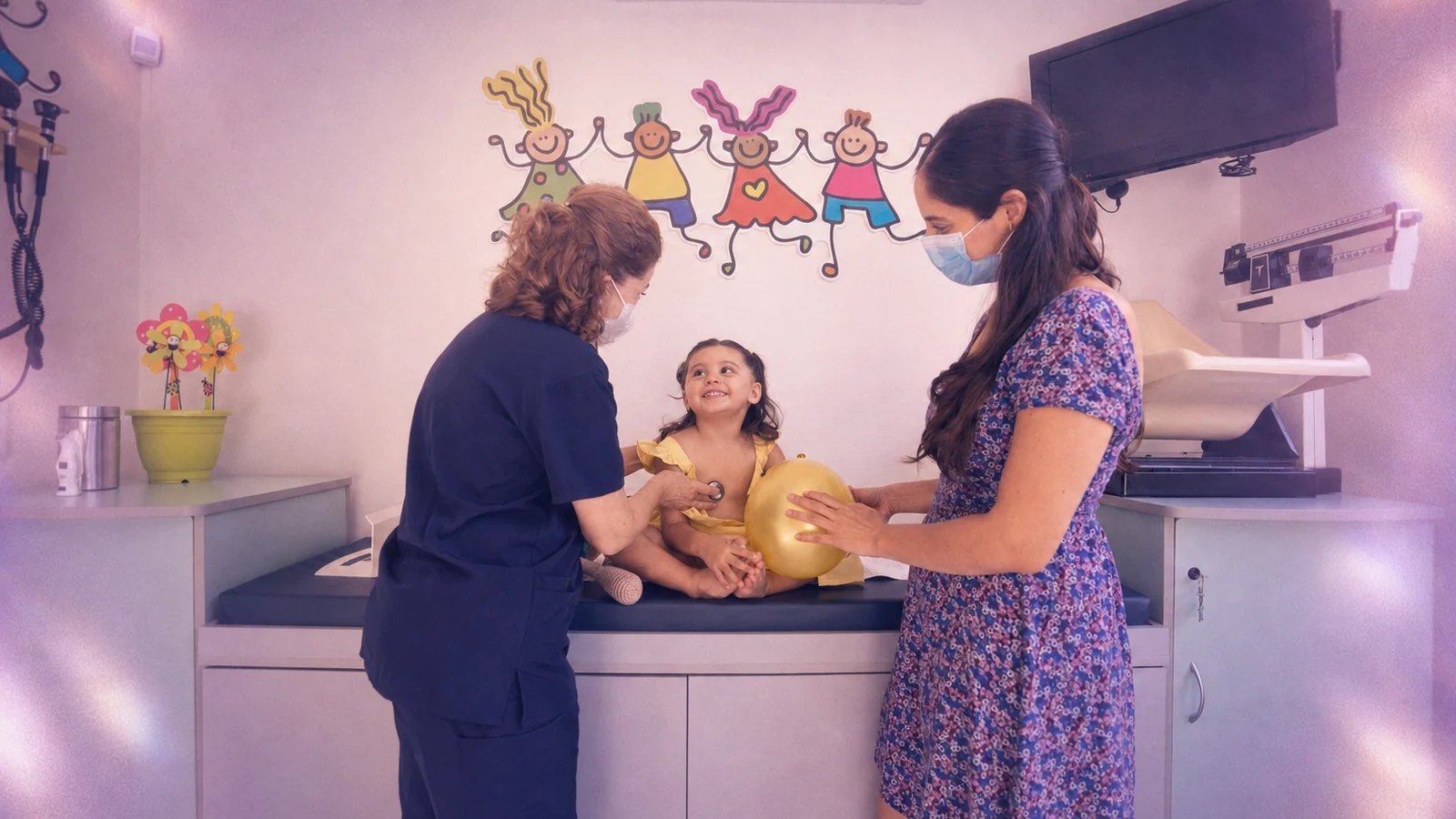
Checking takes place over several visits. It starts with watching development over time and adds formal screening questionnaires at set ages.
| Check | When it happens | What it looks for | Who fills it in |
|---|---|---|---|
| Developmental monitoring | Every well-baby visit | How your baby plays, learns, speaks, acts, and moves | No form. You and the doctor observe and talk |
| Developmental screening | 9, 18, and 30 months | Skills across language, movement, thinking, behavior, and emotions | A parent or caregiver questionnaire, scored by the care team |
| Autism screening | 18 and 24 months | Early social and communication signs linked to autism | A parent or caregiver questionnaire |
Checks at well-baby visits
Developmental monitoring happens at every visit. You share what you see at home, and the doctor watches your baby in the room. The formal screening questionnaires come at set ages, with general screening at 9, 18, and 30 months and autism screening at 18 and 24 months. One autism screener, the Modified Checklist for Autism in Toddlers, Revised with Follow-Up (M-CHAT-R/F), can be used with children 16 to 48 months old, so it is not given to young babies.
A screening result shows only whether a specialist should take a closer look, so it cannot diagnose autism on its own. Screening can also happen between the scheduled ages any time you or the doctor has a concern.
A visit with a developmental specialist
If screening flags a concern, or your own concerns persist, the next step is a formal evaluation. This is done by one or more trained specialists, such as a developmental pediatrician, child psychologist, speech-language pathologist, or occupational therapist, who watch how your child plays and communicates and ask about your child's history.
Parents sometimes hear that a baby is too young to evaluate. The CDC says an autism diagnosis made by an experienced clinician can be considered reliable by age 2. One large study at a university autism center found that diagnoses held up well from 14 months onward, while diagnoses made at 12 to 13 months were much less stable. Waitlists can be long, so ask early and start early intervention in the meantime.
What should you do if your baby shows signs of autism?
You do not need to be sure before you act. These steps can happen in any order, and several at the same time. A few notes taken now will make each step easier.
- What the behavior looks like: Write down exactly what you see. "Does not turn when I call his name" tells a doctor more than "seems distant" does.
- How often it happens: Note whether it happens every day, a few times a week, or only in certain places, such as noisy rooms.
- When it started: Record roughly when you first noticed it, and whether it has changed.
- Short videos: A 30-second clip of playtime or the behavior itself can show the doctor what you are describing.
- Any skills your baby stopped using: List words, sounds, or gestures your baby once had and no longer shows, with the age when you last saw them.
- Your questions: Bring a written list so the worry of the moment does not push your questions out of your head.
Talk to your baby's doctor
Bring your notes and your videos, and say your concern out loud. Ask about developmental screening, and ask for a referral to a specialist if you want one. The CDC's message to parents on every milestone checklist is that you know your baby best, so do not wait. If the doctor suggests waiting and watching, you can still ask for both, and you can take the next two steps on your own.
Ask for a hearing test
A baby who does not respond to their name may not be hearing it clearly. The CDC notes that a baby who turns their head when they see you, but not when you only call their name, may have a partial or complete hearing loss rather than a habit of ignoring you. All babies should have a hearing screening by 1 month of age, and a full hearing test by 3 months if they do not pass. Passing the newborn screen does not rule out hearing loss that develops later, so ask again if responses to sound change.
Call your state's early intervention program
Early intervention is the system of services for babies and toddlers with developmental delays. It runs under Part C of the Individuals with Disabilities Education Act (IDEA) and covers children from birth to age 3. Programs exist in every state, and you can call your state's program yourself. A doctor's referral is not necessary, and your baby does not need an autism diagnosis to be evaluated.
The evaluation is free, and services for children who qualify, such as speech, physical, and occupational therapy, are free or low cost.
How can you help a baby with early signs of autism?
While evaluations move along, the everyday moments you already have are teaching time. Babies build communication through back-and-forth exchanges with the people who care for them. These ideas draw on the activity tips in the CDC milestone checklists.
- Feeding: Sit face to face and pause between bites or sips. Wait for a look, a sound, or a reach before you continue, so your baby gets a turn.
- Bath time: Blow bubbles, then pause and wait for your baby to look, splash, or vocalize before you blow more.
- Diaper changes: Sing the same short song each time. Near the end, pause and give your baby a chance to fill the gap with a sound or a smile.
- Walks: Point out dogs, trucks, and trees, then look back at your baby. Looking at something together builds early communication.
- Playtime on the floor: Copy your baby's sounds and actions, then add one small thing. If your baby bangs a cup, bang yours too, then roll it.
Therapy through early intervention
If your baby qualifies, therapists work on communication, movement, and everyday skills. Visits often happen in your home or childcare setting, built around your family's routines. The team writes a plan with you, with goals drawn from what your family needs most.
Parent coaching programs
Some programs coach parents directly. A therapist shows you a strategy during play or feeding, you practice it together, and then you use it all week. Ask your early intervention team whether a coaching-based program is available locally.
Everyday play at home
Follow your baby's lead. When your baby makes a sound, make it back, then add a simple word. Play peekaboo and pat-a-cake, and pass toys back and forth to practice taking turns.
Keep it short and light. If your baby turns away, yawns, or fusses, they are asking for a break. Lots of small, happy exchanges across the day add up to real practice.
How Alpaca Health helps when your baby shows early signs of autism
Alpaca Health provides applied behavior analysis (ABA) therapy for autistic children, and ABA for young children is play-based. A Board Certified Behavior Analyst (BCBA) builds a plan around your family's goals, and a therapist works with your child one on one, often in your home.
ABA usually starts after a diagnosis, so for a baby the first steps are the doctor, a hearing test, and a call to early intervention. When a diagnosis does come, families often face waitlists and insurance paperwork at the moment they have the least time for either. Alpaca Health checks your benefits, matches your child with an in-network BCBA, and handles the insurance approvals for you.
If your child has been diagnosed and you are ready to explore therapy, you can start your intake with Alpaca Health.
You don't have to figure this out alone.
Alpaca Health matches your family with a vetted, in-network BCBA. We handle the insurance paperwork so you can focus on your child.
Get matched with a BCBA →Frequently asked questions about signs of autism in babies
How can you tell if a baby is not autistic?
There is no single behavior that rules autism out, and the reassuring picture is the milestone list itself. A baby who steadily gains skills, shares smiles and eye contact, responds to their name, uses gestures, and starts on first words is showing you the pattern doctors hope to see.
Even then, only an evaluation can set the question aside, and screening at 18 and 24 months is recommended for every child. If your gut keeps raising the question, that is reason enough to bring it to your baby's doctor.
What if your baby's doctor says it's too early to tell?
This is common, and it does not have to be the end of the conversation. Diagnosis becomes more reliable during the second year, and one large study at a university autism center found that diagnoses held up well from 14 months.
You still have moves available now. Ask for a developmental screening at the next visit rather than waiting for the scheduled one, and ask for a specialist referral. Call early intervention yourself, because no referral is needed. Keep taking notes and short videos. If an autism diagnosis becomes part of your child's story, Alpaca Health is here to help you start therapy.
Do autistic babies raise their arms to be picked up?
Most babies lift their arms up to be picked up by about 9 months, according to the CDC checklist for that age. Some autistic babies do this later, less often, or not at all, and others do it right on schedule. If your baby is past 9 months and rarely lifts their arms or reaches for you, mention it at the next visit alongside anything else you have noticed.
Do autistic babies play peekaboo?
Many do, and many enjoy it. By 9 months, most babies smile or laugh when you play peekaboo. What doctors watch is whether your baby joins the back-and-forth, looking, laughing, and wanting another round. A baby who consistently does not respond to these games, or who used to play them and has stopped, is worth a conversation with the doctor.
What does autistic baby babble sound like?
It usually sounds like any other baby's babble, and what studies have found is mostly a difference in amount and timing. In one small study of home videos, babies who were later diagnosed with autism tended to babble less and reach steady syllable babbling later than other babies, with the difference clearest around 9 to 12 months.
Less babbling also shows up with plain language delay and no autism, so it never diagnoses anything on its own. Babbling that is late, very limited, or fading is a reason to check hearing and development.
RELATED ARTICLES





NEW TO THE TERMS?
ABA Glossary for Parents →The words you will hear from your child's care team, explained in plain language.