






A 504 plan gives eligible students in North Carolina the support they need to take part in school. You can ask the school in writing to evaluate your child, and a school team decides whether they qualify.
Key Takeaways
- School access: The plan spells out the support your child needs to take part in school.
- Who qualifies: The school looks at how a disability affects your child’s daily life, even if they get good grades.
- Where to start: Send the principal a written request for an evaluation and keep a copy.
- Therapy support: If you’re also looking for therapy outside school, you can sign up with Alpaca Health to explore applied behavior analysis.
What is a 504 plan in North Carolina?
A 504 plan describes the support a student with a disability needs to take part in public school. It gets its name from Section 504 of the Rehabilitation Act, a federal civil rights law. For eligible public school students, required support is free. Depending on your child’s needs, the plan can cover more than classroom instruction and help your child take part in tests, lunch, recess, or school transportation.
You don't have to figure this out alone.
Alpaca Health matches your family with a vetted, in-network BCBA. We handle the insurance paperwork so you can focus on your child.
Get matched with a BCBA →
Who qualifies for a 504 plan in North Carolina?
Your child may qualify if a physical or mental impairment substantially limits at least one major life activity, such as learning, reading, concentrating, or communicating. The school evaluates what your child needs using information from several sources, such as teacher observations, schoolwork, and your own notes. The team looks at how your child functions, because a diagnosis by itself doesn’t make a child eligible.
How autism can qualify
An autistic child may qualify if the way they experience noise, communicate, or cope with changes substantially limits a major life activity. Think about transitions, taking part in group activities, or staying focused in a busy classroom. Your child can earn good grades and still need support to get through the school day.
How ADHD, anxiety and other conditions can qualify
Attention-deficit/hyperactivity disorder (ADHD), anxiety, and other conditions can qualify when they substantially limit a major life activity. For example, tell the team what happens when your child has to follow several instructions at once or take a test in a busy room. The team’s decision depends on how the condition affects your child and what support they need.
What is the difference between a 504 plan and an IEP in North Carolina?
A 504 plan describes the support your child needs for equal access at school. An individualized education program (IEP) also sets learning goals and provides specially designed instruction for children who qualify under the Individuals with Disabilities Education Act (IDEA).
| Topic | 504 plan in NC | IEP in NC |
|---|---|---|
| Which law applies? | Federal Section 504 of the Rehabilitation Act. | Federal IDEA and North Carolina special education rules. |
| Who qualifies? | A student with an impairment that substantially limits a major life activity. | A student who meets IDEA disability criteria and needs special education because of the disability. |
| What does the student get? | Individual supports, which can include accommodations, instruction, or related services. | Individual learning goals, special education, related services, and accommodations as needed. |
| Who develops it? | A group that knows the child, understands the evaluation, and knows the placement options. | An IEP team with required members, including the parents. |
| How often is it reviewed? | Federal law requires periodic reevaluation and an evaluation before a significant change in placement. Ask about the school’s review schedule. | The team reviews the IEP at least annually. Reevaluation is generally required at least every three years unless the parent and school agree it isn’t needed. |
| Who oversees it? | The school or district’s 504 coordinator and the federal Office for Civil Rights (OCR). | The state’s Department of Public Instruction (NC DPI) oversees IDEA implementation. |
| Does it count for ESA+? | A 504 plan does not meet the disability documentation requirement for the state’s Education Student Accounts (ESA+) scholarship. | The program accepts an Eligibility Determination from a North Carolina public school or a Department of Defense school in North Carolina. An IEP by itself is insufficient. |
When a 504 plan fits your child
A 504 plan may fit if your child can take part in regular instruction with help such as noise reduction, visual supports, or advance warning about changes.
When to ask for an IEP instead
Ask for an IDEA evaluation if you think your child needs specially designed instruction. For example, your child may need to be taught a skill in a different way, with individual goals and a plan for tracking progress. You can ask for an evaluation even if your child already has a 504 plan.
What accommodations can a 504 plan include for an autistic child?
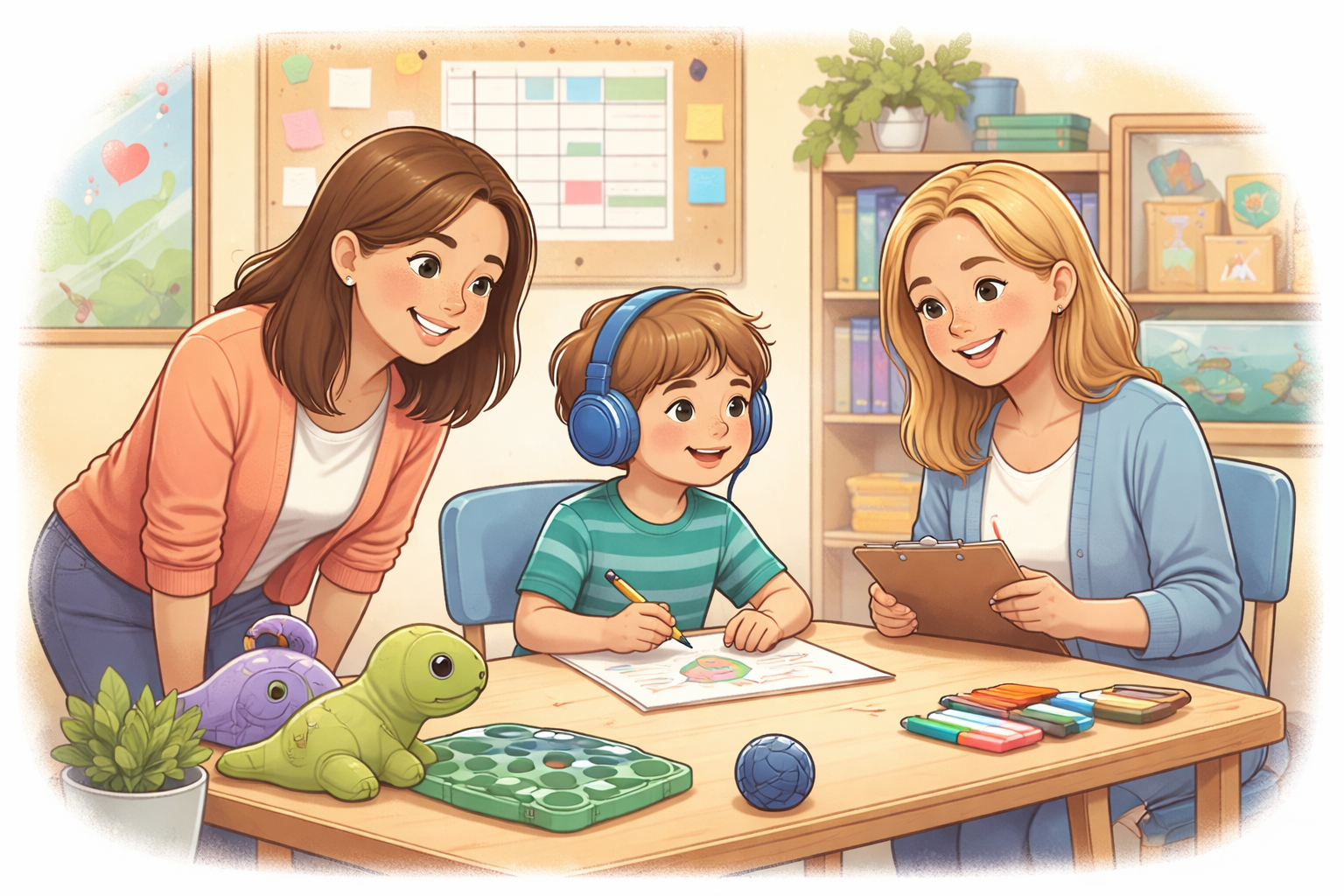
A 504 plan can give your child a quieter place to work, more time to process directions, or help getting through a change in routine. Start with the parts of the school day your child finds hard, then ask what would help in each situation.
| What’s hard at school | Possible supports | What to ask the school |
|---|---|---|
| Loud rooms | A quieter place to work, noise-reducing headphones, or breaks. | Where can my child go when they need somewhere quieter? |
| Unexpected changes in routine | A visual schedule, advance notice, or help with transitions. | Who will tell my child when the schedule changes? |
| Group work | Clear roles, smaller groups, or another way to present the work. | How can my child take part without getting overwhelmed? |
| Timed tests | Extra time, breaks, or a quieter testing room where allowed. | Will these supports also apply to state tests? |
| Following spoken directions | Written directions, pictures, or more time to respond. Some students use picture exchange to communicate. | How will the teacher check that my child understood? |
| Lunch and recess | A predictable place, support from a designated adult, or quieter options. | How will you help my child feel safe and included? |
| Overload or trouble managing emotions | A break card and a clear plan for support. | Who will help before my child gets overwhelmed? |
Supports on North Carolina state tests
North Carolina’s testing rules determine which accommodations can be used on each End-of-Grade (EOG) or End-of-Course (EOC) test. Ask the 504 team to go over each test and document the supports your child needs. A support your child uses in class may work differently on a state test. If your child needs an accommodation that isn’t listed in the state handbook, ask the school about NC DPI’s request process.
Behavior supports and discipline protections
A 504 plan can spell out who will help when your child is getting overwhelmed and what staff can do before things escalate. If the school proposes discipline that would significantly change your child’s placement, federal Section 504 rules require an evaluation first. The team checks whether the behavior was related to the disability. This is called a manifestation determination. The federal Office for Civil Rights treats a removal of more than ten school days in a row, or a pattern of removals totaling more than ten school days, as a significant change in placement.
How do you request a 504 plan from a North Carolina school?
Start by emailing the principal and the school’s Section 504 coordinator to ask for an evaluation.
Dear Principal and Section 504 Coordinator,
I am requesting a Section 504 evaluation for my child, [child's name].
My child is having difficulty with [specific situations] at school.
Please confirm that you received this request and explain the next steps, including any forms or information you need from us.
Thank you,
[Parent's name]
Put your request in writing
In your request, describe what happens at school. A specific example of where your child gets stuck gives the team more to work with than a diagnosis on its own. Keep a copy and ask when you should expect to hear back.
Sign consent so the school can assess your child
The school must get your informed permission before it does an initial Section 504 evaluation. The federal Office for Civil Rights accepts written consent, so ask the school which form it uses. If the school declines to evaluate, ask for written notice explaining the decision and a copy of your rights under Section 504.
Meet with the 504 committee
Bring your own observations and ideas to the meeting. You know what happens before and after school, and that can help the team understand what it sees in class. Ask what each support will look like, when it will be used, and who will help your child use it.
Follow up once the plan starts
Agree on who will follow up, how teachers will hear about the plan, and when you’ll get an update. Ask whom to contact if a support isn’t being used or isn’t helping.
How do you prepare for a 504 meeting?
Bring records that show what school is like for your child and a short list of the problems you want to solve. One question worth asking is, “What will you do if my child can’t use the support on their own?”
- Report cards and relevant schoolwork
- Teacher notes, emails, and specific examples
- A diagnosis report or outside evaluation, if you have one
- Relevant progress notes from your child’s applied behavior analysis (ABA) provider
- Notes on how your child is doing after the school day
- Your child’s own experiences and wishes
- The two or three problems you most want the plan to address
- Ideas for supports, who will provide them, and how to follow up
- Questions about testing, recess, discipline, and school changes
Wondering how you'll pay for ABA?
Alpaca Health checks your benefits for free before therapy starts, so you know what your plan covers.
Check your coverage →
What can you do if the school denies a 504 plan?
Ask the school to explain its decision in writing and give you a copy of your rights. You can use the district’s grievance process, request a Section 504 hearing for certain decisions, or report possible discrimination to the federal Office for Civil Rights. If your concern involves an IEP or another right under IDEA, North Carolina has separate options.
| Option | Who handles it? | When does it fit? | Deadline or next step |
|---|---|---|---|
| District grievance | The district’s 504 coordinator or designated grievance official. | A concern about disability discrimination, including failure to provide 504 supports. | Ask for the local procedure and filing deadline. |
| Impartial hearing (504) | An impartial hearing officer under the school system’s 504 safeguards. | A dispute about identification, evaluation, or placement. | Ask for the written safeguards and check how and when to file. |
| OCR complaint | U.S. Department of Education’s Office for Civil Rights. | Possible disability discrimination or a failure to follow 504 safeguards. | Usually within 180 calendar days of the alleged discrimination. OCR can waive the deadline in some cases. |
| IDEA state complaint, mediation, or due process | NC DPI handles state complaints and mediation. File due process petitions with the NC Office of Administrative Hearings. | A concern about IDEA rights or special education services. Mediation is voluntary. | A state complaint must be about a violation within the year before NC DPI receives it. For due process, check North Carolina’s one-year rule and exceptions. Check filing deadlines even if you request mediation. |
Use the district's grievance process
Ask the district’s 504 coordinator for the written grievance process and any filing deadline. Request the school’s reasons and any records that help explain the decision. Keep your emails, dates, and a copy of what you submit.
Request an impartial hearing
You have the right to an impartial hearing to challenge a decision about your child’s identification, evaluation, or educational placement under Section 504. Federal rules also give you notice, access to relevant records, a chance to take part in the hearing and bring an attorney, and a way to seek review. Ask the school system for its written safeguards, including where to file and the local deadline.
File a complaint with the U.S. Office for Civil Rights
You can file a complaint with the U.S. Department of Education’s Office for Civil Rights if you believe your child faced disability discrimination. Explain what the school did or failed to do, when it happened, and why you believe it was discriminatory. You usually have 180 calendar days from the alleged discrimination, and you can ask OCR for a waiver if you file late.
You can generally file without using the district’s grievance process first. If you’ve already started a comparable formal process, OCR says you have 60 days after that process ends to file. Check with OCR if you’re unsure which deadline applies.
What happens to a 504 plan when your child changes schools?
Give the new school a copy of the plan and any supporting records, and ask what support your child will have when they start. Whether the school can use the existing plan depends on the type of school and the team’s review.
Moving to another North Carolina public or charter school
If your child is moving to a new district, the receiving team should review the plan and supporting records. If it finds the plan appropriate, it must implement it. If it finds the plan inappropriate, it must evaluate your child under Section 504 and decide what support is needed.
North Carolina charter schools are public schools. The federal Section 504 duties apply to federally funded charter schools, including those covered through their district. Ask who will review the plan and what will be in place on the first day.
Moving to North Carolina from another state
Give the North Carolina school the plan and evaluation records from your former school. The same federal Section 504 review applies across state lines. If your child transfers with an IEP during the school year, federal IDEA rules also require comparable services, in consultation with you, while the new school determines whether an evaluation is needed and develops a new IEP if appropriate.
Moving to a private school
If you choose a private school, ask which supports it can offer and get that in writing before enrolling. Section 504 applies to private schools that receive federal financial assistance, with rules specific to private schools. Under IDEA, children placed in private school by their parents may qualify for some services through the public school system. They do not have an individual right to the same services they would receive in public school. Different rules apply if a public agency places your child there.
How can your child's ABA provider help with the 504 plan?
Your child’s ABA provider can share observations about communication, transitions, or independence with your permission. A board certified behavior analyst (BCBA) can also explain which strategies have helped and how your child uses them. For example, if your child uses a visual break card in therapy, show it to the school team. Ask where it could be kept in class, who will notice when your child shows it, and where your child can take a break.
The school team decides what goes in the 504 plan and how staff will provide it. If your provider offers parent coaching, ask how you can practice the same skill at home.
Where can North Carolina families get help with a 504 plan?
Statewide groups can help you understand school rights, prepare for a meeting, or decide what to do after a disagreement. The right place to start depends on the kind of help you need.
Exceptional Children's Assistance Center
The Exceptional Children’s Assistance Center (ECAC) offers free information, parent training, and one-on-one guidance. A parent educator can help you prepare questions for the school. Call 800-962-6817.
Disability Rights North Carolina
Disability Rights North Carolina has resources on school rights and takes requests for legal help. Contact its intake team to see whether it can assist with your situation.
Legal Aid of North Carolina
Legal Aid of North Carolina’s Right to Education Project helps with issues such as special education, school discipline, and disability discrimination. You can use its education resources or apply for help. Whether it can take your case depends on its intake review.
How Alpaca Health helps North Carolina families with 504 plans
Alpaca Health connects families with independent providers who offer ABA therapy in North Carolina. If your child’s school team identifies a hard part of the day, such as getting ready for a change in routine or asking for a break, you can bring that example to a provider and ask what your child might practice in therapy. Depending on your area, sessions can take place at home, at a clinic, by telehealth, or at school if the school agrees, and Alpaca Health also helps families with insurance. When you’re ready, you can start an intake to explore local options.
You don't have to figure this out alone.
Alpaca Health matches your family with a vetted, in-network BCBA. We handle the insurance paperwork so you can focus on your child.
Get matched with a BCBA →Frequently Asked Questions About 504 Plans in North Carolina
Is there a downside to having a 504 plan?
A 504 plan can be a good fit when it covers the support your child needs. The risk is relying on it when your child needs specially designed instruction and should be evaluated under IDEA. A child may be protected by both laws. If the IEP meets your child’s Section 504 education requirements, the school does not need to write a separate 504 plan.
Do you need a doctor's note to get a 504 plan?
No. Section 504 does not make a doctor’s note a condition of eligibility. The school can use records from several sources, including teacher observations, schoolwork, and information you share. If the team decides a medical assessment is necessary to complete the evaluation, the school must make sure your child gets it at no cost to you.
Does a 504 plan follow a student for life?
No, a school 504 plan does not automatically follow your child for life. Disability protections can still apply later, but a college or other program may have its own process for requesting accommodations.
Can a child fail with a 504 plan?
Yes. A 504 plan gives your child access to the support they need at school, and the school must provide it. The plan does not guarantee a passing grade. If your child is struggling, ask whether the supports are being used and whether they’re helping.
Is having a 504 considered a disability?
A 504 plan reflects the school’s determination that your child has a disability under Section 504 and needs support at school. A medical diagnosis and eligibility for other programs are separate decisions. If you’re also looking for ABA therapy outside school, you can sign up with Alpaca Health to explore care.
RELATED ARTICLES






NEW TO THE TERMS?
ABA Glossary for Parents →The words you will hear from your child's care team, explained in plain language.