




Colorado gives families of autistic children more educational paths than most states. Private specialty schools, public district ASD programs, charter options, and residential placements all serve different needs and budgets, and the right fit depends on your child's learning profile, your district, and how much additional support they need outside the classroom. When school alone isn't enough, ABA therapy can add support at home or during the school day. For a broader look at Colorado ABA providers and therapy options alongside school, that resource covers the full picture.
Key Takeaways
- Colorado has both private specialty schools and free public autism programs. Private specialty schools charge tuition, and some do not publish it. Public district autism center programs are free and available in most major districts.
- Your child's IEP drives placement. Public schools are legally required to provide a free appropriate public education in the least restrictive environment. Understanding your IEP rights is the foundation of every school decision.
- Tuition assistance and grants exist for families who need private placements. Health First Colorado and Colorado autism grants can offset costs.
- School and ABA therapy work best together. In-school ABA support through a BCBA can extend what happens in the classroom into every part of your child's day.
- Colorado families can get matched with a BCBA. Begin your intake to find in-school or in-home ABA support alongside your child's school program.
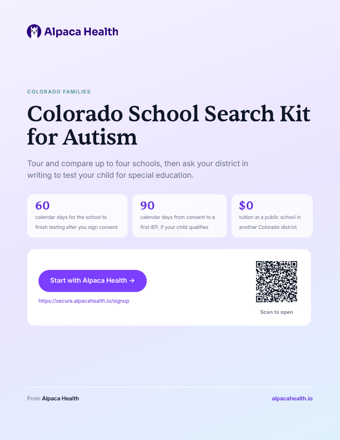
Compare up to four Colorado schools and ask your district to test your child.
We also sent the link to your email.
Private Autism and Special-Education Schools in Colorado
Denver Metro
The Joshua School (Englewood and Boulder)
The Joshua School is a nonprofit serving students with autism spectrum disorder and developmental disabilities through highly individualized programming. They operate campuses in Englewood and Boulder and focus on functional life skills alongside academic goals. Tuition is not published; contact the school directly for current pricing.
Denver Academy (Denver)
Denver Academy serves students in grades 2 through 12 with learning differences including dyslexia, ADHD, and autism profiles. For the 2025-26 school year, tuition is $36,560 for grades 2-6 and $39,500 for grades 7-12. On average, 30 percent of families receive tuition assistance based on financial need. Denver Academy emphasizes small class sizes, differentiated instruction, and a strength-based approach to learning differences.
Rise School of Denver (Denver)
Rise is a small private school serving students with autism and related needs. Tuition is not published on their website; they apply for grants each year to offer tuition support, and have historically been able to meet every family's full need. Families should contact Rise directly about current enrollment and waitlist status.
Boulder
Temple Grandin School (Boulder)
Temple Grandin School is a private middle and high school built for autistic students and students with similar profiles who thrive in smaller, structured, and supportive settings. In recent years tuition has been approximately $48,880 per year. The school emphasizes the strengths-based philosophy of its namesake and uses project-based learning, sensory-aware environments, and individualized support.
Littleton
Havern School (Littleton)
Havern School serves students with learning disabilities, executive functioning challenges, and autism through its Havern Autism Program (HAP). HAP provides a structured, specialized environment within the broader Havern community for students whose needs require more intensive support than a general learning disabilities program provides. Havern serves grades 1 through 8. Contact the school directly for current tuition.
Colorado Springs
Kishami Academy (Colorado Springs)
Kishami Academy is a private school built for autistic students and students with special needs who may feel underserved by traditional public school settings. They serve grades 3 through high school with a customized curriculum covering life skills, social skills, emotional management, and self-advocacy. Kishami is not a one-on-one program; students should be relatively independent. Tuition is $24,000 per year for full-time enrollment and $12,000 per year for the half-day program. Kishami is not accredited and awards a diploma based on mastered strengths rather than a standard high school diploma.
Pikes Peak BOCES - School of Excellence (Colorado Springs)
The School of Excellence operates through Pikes Peak BOCES and houses multiple specialized programs including LIBERTY and Pathways. The LIBERTY program serves students with dual diagnoses and autism using ABA and Verbal Behavior principles with an average ratio of three to four students per teacher. The Pathways program focuses on social and emotional skills and behavior support with approximately one special education teacher per six to eight students. For ABA in Colorado Springs alongside these school programs, that page covers local providers and Medicaid coverage.
You don't have to figure this out alone.
Alpaca Health matches your family with a vetted, in-network BCBA. We handle the insurance paperwork so you can focus on your child.
Get matched with a BCBA →
Public ASD Center Programs by District
Eligible students attend these programs for free, and families get access through the IEP process. Contact your district's special education office to request an evaluation or discuss placement options.
Jefferson County Public Schools (Jeffco)
Jeffco Public Schools operates ASD Center Programs across multiple school sites serving students with autism from preschool through high school. Their special education department also includes an Affective Needs Center Program for students with behavioral and emotional support needs. Placement is determined through the IEP process and based on the least restrictive environment appropriate for each student.
Boulder Valley School District (BVSD)
BVSD's autism programs provide specialized support for autistic students across the district. Their special education department offers a full continuum of services from inclusion support in general education classrooms to more intensive self-contained programming depending on individual need. Eligibility and placement are determined through the IEP process.
Denver Public Schools (DPS)
Denver Public Schools provides special education services including Affective Needs programs and autism-specific support across district schools. DPS uses a continuum of placement options from supported inclusion to specialized classroom settings. Families can request an evaluation through their neighborhood school's special education team.
Colorado Springs District 11 (D11)
District 11 provides special education services to students ages 3 through 21 through their Individualized Education Department. D11 serves a wide range of needs including autism, with programming across district schools at multiple levels of intensity depending on the student's IEP.
Academy District 20 (D20)
Academy District 20 operates special education programming including Communication Social Development (CSD) programs for autistic students who need structured social communication support. D20 also provides inclusion supports and IEP-based services across district schools.
Cheyenne Mountain School District 12 (CMSD12)
CMSD12 supports students from preschool through age 21 through their special education department, using IEPs to address academic, social, and behavioral needs. Professional staff include speech and language pathologists, occupational therapists, and psychologists.
Compare up to four Colorado schools and ask your district to test your child.
We also sent the link to your email.
How to Choose the Right School
Class Size and Staffing Ratios
For many autistic students, smaller ratios make a meaningful difference in how well they can engage and learn. A classroom with three to four students per teacher looks very different from one with eight to ten for some children. Ask every school and program what the actual student-to-staff ratio is during instruction, since the ratio at lunch or during transitions can be different.
Sensory Environment
Many people find it helpful to visit in person before committing. Lighting, acoustics, hallway traffic, and the physical layout of the classroom all affect how your child will function day to day. Ask whether the school has a sensory room or designated quiet space, and how transitions between activities are managed.
IEP Fit
For public school placements, understanding your rights in the IEP process, including the right to request an evaluation, attend all meetings, and dispute placement decisions, is the foundation of effective school advocacy. IEP goals for autism covers how to read and push back on IEP language, and the Colorado 504 plan guide explains how 504 accommodations differ from IEP services and when each applies.
For private school placements, ask how the school coordinates with outside therapists and whether they will collaborate with your child's BCBA on shared goals.
Transition Planning
Ask every program, public or private, how they support transition planning. What does the path from their program look like at age 14, 18, and 21? For students heading toward post-secondary education or employment, transition goals should be embedded in the IEP well before high school. For students who need life skills programming, ask how the curriculum is structured around functional independence rather than academic benchmarks alone.
Wondering how you'll pay for ABA?
Alpaca Health is in-network with 100+ plans, including Medicaid in the states we serve, and we verify your coverage for free before anything starts.
Check your coverage →
Paying for Specialized Schools and ABA
Private autism schools in Colorado typically range from approximately $12,000 to $49,000 per year. That's a real number, and most families need multiple funding sources to make it work.
Health First Colorado (Colorado Medicaid) can fund ABA therapy alongside or in addition to school placement. It does not typically fund private school tuition directly, but it covers the therapy services that support your child's school success. Health First Colorado and ABA covers what's included and how to access it.
Out-of-district placement is an option when your home district cannot meet your child's needs through its own programs. If an IEP team determines that no appropriate placement exists within the district, the district may be required to fund a private placement. This is a formal process that typically requires advocacy and documentation, but it is a legal right under IDEA.
Tuition assistance is available at several Colorado private schools including Denver Academy (30 percent of families receive aid) and Rise (grant-funded support available). Contact each school's admissions office directly about their current assistance programs.
Colorado autism grants can offset therapy and education-related costs for families who qualify. Colorado autism grants covers the current grant landscape including income thresholds and application timelines.
When School Alone Is Not Enough: Pairing School with ABA
Many autistic students make the most progress when school programming is reinforced by ABA therapy outside the classroom, or embedded within the school day itself. Skills learned in a structured classroom environment generalize more reliably when a BCBA is also working on those same skills at home, in the community, and during the natural routines of your child's day.
In-school ABA places a BCBA or RBT directly in your child's school setting, working alongside teachers and paraprofessionals on IEP-aligned goals during the school day. In-home ABA extends that work into mornings, evenings, and weekends when the school day ends. Virtual ABA therapy is available for families whose schedules or locations make in-person sessions difficult to arrange.
For Denver families, no-waitlist ABA in Denver covers how to start in-school or in-home support without the four-plus month wait common at traditional clinic-based providers. Alpaca Health is in-network with Health First Colorado and 100+ commercial payers, and matches families with a local BCBA.
Denver Autism Resources
Families across the metro area can find local autism support through community organizations, therapy providers, and programs that work alongside school.
Working With a BCBA Alongside Your Colorado School
Alpaca Health matches Colorado families with independent BCBAs, accepts Health First Colorado and 100+ commercial plans, and offers in-school, in-home, and virtual ABA across the state. Families work directly with their BCBA, without a corporate intake queue or facility overhead. Begin your intake to find a BCBA who can work alongside your child's school program.
You don't have to figure this out alone.
Alpaca Health matches your family with a vetted, in-network BCBA. We handle the insurance paperwork so you can focus on your child.
Get matched with a BCBA →
Compare up to four Colorado schools and ask your district to test your child.
We also sent the link to your email.
Frequently Asked Questions About Autism Schools in Colorado
What is the best autism school in Colorado?
There is no single best option because the right school depends on your child's specific profile, your location, and your family's priorities. Temple Grandin School in Boulder and The Joshua School in Englewood and Boulder are widely respected private options for autistic students. For families who need a free placement, public district ASD center programs in Jeffco, BVSD, DPS, and the Colorado Springs districts offer structured programming at no cost through the IEP process.
What makes a school autism-friendly?
Low student-to-staff ratios, sensory-aware environments, staff trained in autism-specific supports, a strengths-based philosophy, clear transition planning, and genuine collaboration with outside therapists and families. A school that involves parents meaningfully in IEP development and communicates proactively about progress is a stronger partner than one that treats IEP meetings as a formality.
What is the difference between an IEP and a 504 plan in Colorado?
An IEP (Individualized Education Program) provides specialized instruction and related services for students who qualify under one of the IDEA disability categories, including autism. A 504 plan provides accommodations within a general education setting for students with disabilities who don't require specialized instruction. IEPs carry more legal weight and more detailed obligations for the school. The Colorado 504 plan guide explains when each applies and how to request one.
Can my autistic child attend a mainstream public school in Colorado?
Yes. Most autistic students in Colorado are educated in general education settings with varying levels of support. Public schools are legally required to educate students in the least restrictive environment appropriate to their needs. That may mean a fully inclusive classroom with pull-out support, a resource room for part of the day, a self-contained ASD center program, or an out-of-district placement. The IEP team determines placement based on your child's individual needs, not on a school's preference or convenience.
What does Colorado offer that other states don't?
Colorado has one of the strongest school choice systems in the country, allowing families to apply to any public school across district lines, access a large charter school network, and pursue open enrollment without geographic restriction. Colorado also has Health First Colorado Medicaid coverage for ABA therapy for children under 21, a state autism grant program, and a growing network of independent BCBAs who work in school settings alongside existing special education programming.
How does out-of-district placement work in Colorado?
If your child's IEP team determines that no appropriate placement exists within your home district, the district may be required to fund a private or out-of-district placement under IDEA. This typically requires a formal evaluation, documentation that the district's current programs cannot meet your child's needs, and in many cases, parent advocacy. Families who believe their district is not meeting their child's needs can request an independent educational evaluation and consult with a special education advocate. For ABA support during this process, start your intake with Alpaca Health to get therapy in place while the school placement process works through.
Some days are hard. We can help.
When you're ready for expert support, Alpaca Health matches your family with a caring BCBA who can help with the moments that feel impossible, at home, in clinic, or online.
Get matched with a BCBA →
RELATED ARTICLES