

ABA Therapy Glossaryfor Parents
All termsStimulus control
Stimulus control means a behavior reliably happens when a certain cue is present and not when it's absent, because it was rewarded with that cue.
What it means
Stimulus control means a behavior reliably happens when a certain cue is present and not when it's absent. It forms because the behavior has been rewarded when that cue was there. Behavior analysts call the cue a discriminative stimulus (SD). It signals that a reward is there for that response. For example, a child says "Mary" when asked "What is your name?" and doesn't say it when someone asks another person.
Stimulus control is built through discrimination training, which teaches a child to respond to one cue and not to others. In applied behavior analysis (ABA), much of teaching is building the right stimulus control. Your child should respond to the real instruction or object. A side cue, like the therapist's glance or where a card sits, shouldn't be the signal. Prompts help at first, and the team fades them so the real cue takes over.
What it looks like for your child
Your child may seem to know a skill only with one therapist or one set of materials. Then the skill may be tied to the wrong cue. This is called faulty stimulus control, and it can hold back key goals. That's one reason teams teach across people and places.
Mistakes that repeat in a pattern, such as always picking the same side, can also be learned by accident. In one study, smaller teaching steps fixed the pattern. Registered Behavior Technicians (RBTs) run discrimination training, and Board Certified Behavior Analysts (BCBAs) design it.
What to ask your BCBA
- Different people and places: Ask your BCBA how the team checks that your child uses each skill with different people and materials.
- Repeated mistakes: If your child keeps making the same kind of mistake, ask what change to the teaching steps the team will try.
- Practice at home: Ask whether parent training includes practicing new skills with you at home.
Does your child use a skill with one person but not another?
A BCBA plans teaching so skills follow the real cue, in sessions and at home.

Sources
- Halbur, Caldwell and Kodak (2021), stimulus control research and practice, Behavior Analysis in Practice 14(1).
- Behavior Analyst Certification Board (BACB), BCBA Test Content Outline, 6th ed., B.12, B.13 and G.6.
- BACB, RBT Test Content Outline, 3rd ed., C.6 and C.7.
- Saunders, Hine, Hayashi and Williams (2016), maladaptive stimulus control study, Behavior Analysis in Practice 9(3).
Related terms
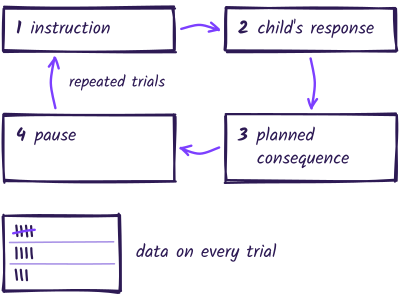
Discrete trial training (DTT)
Discrete trial training (DTT) is a structured ABA teaching style that breaks a skill into small parts and practices them in short, repeated trials.
Definition →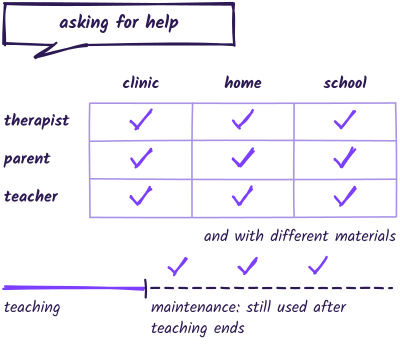
Generalization and maintenance
Generalization means your child uses a skill beyond where it was taught, and maintenance means they keep using it over time after teaching ends.
Definition →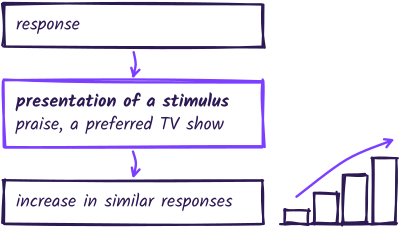
Positive reinforcement
Positive reinforcement happens when something is added after a behavior, like praise or a favorite activity, and the behavior then happens more often.
Definition →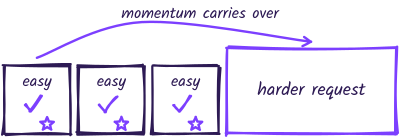
Behavioral momentum
Behavioral momentum is a teaching strategy that gives a child a few easy requests and praise, then a harder one right away.
Definition →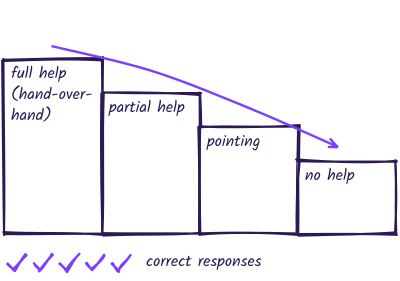
Errorless learning
Errorless learning is a way of teaching that gives a child enough help to answer correctly, then fades that help step by step.
Definition →