

ABA Therapy Glossaryfor Parents
All termsGeneralization and maintenance
Generalization means your child uses a skill beyond where it was taught, and maintenance means they keep using it over time after teaching ends.
What it means
Generalization means your child uses a skill beyond the exact situation where they learned it. That can mean with different people, in different places or with different materials. Maintenance means your child keeps using the skill over time, after teaching ends or support fades. Neither one happens on its own, so applied behavior analysis (ABA) plans build both in from the start.
Federal Medicaid guidance says the goal is for a child to use a skill across routines, people and settings. That way, the skill lasts and becomes part of daily life. The Council of Autism Service Providers asks that every goal include a plan for carrying the skill over.
What it looks like for your child
Say your child learns to ask for help with their therapist at the table. Generalization would be your child asking you at home, or asking a teacher at school. To get there, the team practices with several people and materials and teaches during daily routines. Training caregivers is one of the main ways skills carry over and last.
For maintenance, the team mixes mastered skills back into sessions and gives rewards less often over time. It also shifts toward rewards that happen naturally.
What to ask your BCBA
- Practice outside sessions: Ask your Board Certified Behavior Analyst (BCBA) how each goal will be practiced at home, at school and with different people.
- Your part in it: Ask what caregiver training is planned to help skills carry over into daily life.
- Checking later: Ask how the team checks that mastered skills are still being used after teaching stops.
Skills showing up in sessions but not at home?
A BCBA builds practice with family members and new places into each goal from the start.

Sources
- Behavior Analyst Certification Board: RBT Test Content Outline, C.8 and C.9, and BCBA Test Content Outline, G.16.
- Centers for Medicare & Medicaid Services (2026), Medicaid ABA Toolkit, pp. 12 and 41.
- Council of Autism Service Providers (2014, 2020), ABA practice guidelines, 2nd edition, pp. 13 and 24.
- Schreibman et al. (2015), naturalistic developmental behavioral interventions.
Related terms
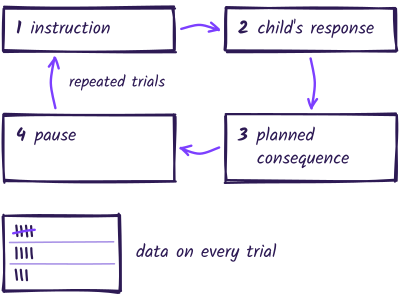
Discrete trial training (DTT)
Discrete trial training (DTT) is a structured ABA teaching style that breaks a skill into small parts and practices them in short, repeated trials.
Definition →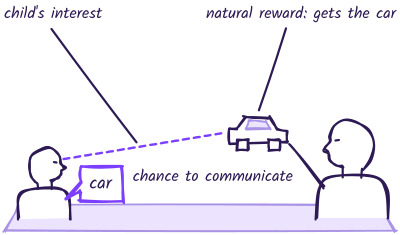
Natural environment teaching (NET)
Natural environment teaching (NET) is ABA teaching built into play and daily routines, using a child's interests and natural rewards.
Definition →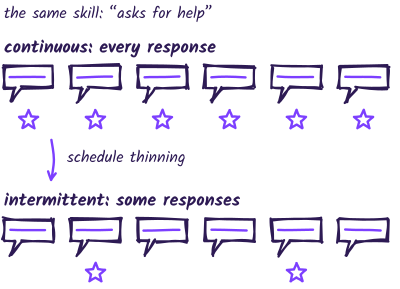
Reinforcement schedules
A reinforcement schedule is the rule for which times a behavior earns a reinforcer: every time (continuous) or only some times (intermittent).
Definition →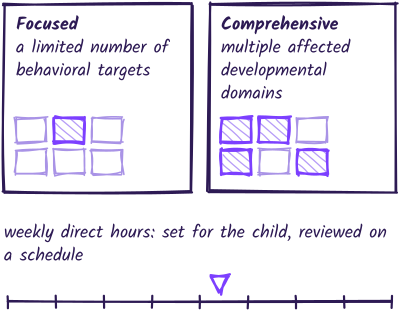
Treatment plan (comprehensive vs focused ABA)
An ABA treatment plan is the written, individualized plan your BCBA builds before services start, setting goals, methods, weekly hours and a review schedule.
Definition →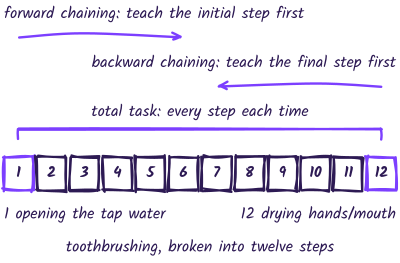
Chaining
Chaining teaches a multi-step skill, like brushing teeth, by breaking it into steps and teaching them until they link into one routine.
Definition →