

ABA Therapy Glossaryfor Parents
All termsBehavioral momentum
Behavioral momentum is a teaching strategy that gives a child a few easy requests and praise, then a harder one right away.
What it means
Behavioral momentum, in everyday applied behavior analysis (ABA), is a teaching strategy. Your child gets a few quick, easy requests they're very likely to do, with praise after each one. Then the harder request comes right away. A national review of autism practices says this order lets learners earn rewards sooner and stay engaged with harder tasks. Behavior analysts call the easy ones high-probability requests.
The name comes from a broader theory. Behavior that has been rewarded often in a setting tends to keep going, even when things change. Behavior analysts also use the theory to understand why problem behavior can come back. A 2026 Medicaid toolkit notes concerns about ABA, including that it may focus on rewarding compliance over a child's own choices.
What it looks like for your child
Before a harder request, you might ask your child for a high five and then to touch their nose, praising each one. Then you ask for the harder thing right away. Timing matters here. The effect depends on the harder request coming close behind the easy ones. No source sets a fixed number of easy requests, so your child's team plans what fits. The strategy can be used for school, social, communication and behavior goals.
What to ask your BCBA
- Where it's used: Ask your Board Certified Behavior Analyst (BCBA) which goals use easy requests before harder ones.
- Fading it out: Ask how the team will cut back the easy requests as your child learns.
- Using it at home: Ask whether parent training will show you how to time the requests at home.
Hard tasks stalling before they start at home?
A BCBA plans the order of requests so your child stays engaged with harder tasks.

Sources
- Steinbrenner et al. (2020), UNC Frank Porter Graham Institute (NCAEP), autism practices report, p. 28 and p. 70.
- Mace et al. (1988), behavioral momentum study, Journal of Applied Behavior Analysis 21(2).
- Nevin and Shahan (2011), behavioral momentum theory, Journal of Applied Behavior Analysis 44(4).
- Centers for Medicare & Medicaid Services (CMS), Medicaid ABA Toolkit, p. 10 (August 2026).
Related terms
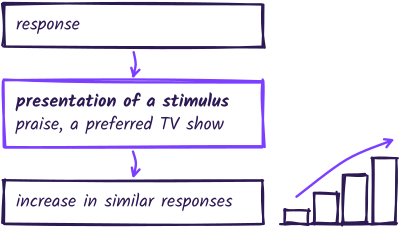
Positive reinforcement
Positive reinforcement happens when something is added after a behavior, like praise or a favorite activity, and the behavior then happens more often.
Definition →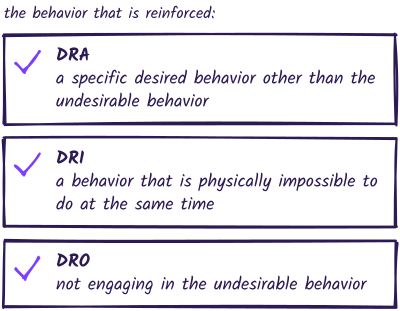
Differential reinforcement
Differential reinforcement means giving positive consequences for a chosen behavior, or for not doing a problem behavior, so the better behavior grows.
Definition →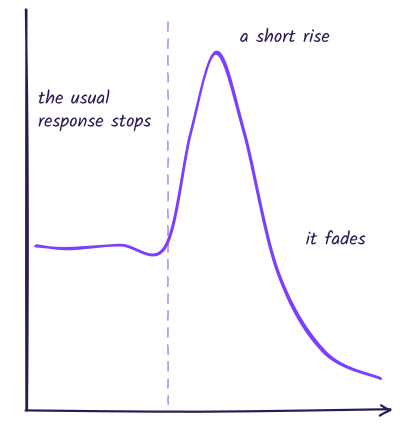
Extinction and extinction burst
Extinction means a behavior stops getting the payoff that kept it going; an extinction burst is a short rise in that behavior before it drops.
Definition →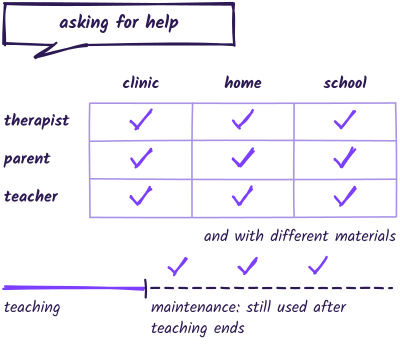
Generalization and maintenance
Generalization means your child uses a skill beyond where it was taught, and maintenance means they keep using it over time after teaching ends.
Definition →