

ABA Therapy Glossaryfor Parents
All termsSensory seeking and sensory avoiding
Sensory seeking is looking for more sensory input, like rocking or touching things; sensory avoiding is pulling away from input that feels like too much.
What it means
Sensory seeking and sensory avoiding describe two ways a child can respond to sensations. A child who seeks looks for more input by adding movement, touch, sound or things to look at. A child who avoids pulls back from input that feels like too much. They may resist joining in when sights and sounds are hard to predict. They may also prefer routines. Alsaedi and colleagues note that studies differ on whether seeking is its own pattern or part of being less sensitive.
Over- or under-reacting to sensory input is part of the autism criteria. But sensory differences also show up in other conditions, such as anxiety and attention problems. "Sensory processing disorder" isn't a diagnosis in the manual used to diagnose autism. In 2012, the American Academy of Pediatrics said it generally shouldn't be diagnosed, while some researchers, such as Crasta and colleagues, use criteria from a separate early childhood manual.
What it looks like for your child
Seeking might look like rocking, lots of touching or smelling things, or mouthing objects. Some children stare at lights and movement. Avoiding might look like distress at certain sounds or textures, like loud music or some clothes. Some children also seem not to notice pain or heat and cold. Head banging can also be a way to seek sensation. If you see it, raise it with your child's clinicians because of the risk of injury.
What to ask your BCBA
- Who evaluates it: Ask your child's pediatrician about an occupational therapy evaluation, since occupational therapists assess sensory processing.
- What the behavior does: Ask your Board Certified Behavior Analyst (BCBA) whether a seeking behavior gives your child its own sensory payoff, which behavior analysts call automatic reinforcement.
- Staying safe: If seeking includes head banging or other risky behavior, ask your child's clinicians how to keep your child safe.
Is your child seeking or avoiding certain sensations?
A short screener is one place to start before you talk with your pediatrician.

Sources
- Centers for Disease Control and Prevention, Clinical Testing and Diagnosis (DSM-5 criteria).
- American Academy of Pediatrics, HealthyChildren.org: Sensory Integration Therapy.
- Mallory and Keehn (2021), sensory processing in school settings.
- Alsaedi, Carrington and Watters (2024), sensory processing patterns study.
Related terms
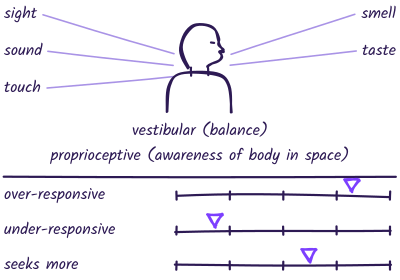
Sensory processing differences
Sensory processing differences describe how a child notices and reacts to sights, sounds, touch, movement and other input, more or less strongly than others.
Definition →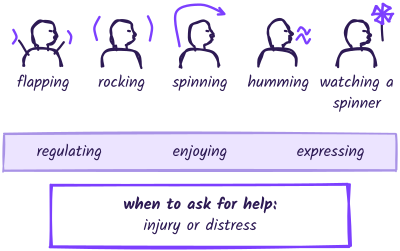
Stimming
Stimming, short for self-stimulating behavior, is a repeated movement or sound, such as hand flapping, rocking, spinning or humming.
Definition →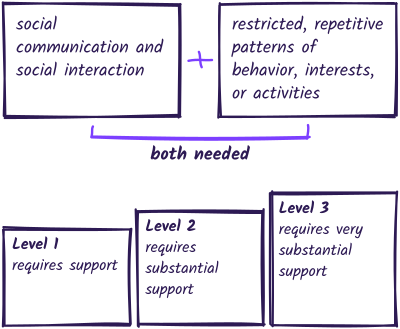
Autism spectrum disorder (ASD)
Autism spectrum disorder (ASD) is a neurological and developmental condition that affects how people communicate, interact with others, learn and behave.
Definition →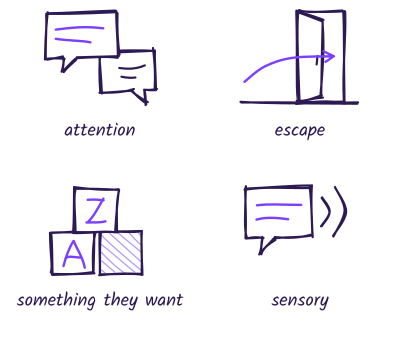
Functions of behavior
A behavior's function is the payoff that keeps it going, like attention, escape from a demand, an item, or a reward the behavior creates itself.
Definition →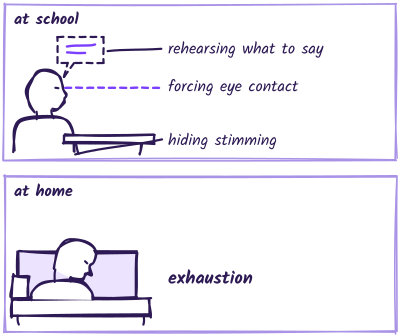
Masking
Masking, also called camouflaging, is when an autistic person hides or makes up for autistic traits, on purpose or not, to appear non-autistic.
Definition →