

ABA Therapy Glossaryfor Parents
All termsMasking
Masking, also called camouflaging, is when an autistic person hides or makes up for autistic traits, on purpose or not, to appear non-autistic.
What it means
Masking, also called camouflaging, is when an autistic person hides or makes up for autistic traits to appear non-autistic. It can be on purpose or not. Researchers describe it as a mix of hiding natural responses and using learned workarounds. They note it isn't always a choice. The autism criteria themselves say learned strategies can hide signs later in life. There are no formal clinical tests for masking.
Studies link masking to exhaustion, poorer mental health, autistic burnout and late or missed diagnosis. Most of this research is on adults, and it shows links, not proof of cause. Hull and colleagues and the National Autistic Society tie masking more to girls and women, while Pearson and Rose warn that treating it as a female trait can mean others are missed.
What it looks like for your child
A child who masks might force eye contact, hide stimming or plan what to say ahead of time. They may hold it together at school and show distress later, such as when they get home. Masking can happen without a child knowing it. That means your child may not be able to tell you they're doing it. The National Autistic Society says autistic people should never be expected to mask or be punished for not masking.
What to ask your BCBA
- Goals that touch masking: Ask your Board Certified Behavior Analyst (BCBA) whether any goal targets eye contact or stimming, and why.
- School and home: If your child seems fine at school but struggles at home, ask your BCBA and your child's teacher to compare what each of you sees.
- Your child's own account: Ask how the team will include your child's description of their own experience, since there's no clinical test for masking.
Not sure what you are seeing at home?
A two-minute screener tells you whether an evaluation is worth asking for.

Sources
- National Autistic Society, Masking.
- Pearson and Rose (2021), Conceptual analysis of masking.
- Hull et al. (2017), Social camouflaging in autistic adults.
- Centers for Disease Control and Prevention, Clinical Testing and Diagnosis (DSM-5 criteria).
Related terms
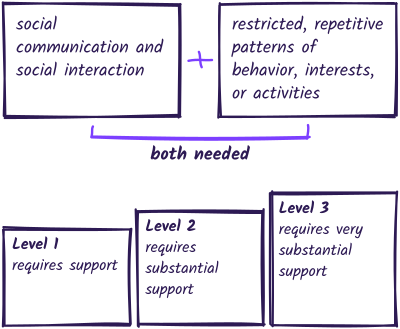
Autism spectrum disorder (ASD)
Autism spectrum disorder (ASD) is a neurological and developmental condition that affects how people communicate, interact with others, learn and behave.
Definition →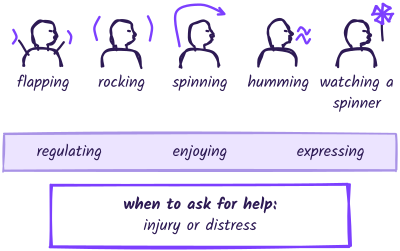
Stimming
Stimming, short for self-stimulating behavior, is a repeated movement or sound, such as hand flapping, rocking, spinning or humming.
Definition →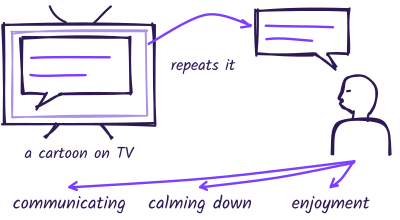
Scripting
Scripting is when a child repeats lines heard earlier, from TV shows, movies, songs or past conversations, often called delayed echolalia.
Definition →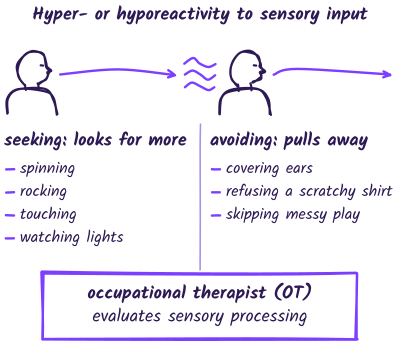
Sensory seeking and sensory avoiding
Sensory seeking is looking for more sensory input, like rocking or touching things; sensory avoiding is pulling away from input that feels like too much.
Definition →