

ABA Therapy Glossaryfor Parents
All termsAutism spectrum disorder (ASD)
Autism spectrum disorder (ASD) is a neurological and developmental condition that affects how people communicate, interact with others, learn and behave.
What it means
Autism spectrum disorder (ASD) is a neurological and developmental condition. It affects how people communicate, interact with others, learn and behave. To be diagnosed, a child must have lasting challenges with social communication and interaction in three areas. They must also show at least two of four kinds of repeated behaviors or interests. These signs start early in life, though learned strategies may hide them later on.
"Spectrum" means people with autism have a wide range of traits, needs, strengths and challenges. Support needs are rated in each area using levels of autism. They range from Level 1 (needs support) to Level 3 (needs very substantial support). Since 2013, the diagnosis also covers conditions once diagnosed on their own, such as Asperger syndrome. In 2022, a federal tracking network identified about 1 in 31 children aged 8 with ASD.
What it looks like for your child
Because autism is a spectrum, two autistic children can look very different. For one child, the clearest signs may be in social communication. For another, they may be repeated words or phrases, or strong reactions to certain sounds or textures. People with autism can also have many strengths, such as learning well by seeing and hearing. There's no blood test for autism, so clinicians look at behavior and development. It can usually be diagnosed reliably by age 2.
What to ask your BCBA
- Ask the evaluating clinician: If your child is being evaluated, ask which tools and sources of information the clinician will use.
- After a diagnosis: Ask the clinician to explain the support level for each area, whether it can change over time and which next steps after diagnosis they suggest.
- Ask your behavior analyst: Ask your Board Certified Behavior Analyst (BCBA) how your child's strengths and support needs shape their therapy goals.
Seeing signs and wondering if it could be autism?
Start with a short screener, then bring the results to your child's doctor.

Sources
- National Institute of Mental Health (2025), Autism Spectrum Disorder.
- Centers for Disease Control and Prevention: Clinical Testing and Diagnosis (DSM-5 criteria), About Autism Spectrum Disorder and Data and Statistics.
- American Academy of Pediatrics, HealthyChildren.org: Understanding Autism.
Related terms
ADOS-2
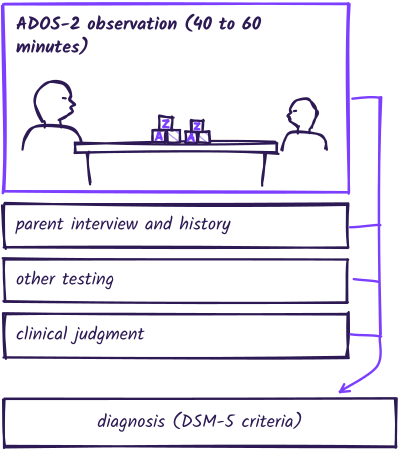
The Autism Diagnostic Observation Schedule, Second Edition (ADOS-2) is a standardized observation that clinicians use as one part of an autism evaluation.
Definition →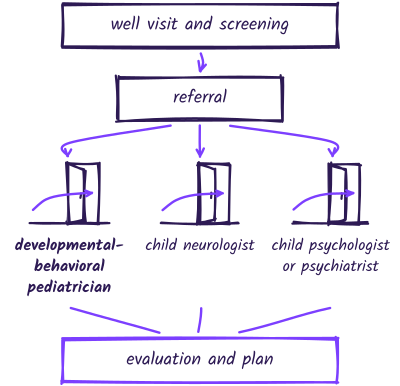
Developmental pediatrician
A developmental pediatrician is a children's doctor with three more years of specialty training who evaluates development, learning and behavior, including autism.
Definition →
DSM-5-TR autism criteria
The DSM-5-TR autism criteria are the rules clinicians use to diagnose autism, covering social communication plus repetitive behaviors, interests or sensory responses.
Definition →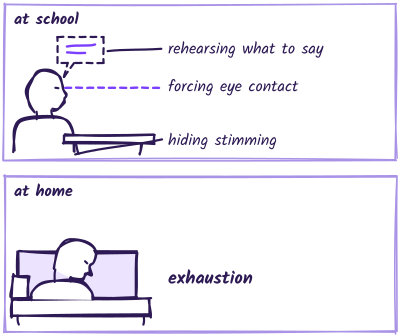
Masking
Masking, also called camouflaging, is when an autistic person hides or makes up for autistic traits, on purpose or not, to appear non-autistic.
Definition →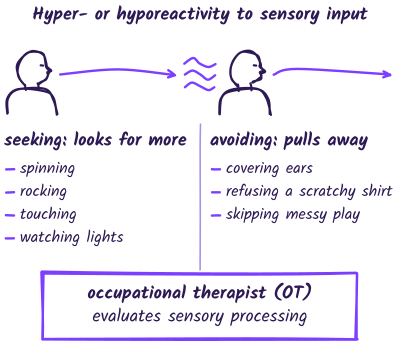
Sensory seeking and sensory avoiding
Sensory seeking is looking for more sensory input, like rocking or touching things; sensory avoiding is pulling away from input that feels like too much.
Definition →