

ABA Therapy Glossaryfor Parents
All termsSensory processing differences
Sensory processing differences describe how a child notices and reacts to sights, sounds, touch, movement and other input, more or less strongly than others.
What it means
Sensory processing differences describe how a child takes in and reacts to the senses. That includes sights, sounds, touch, smells and tastes, plus balance and body position. Some children react more strongly than others, some react less, and some seek out extra input. Over- or under-reacting to the senses is part of the autism criteria. It also shows up with anxiety, attention problems and other conditions. So on its own, it doesn't mean a child is autistic.
"Sensory processing disorder" isn't in the manual used to diagnose autism. In 2012, the American Academy of Pediatrics (AAP) said it generally shouldn't be diagnosed, while some researchers use a separate early childhood manual. Jean Ayres, an occupational therapist, created sensory integration therapy in the 1970s, and views on it differ. The AAP calls its evidence for autism limited and unclear, while a 2020 national review found evidence for one form, Ayres Sensory Integration.
What it looks like for your child
Your child might seem not to notice pain, heat or cold, or get upset by certain sounds or textures. If you're worried, the AAP says to start with your child's pediatrician. Then an occupational therapist usually checks how your child takes in the senses.
Some therapies use brushing or weighted vests. These aren't the same as the Ayres form, which trained therapists give. If your child tries one, the AAP suggests treating it as a trial with a clear way to judge it. A sensory diet doesn't replace an evaluation.
What to ask your BCBA
- Judging a therapy: If a sensory therapy is suggested, ask how long the trial lasts and how you'll tell whether it helps.
- What the behavior does: Ask your Board Certified Behavior Analyst (BCBA) whether a sensory-seeking behavior gives your child its own payoff, and how the plan can offer safe ways to get that input.
Noticing big reactions to certain sounds or textures?
A short screener is one way to decide whether to bring sensory signs to your pediatrician.

Sources
- Centers for Disease Control and Prevention, Clinical Testing and Diagnosis (DSM-5 criteria).
- American Academy of Pediatrics, HealthyChildren.org: Sensory Integration Therapy.
- Steinbrenner et al. (2020), UNC Frank Porter Graham Institute (NCAEP), autism practices report, p. 2 and p. 69.
- Crasta et al. (2020), sensory processing and attention profiles, Frontiers in Integrative Neuroscience 14.
Related terms
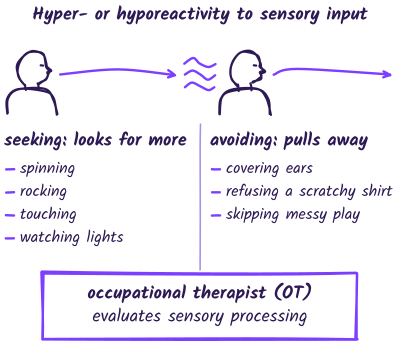
Sensory seeking and sensory avoiding
Sensory seeking is looking for more sensory input, like rocking or touching things; sensory avoiding is pulling away from input that feels like too much.
Definition →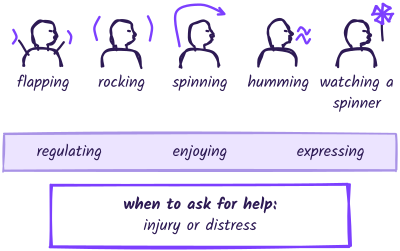
Stimming
Stimming, short for self-stimulating behavior, is a repeated movement or sound, such as hand flapping, rocking, spinning or humming.
Definition →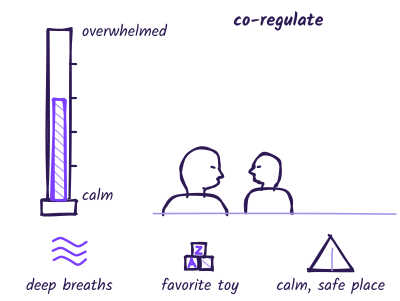
Emotional regulation
Emotional regulation is the ability to notice a strong feeling and bring it back to a manageable level, like calming down after being upset.
Definition →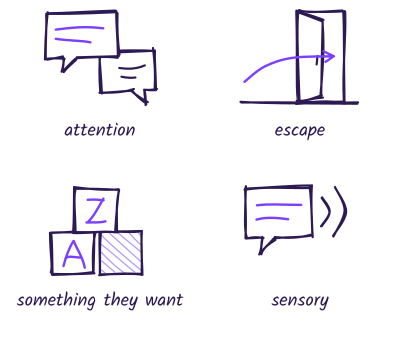
Functions of behavior
A behavior's function is the payoff that keeps it going, like attention, escape from a demand, an item, or a reward the behavior creates itself.
Definition →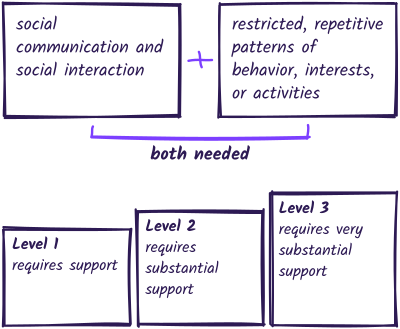
Autism spectrum disorder (ASD)
Autism spectrum disorder (ASD) is a neurological and developmental condition that affects how people communicate, interact with others, learn and behave.
Definition →