

ABA Therapy Glossaryfor Parents
All termsFunctions of behavior
A behavior's function is the payoff that keeps it going, like attention, escape from a demand, an item, or a reward the behavior creates itself.
What it means
In applied behavior analysis (ABA), a behavior's function is the payoff that keeps it going. It's what the behavior gets your child, or gets your child out of, whatever it looks like. A common shorthand names four: attention, escape from a demand, access to an item or activity, and automatic reinforcement. In that last case, the behavior is its own reward, such as a sensory payoff.
Research also counts combinations, so one behavior can serve more than one function. The same behavior can also have a different function in a different child. That's why the team finds the function through an assessment instead of guessing from how it looks. Many people assume attention is the payoff. But one review found it was the payoff in only about a quarter to a third of the cases it examined.
What it looks like for your child
Picture your child tossing a puzzle piece off the table. If the toss ends the puzzle, the payoff may be escape, and if it brings you over, it may be attention. Behavior with an automatic function often keeps going even when your child is alone. Once the team knows the payoff, it can teach your child another way to get the same thing, such as asking for a break.
What to ask your BCBA
- How the function was found: Ask your Board Certified Behavior Analyst (BCBA) which assessment the team used and what it showed.
- More than one function: Ask whether the behavior could be getting your child more than one thing.
- Behavior that is its own reward: Ask whether the plan targets behavior like stimming and why, since this choice is debated.
Not sure what a behavior is getting your child?
A BCBA finds the payoff through an assessment instead of guessing from how it looks.

Sources
- Behavior Analyst Certification Board (BACB), RBT Test Content Outline, 3rd ed., task D.1.
- Hanley (2012), functional assessment of problem behavior, Behavior Analysis in Practice 5(1).
- Hagopian, Rooker and Zarcone (2015), automatic reinforcement subtypes, Journal of Applied Behavior Analysis 48(3).
- Mueller, Nkosi and Hine (2011), 90 functional analyses in schools, Journal of Applied Behavior Analysis 44(4).
Related terms
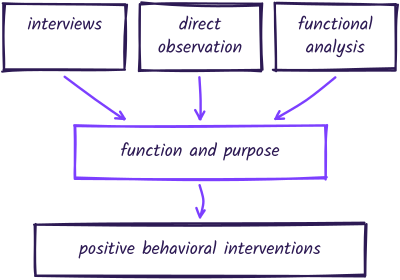
Functional behavior assessment (FBA)
A functional behavior assessment (FBA) is a structured process for working out why a specific behavior happens, so the team can plan better alternatives.
Definition →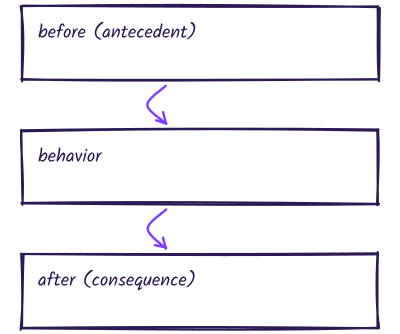
ABC data
ABC (antecedent, behavior, consequence) data is a record of what happened just before a behavior, the behavior itself, and what came right after.
Definition →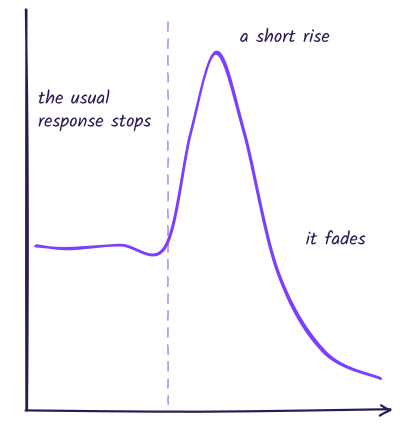
Extinction and extinction burst
Extinction means a behavior stops getting the payoff that kept it going; an extinction burst is a short rise in that behavior before it drops.
Definition →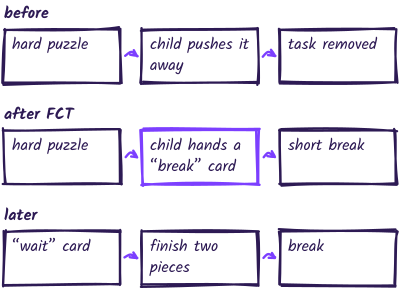
Functional communication training (FCT)
Functional communication training (FCT) teaches a child a clear way to ask for what a challenging behavior was getting them.
Definition →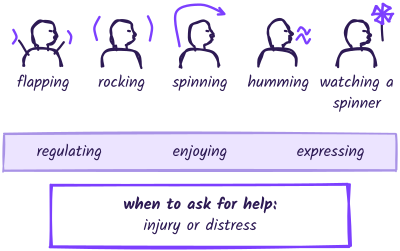
Stimming
Stimming, short for self-stimulating behavior, is a repeated movement or sound, such as hand flapping, rocking, spinning or humming.
Definition →