

ABA Therapy Glossaryfor Parents
All termsReinforcement schedules
A reinforcement schedule is the rule for which times a behavior earns a reinforcer: every time (continuous) or only some times (intermittent).
What it means
A reinforcement schedule is the rule for which times a behavior earns a reward or other reinforcer. On a continuous schedule, your child earns it every time they get it right. On an intermittent schedule, also called partial reinforcement, they earn it only some of the time. A ratio schedule rewards after a set or changing number of tries. A fixed-interval schedule rewards the first try after a set amount of time passes.
New skills often start on continuous reinforcement. Then the team thins the schedule slowly, across many sessions. The goal is a schedule families can keep up, with rewards closer to everyday life. Hagopian and colleagues warn that moving too fast can make a new skill drop out and old behavior come back. Behavior that pays off only some of the time is also harder to stop. That may be why giving in now and then can keep a challenging behavior going.
What it looks like for your child
Say your child is learning to ask for help. At first, the Registered Behavior Technician (RBT) might praise every ask. Later, praise comes after some asks, and getting the help becomes the main reward. The RBT follows the schedule your Board Certified Behavior Analyst (BCBA) sets. The end goal is natural rewards like praise, play or getting what your child asked for, instead of tokens or treats forever.
What to ask your BCBA
- The current schedule: Ask your BCBA how often each skill is being reinforced right now.
- The thinning plan: Ask how and when the team will thin reinforcement, and what would make them slow down.
- Matching it at home: Ask how you can follow the same schedule at home, and whether parent training covers it.
Wondering how rewards will change as your child learns?
A BCBA plans how reinforcement thins out over time and walks you through each change.

Sources
- American Psychological Association, APA Dictionary of Psychology, "schedule of reinforcement," "intermittent reinforcement" and "partial reinforcement effect."
- Hagopian, Boelter and Jarmolowicz (2011), reinforcement schedule thinning, Behavior Analysis in Practice 4(1).
- Behavior Analyst Certification Board (BACB), RBT Test Content Outline (3rd ed.), C.1, and BCBA Test Content Outline (6th ed.), G.16.
Related terms
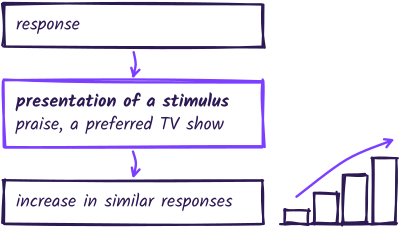
Positive reinforcement
Positive reinforcement happens when something is added after a behavior, like praise or a favorite activity, and the behavior then happens more often.
Definition →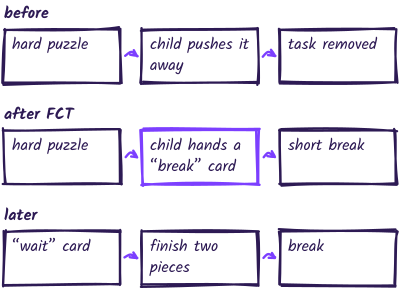
Functional communication training (FCT)
Functional communication training (FCT) teaches a child a clear way to ask for what a challenging behavior was getting them.
Definition →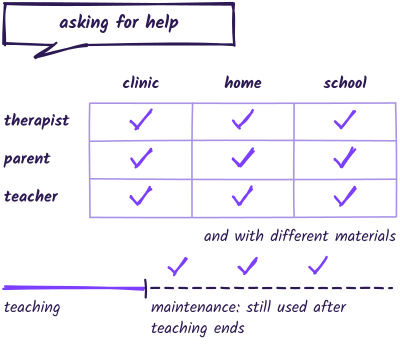
Generalization and maintenance
Generalization means your child uses a skill beyond where it was taught, and maintenance means they keep using it over time after teaching ends.
Definition →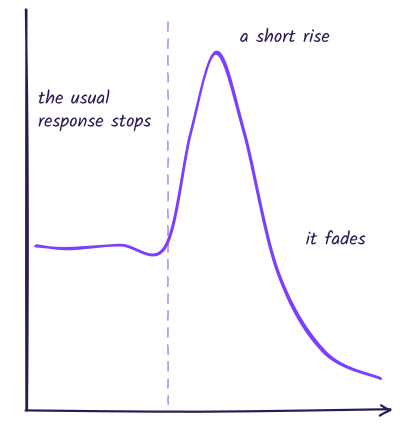
Extinction and extinction burst
Extinction means a behavior stops getting the payoff that kept it going; an extinction burst is a short rise in that behavior before it drops.
Definition →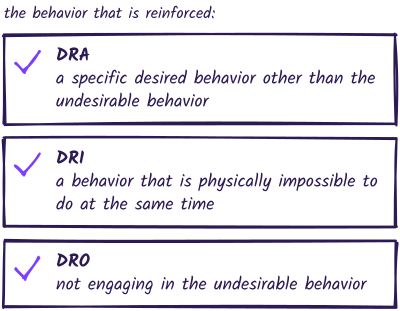
Differential reinforcement
Differential reinforcement means giving positive consequences for a chosen behavior, or for not doing a problem behavior, so the better behavior grows.
Definition →