

ABA Therapy Glossaryfor Parents
All termsFunctional communication training (FCT)
Functional communication training (FCT) teaches a child a clear way to ask for what a challenging behavior was getting them.
What it means
Functional communication training (FCT) teaches your child a clear way to ask for the same thing a challenging behavior was getting them. In a 1985 study, Carr and Durand described some behavior problems as a way to communicate without words. So FCT starts with a functional behavior assessment (FBA). It finds what the behavior gets your child, such as attention, help or a break. Then the team teaches a request that gets the same result. It might be a word, a sign, a picture card or a speech device.
Hagopian and colleagues say it's one of the more common treatments for problem behavior. A large autism report says that in FCT, the old behavior usually stops getting its payoff, called extinction, while Tiger and colleagues note a few cases where FCT worked without it.
What it looks like for your child
Say your child pushes a hard puzzle away, and the assessment shows the behavior gets them a break. With FCT, they might learn to hand over a break card, and the short break comes right away. Early on, the request should work every time. Later, the team slowly teaches waiting, sometimes with a "wait" card. Some challenging behavior is expected during that step. The skill has to work with everyone who cares for your child, in every place, including home.
What to ask your BCBA
- What the behavior gets: Ask your Board Certified Behavior Analyst (BCBA) what the FBA found and which request the team will teach.
- The old behavior: Ask how the team will respond to the old behavior while your child learns the new request.
- Practicing at home: Ask how you should respond to the request at home, and whether parent training covers it.
Wondering what your child's behavior might be trying to say?
A BCBA finds what the behavior gets your child, then teaches a clearer way to ask for it.

Sources
- Steinbrenner et al. (2020), UNC Frank Porter Graham Institute (NCAEP), autism practices report, FCT fact sheet, p. 89.
- Carr and Durand (1985), functional communication training study, Journal of Applied Behavior Analysis 18(2).
- Tiger, Hanley and Bruzek (2008), FCT review and guide, Behavior Analysis in Practice 1(1).
- Hagopian, Boelter and Jarmolowicz (2011), thinning reinforcement after FCT, Behavior Analysis in Practice 4(1).
Related terms
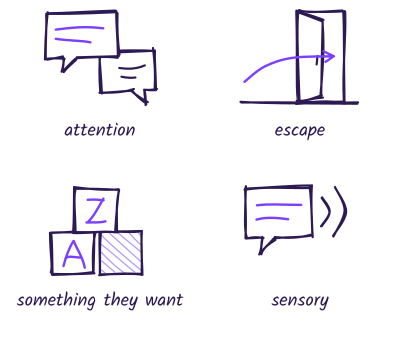
Functions of behavior
A behavior's function is the payoff that keeps it going, like attention, escape from a demand, an item, or a reward the behavior creates itself.
Definition →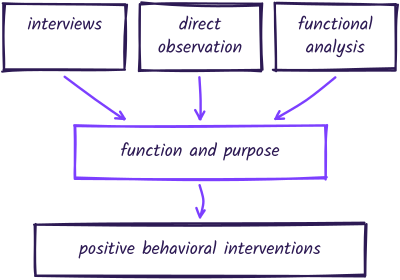
Functional behavior assessment (FBA)
A functional behavior assessment (FBA) is a structured process for working out why a specific behavior happens, so the team can plan better alternatives.
Definition →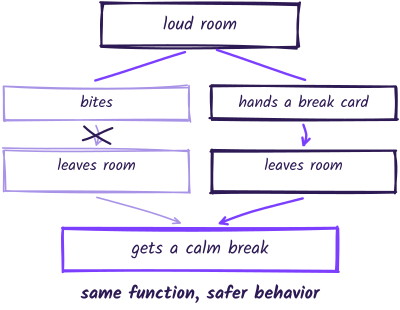
Replacement behavior
A replacement behavior is a safer, more useful action taught in place of a challenging behavior, chosen to meet the same need.
Definition →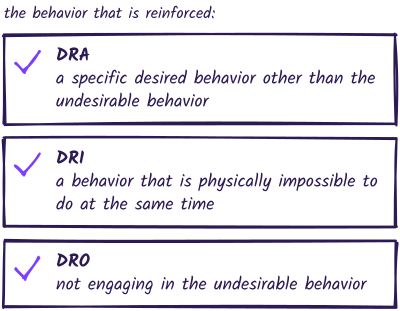
Differential reinforcement
Differential reinforcement means giving positive consequences for a chosen behavior, or for not doing a problem behavior, so the better behavior grows.
Definition →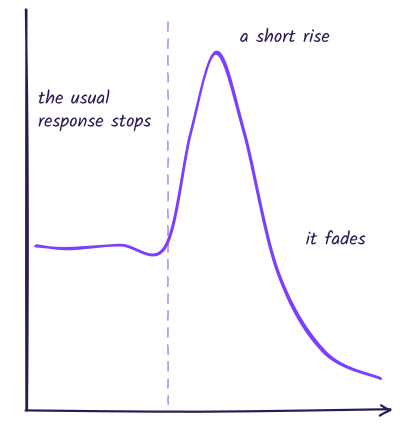
Extinction and extinction burst
Extinction means a behavior stops getting the payoff that kept it going; an extinction burst is a short rise in that behavior before it drops.
Definition →