

ABA Therapy Glossaryfor Parents
All termsNonverbal and minimally verbal autism
Nonverbal or minimally verbal autism describes autistic children who use no spoken words or only a few. It describes speech, not understanding.
What it means
Nonverbal or minimally verbal autism means an autistic child uses no spoken words or only a few. Newer research also says "nonspeaking," and the label is about speech alone. It isn't a separate diagnosis or one of the levels of autism. It also doesn't measure what a child understands. Some of these children understand much more than they can say.
There's no agreed cutoff, and studies use different word counts and ages. Many young children with autism aren't talking yet and later learn to talk. So the label fits older children better than toddlers. A 2013 review by Tager-Flusberg and Kasari found that about 3 in 10 autistic children of school age stay minimally verbal.
What it looks like for your child
Your child can still communicate without speech. Goals can include gestures such as sign language, or pictures used to share thoughts, as in picture exchange communication. Devices that speak for your child are another option. All of these are forms of augmentative and alternative communication (AAC). The American Speech-Language-Hearing Association (ASHA) says a child doesn't need any skills first to start AAC. It also says AAC may help speech when it's used with other ways to communicate.
What to ask your BCBA
- Understanding and speaking: Ask your child's speech-language pathologist (SLP) to check what your child understands separately from what they say.
- A hearing test: Ask whether your child has had a hearing test, since an SLP may refer your child for one to make sure their hearing is normal.
- AAC in therapy: Ask your Board Certified Behavior Analyst (BCBA) how your child's AAC system will be used in sessions and at home.
Is your child using few or no words?
A short screener can help you decide what to raise with your pediatrician.

Sources
- National Institute on Deafness and Other Communication Disorders (NIDCD), autism and communication problems (April 2020).
- American Speech-Language-Hearing Association (ASHA), AAC Practice Portal.
- Tager-Flusberg and Kasari (2013), minimally verbal school-aged children, Autism Research 6(6).
- Koegel et al. (2020), defining nonverbal and minimally verbal, Journal of Autism and Developmental Disorders 50(8).
Related terms
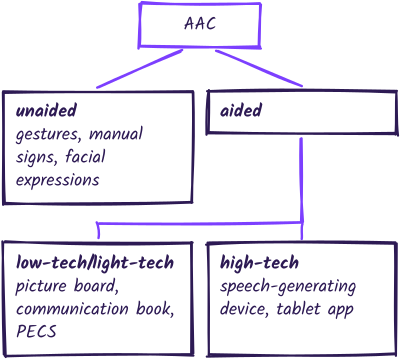
AAC (augmentative and alternative communication)
Augmentative and alternative communication (AAC) is any way of communicating that adds to speech or stands in for it, from gestures to speech devices.
Definition →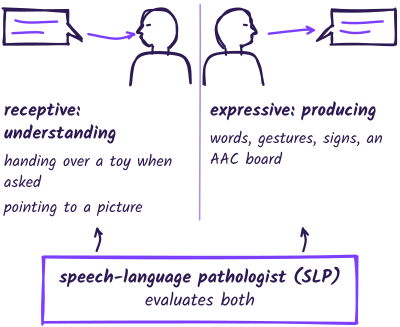
Receptive and expressive language
Receptive language is understanding what others say, and expressive language is sharing thoughts and needs through words, gestures, signs or writing.
Definition →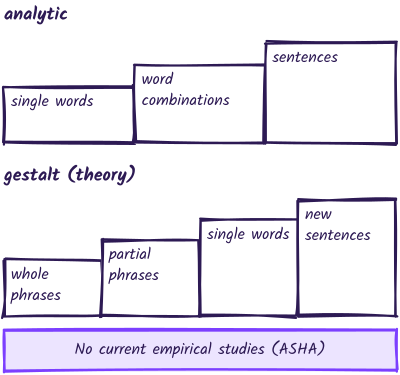
Gestalt language processing
Gestalt language processing is the idea that some children learn language in whole chunks first, like lines from shows, before single words.
Definition →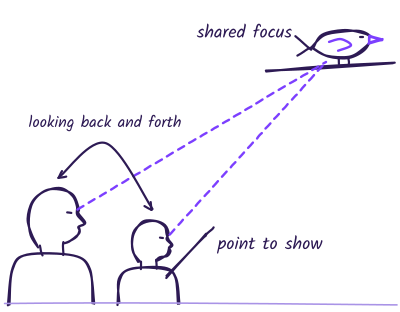
Joint attention
Joint attention is two people sharing focus on the same thing, like a child following a parent's point or pointing to show something.
Definition →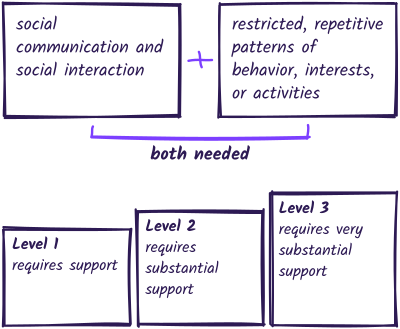
Autism spectrum disorder (ASD)
Autism spectrum disorder (ASD) is a neurological and developmental condition that affects how people communicate, interact with others, learn and behave.
Definition →