

ABA Therapy Glossaryfor Parents
All termsAAC (augmentative and alternative communication)
Augmentative and alternative communication (AAC) is any way of communicating that adds to speech or stands in for it, from gestures to speech devices.
What it means
Augmentative and alternative communication (AAC) covers the ways people add to their speech or communicate without it. "Augmentative" means adding to speech, and "alternative" means in place of it. Unaided AAC uses only the body, such as gestures, signs and facial expressions. Aided AAC uses a tool. Low-tech tools include picture boards and communication books. High-tech tools include tablet apps and devices that turn words or pictures into speech.
A speech-language pathologist (SLP) assesses your child, suggests a system and teaches you both to use it. Many people use more than one method. AAC may help improve natural speech, and research reviews found it doesn't hold speech back, though the gains were modest.
What it looks like for your child
Your child might point to pictures, sign, or tap words on a tablet app that speaks them aloud. One low-tech program, the Picture Exchange Communication System (PECS), is based on applied behavior analysis (ABA). It starts with your child handing over one picture to ask for something they want. Children younger than 3 can start using AAC. There's no test score or milestone they need to reach first. Your child's ABA team can help them use it in sessions, while the SLP leads the assessment.
What to ask your BCBA
- Working with the SLP: Ask your Board Certified Behavior Analyst (BCBA) how they'll work with your child's SLP on AAC.
- Using it in sessions: Ask how your child's AAC system will be part of therapy goals and daily routines.
- Paying for it: Ask your insurance whether it covers the tool your SLP recommends, since some AAC tools are covered and some aren't.
Want your child's AAC used in therapy and at home?
A BCBA can work with your child's SLP so the system shows up in sessions and daily routines.

Sources
- American Speech-Language-Hearing Association, Augmentative and Alternative Communication, Practice Portal.
- Communication Health Support Association, with ASHA expertise, AAC for families.
- National Institute on Deafness and Other Communication Disorders (2019), Assistive Devices.
Related terms
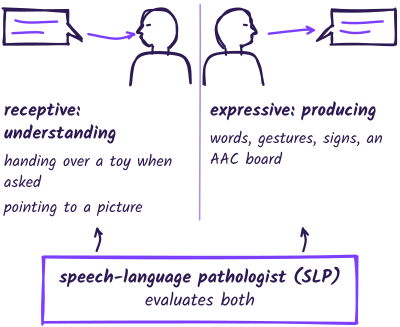
Receptive and expressive language
Receptive language is understanding what others say, and expressive language is sharing thoughts and needs through words, gestures, signs or writing.
Definition →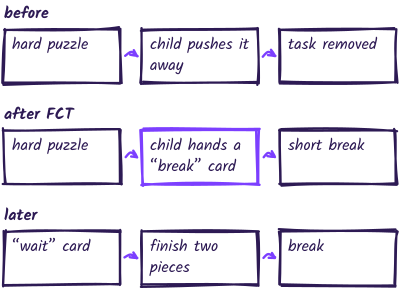
Functional communication training (FCT)
Functional communication training (FCT) teaches a child a clear way to ask for what a challenging behavior was getting them.
Definition →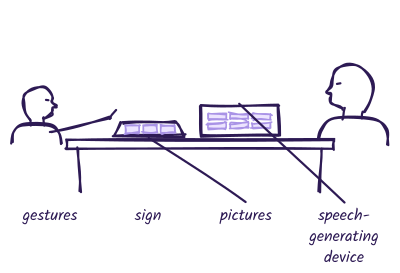
Nonverbal and minimally verbal autism
Nonverbal or minimally verbal autism describes autistic children who use no spoken words or only a few. It describes speech, not understanding.
Definition →