

ABA Therapy Glossaryfor Parents
All termsGestalt language processing
Gestalt language processing is the idea that some children learn language in whole chunks first, like lines from shows, before single words.
What it means
Gestalt language processing (GLP) is the idea that some children learn language in whole chunks first. A chunk might be a line from a show or a song. Later, the child breaks those chunks into single words and builds new sentences. "Gestalt" means "whole." The idea grew out of research on delayed echolalia, which is repeating phrases heard earlier. A speech-language pathologist (SLP), Marge Blanc, turned it into a staged program called Natural Language Acquisition (NLA).
The American Speech-Language-Hearing Association (ASHA) says there are no current studies that test GLP. It says SLPs can consider the theory but should take care not to apply it to all autistic children. A 2024 analysis says the theory behind NLA lacks research support, though critics don't call the idea disproven. One 2024 paper calls GLP neurodiversity-affirming, while a 2025 paper says that label is premature.
What it looks like for your child
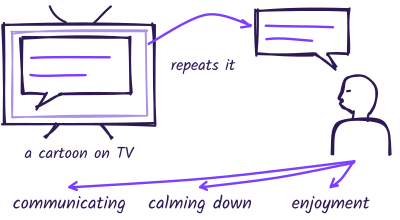
Your child might repeat whole phrases from shows or past conversations. That's delayed echolalia, and it's well documented. Whether your child is a "gestalt language processor" is a theory, and it isn't a diagnosis. Both sides agree that repeated phrases can be a way to talk and deserve respect. So treat your child's scripts as tries at talking with you, and bring them up with your child's speech therapist.
What to ask your BCBA
- The evidence: If your child's SLP mentions GLP, ask what evidence supports the plan.
- Measuring progress: Ask the SLP how progress will be measured and how often you'll see it.
- One team: Ask your Board Certified Behavior Analyst (BCBA) how therapy will respond to your child's scripts and fit with the speech plan.
Is your child talking in whole lines from shows and songs?
A short screener is a simple first step before you talk with your child's doctor.

Sources
- American Speech-Language-Hearing Association (ASHA), Autism Practice Portal, assessment and treatment sections.
- Hutchins, Knox and Fletcher (2024), a critical analysis of NLA, Autism and Developmental Language Impairments 9.
- Venker and Lorang (2025), echolalia and gestalt language development, Autism 29(3).
- Lorang, Mathée-Scott, Johnson and Venker (2026), response on GLP and NLA, Perspectives of the ASHA Special Interest Groups 11(1).
Related terms
Scripting
Scripting is when a child repeats lines heard earlier, from TV shows, movies, songs or past conversations, often called delayed echolalia.
Definition →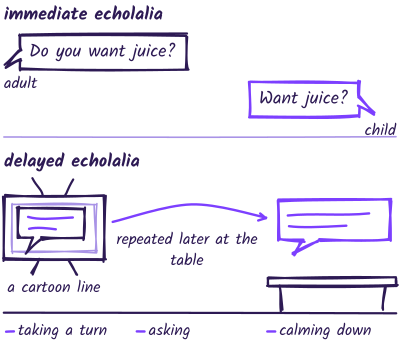
Echolalia
Echolalia is repeating words or phrases that someone else said, either right after hearing them or much later.
Definition →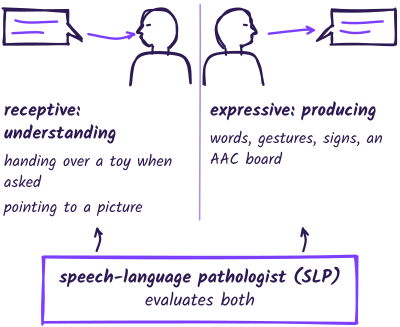
Receptive and expressive language
Receptive language is understanding what others say, and expressive language is sharing thoughts and needs through words, gestures, signs or writing.
Definition →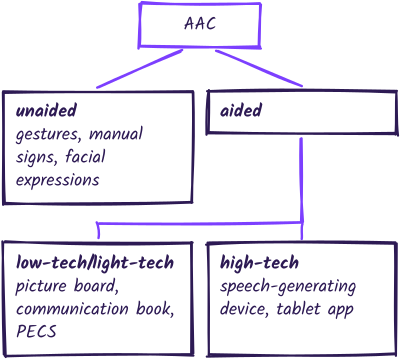
AAC (augmentative and alternative communication)
Augmentative and alternative communication (AAC) is any way of communicating that adds to speech or stands in for it, from gestures to speech devices.
Definition →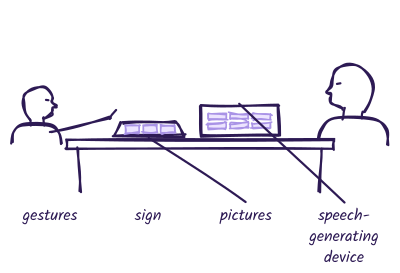
Nonverbal and minimally verbal autism
Nonverbal or minimally verbal autism describes autistic children who use no spoken words or only a few. It describes speech, not understanding.
Definition →