

ABA Therapy Glossaryfor Parents
All termsNeurodivergent
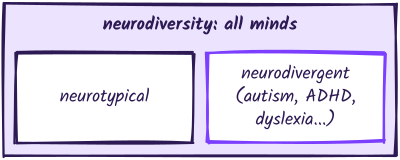
Neurodivergent describes a person whose brain works differently from what society treats as typical, such as an autistic person or someone with dyslexia.
What it means
Neurodivergent describes a person whose brain works in ways that differ from what most people see as typical. The word for most other people is neurotypical. It's often used for autistic people, and many people with dyslexia and other conditions have joined the movement behind it. No source gives a fixed list of who counts. Like other words in autism and neurodiversity language, it describes who a person is, and it isn't a diagnosis or another word for autism.
The word grew out of a movement that autistic self-advocates began. The National Autistic Society says Kassiane Asasumasu coined it in 2000. The movement asks for respect. It holds that a brain that works this way is no less worthy than a typical one. People in the movement disagree on some big ideas, and views on therapy differ, too. Some writers reject therapy that tries to make people seem more typical, while two behavior analysts say people with very high support needs gain a lot from behavior analysis.
What it looks like for your child
You may hear the word from other parents, teachers or your child's doctors. On its own, it doesn't tell you what your child needs. A child still needs an evaluation to get an autism diagnosis or a diagnosis of another condition. Support and acceptance can go together, too. One view in the movement still backs teaching daily skills that help a person do well.
What to ask your BCBA
- How goals are chosen: Ask your Board Certified Behavior Analyst (BCBA) how goals are chosen and whether your child's own wishes shape them.
- Skills that help: Ask which daily skills the plan teaches and how each one helps your child.
- Checking for autism: If you're unsure whether your child is autistic, ask your pediatrician about an evaluation.
Heard the word neurodivergent and wondering about your child?
A short screener can help you decide whether to ask your pediatrician about an evaluation.

Sources
- National Autistic Society, The neurodiversity movement.
- Shaw et al. (2025), the neurodiversity paradigm, Medical Education 59(5).
- Dwyer (2022), the neurodiversity approaches, Human Development 66(2).
- Nicolosi and Dillenburger (2025), a behavior analyst's perspective, Perspectives on Behavior Science 48(3).
Related terms
Neurotypical
Neurotypical describes a person whose brain develops and works the way most people's do; it's the counterpart of neurodivergent, not a diagnosis.
Definition →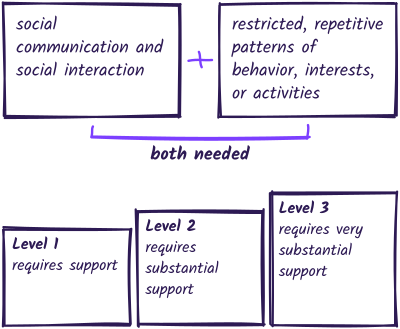
Autism spectrum disorder (ASD)
Autism spectrum disorder (ASD) is a neurological and developmental condition that affects how people communicate, interact with others, learn and behave.
Definition →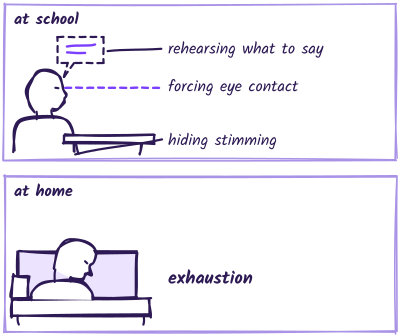
Masking
Masking, also called camouflaging, is when an autistic person hides or makes up for autistic traits, on purpose or not, to appear non-autistic.
Definition →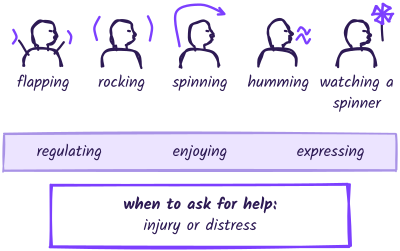
Stimming
Stimming, short for self-stimulating behavior, is a repeated movement or sound, such as hand flapping, rocking, spinning or humming.
Definition →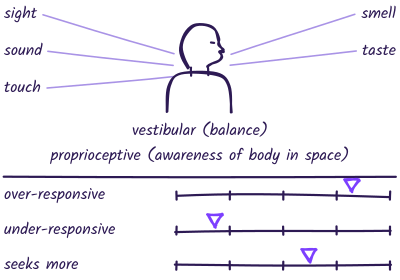
Sensory processing differences
Sensory processing differences describe how a child notices and reacts to sights, sounds, touch, movement and other input, more or less strongly than others.
Definition →