

ABA Therapy Glossaryfor Parents
All termsEcholalia
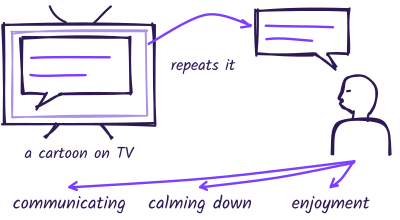
Echolalia is repeating words or phrases that someone else said, either right after hearing them or much later.
What it means
Echolalia is when your child repeats words or phrases that someone else said. With immediate echolalia, the repeat comes right away or a few minutes later. The delayed kind comes much later, and many people call it scripting. Many toddlers who aren't autistic repeat speech too while they learn to talk, and they do it less as their language grows.
U.S. health agencies list echolalia among the signs of autism, but repeating words alone doesn't mean a child is autistic. Early behavior research said it had no meaning. Later research found a child can use it to take a turn, label, ask, agree or protest. It can also help some children learn language or calm down. Some behavior analysis studies still aim to reduce it, while Cohn and colleagues argue against trying to stop all of it.
What it looks like for your child
You might ask your child about juice and hear "want juice" back, or hear a cartoon line again at dinner. Autistic children who are deaf or hard of hearing may echo signs, called manual echolalia. It often depends on the setting, so it helps to note when and where it happens. In speech therapy, a speech-language pathologist (SLP) looks at what your child's repeating is for. It's worth raising with your pediatrician or an SLP if you see it along with other signs.
What to ask your BCBA
- What it does for your child: Ask your Board Certified Behavior Analyst (BCBA) what your child's echolalia seems to do, such as taking a turn, asking or calming down.
- Working with speech therapy: Ask how your BCBA and your child's SLP will share what each of them sees.
- Goals about echolalia: If a goal targets echolalia, ask why and what your child gains from it.
Hearing your child repeat what you just said?
A short screener helps you decide whether it's worth raising with your pediatrician.

Sources
- American Speech-Language-Hearing Association (ASHA), Autism, Practice Portal.
- Centers for Disease Control and Prevention, Signs and Symptoms of Autism.
- Gernsbacher, Morson and Grace (2016), Language and speech in autism, Annual Review of Linguistics 2.
- Cohn, McVilly, Harrison and Stiegler (2022), Repeating purposefully, Autism and Developmental Language Impairments 7.
Related terms
Scripting
Scripting is when a child repeats lines heard earlier, from TV shows, movies, songs or past conversations, often called delayed echolalia.
Definition →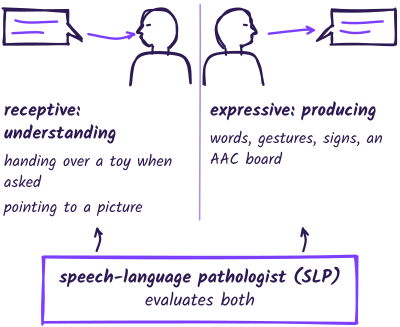
Receptive and expressive language
Receptive language is understanding what others say, and expressive language is sharing thoughts and needs through words, gestures, signs or writing.
Definition →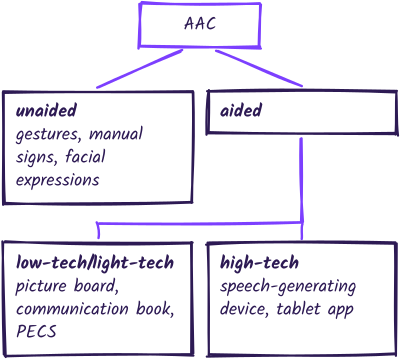
AAC (augmentative and alternative communication)
Augmentative and alternative communication (AAC) is any way of communicating that adds to speech or stands in for it, from gestures to speech devices.
Definition →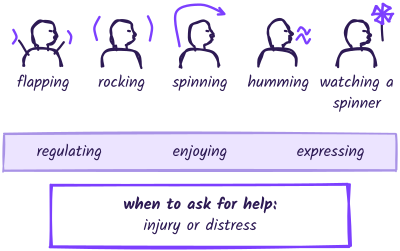
Stimming
Stimming, short for self-stimulating behavior, is a repeated movement or sound, such as hand flapping, rocking, spinning or humming.
Definition →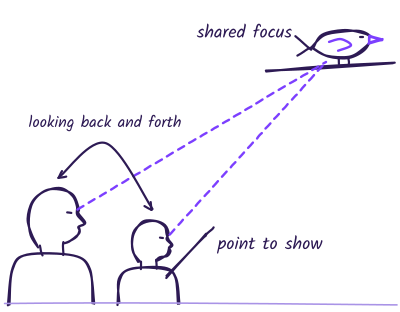
Joint attention
Joint attention is two people sharing focus on the same thing, like a child following a parent's point or pointing to show something.
Definition →