

ABA Therapy Glossaryfor Parents
All termsExplanation of benefits (EOB)
An explanation of benefits (EOB) is a statement your health plan sends after a claim, showing what it paid and what you may owe.
What it means
An explanation of benefits (EOB) is a statement your health plan sends after it processes a claim. A claim is the request for payment your provider sends your plan. The EOB shows the date of service, the provider's charge and the allowed charges, which is what your provider will be paid. It also shows what the plan paid and what you may owe. An EOB isn't a bill.
Labels vary, so the amount you owe might appear as "member responsibility" on yours. The EOB may also list a claim number, billing codes and remark codes, which are notes from the plan about the costs. It also tracks how close you are to your deductible and out-of-pocket limit.
What it looks like for your child
For applied behavior analysis (ABA), an EOB may list ABA billing codes such as 97153 and the number of 15-minute units. Wait for your provider's bill before you pay, and compare the two. Your bill shouldn't be higher than what the EOB says you owe, though the EOB won't show whether you've already paid part of it.
An EOB can also show a denial, such as for an out-of-network provider or a missing prior authorization (your plan's sign-off before care starts). The denial code gives the reason, and your appeal rights may be on the EOB. If a plan refuses to pay a claim, you have the right to appeal and have a third party review it.
What to ask your BCBA
- Ask the billing team: Ask your provider's billing team to match each EOB to its bill and explain any gap.
- Ask your plan about a denial: Ask your plan what a remark or denial code means and how to appeal.
- Ask about codes and units: Ask the billing team which codes and how many units your child's sessions should show.
Got an EOB for your child's ABA and not sure what it means?
Your EOB may list ABA as billing codes and units of time, which you can check against your provider's bill.

Sources
- Centers for Medicare & Medicaid Services (2026), How to read an EOB.
- HealthCare.gov glossary: Claim and Appeal.
- South Dakota Division of Insurance, Explanation of Benefits.
- Iowa Insurance Division (2024), What is an EOB.
Related terms

Deductible, copay and out-of-pocket maximum
You pay the deductible before your plan starts paying, then usually a copay or coinsurance, up to a yearly out-of-pocket maximum for covered in-network care.
Definition →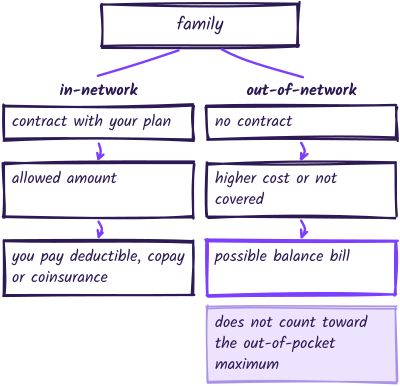
In-network vs out-of-network
An in-network provider has a contract with your health plan, while an out-of-network provider doesn't, which usually means you pay more.
Definition →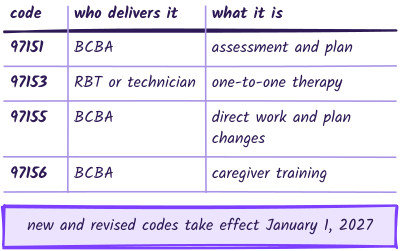
CPT codes for ABA
CPT (Current Procedural Terminology) codes are the billing codes on claims, and ABA uses a set billed in 15-minute units, with changes starting January 2027.
Definition →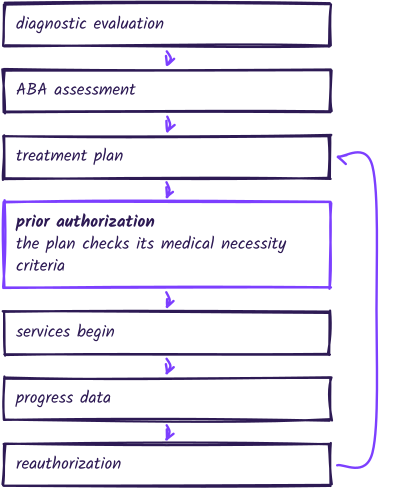
Medical necessity and prior authorization
Medical necessity means care is needed to diagnose or treat a condition, and prior authorization is your plan's approval of a service before it begins.
Definition →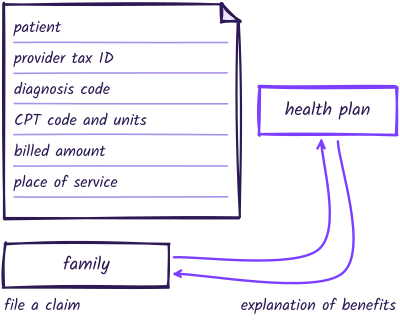
Superbill
A superbill is an itemized receipt from an out-of-network provider that you can send to your health plan to ask for reimbursement.
Definition →