

ABA Therapy Glossaryfor Parents
All termsCPT codes for ABA
CPT (Current Procedural Terminology) codes are the billing codes on claims, and ABA uses a set billed in 15-minute units, with changes starting January 2027.
What it means
CPT (Current Procedural Terminology) codes are the five-digit codes providers put on insurance claims. The American Medical Association publishes them, and applied behavior analysis (ABA) uses a group called adaptive behavior services. In the current set, these are 97151 to 97158, billed in 15-minute units. Providers use them to bill private insurance and Medicaid.
A revised set starts on January 1, 2027. It updates what 97151 to 97158 describe and adds six new codes. One new code, 97180, is for some work a qualified professional does away from your child. Payers adopt new codes on their own timelines, so early in 2027 you might see old or new codes.
What it looks like for your child
On a claim or explanation of benefits (EOB), the code shows who gave a service and what kind it was. In the current set, 97151 is assessment and planning by your Board Certified Behavior Analyst (BCBA). Code 97153 is one-to-one therapy by a behavior technician who follows the plan, and it's billed most often. Code 97155 is the BCBA working with your child and adjusting the plan. Code 97156 is caregiver training for your family, with or without your child there.
Because of the 15-minute units, a claim shows units of time, not hours. A code describes a service, and it doesn't mean your plan covers it.
What to ask your BCBA
- Ask the billing team: Ask your provider's billing team which codes your child's sessions will use and how many units each will bill.
- Ask your plan about 2027: Ask your plan when it will start using the 2027 codes for ABA.
- Ask your BCBA about the mix: Ask how your child's plan splits time between technician therapy, BCBA time and caregiver training.
Seeing codes like 97153 on your child's claims?
Each code shows who delivered a service and what kind it was, such as technician therapy or caregiver training.

Sources
- Centers for Medicare & Medicaid Services (2026), Medicaid ABA Toolkit, pp. 71 to 72 and 161 to 163.
- ABA Coding Coalition, 2027 billing codes and 2027 code crosswalk (September 2026).
- ABA Coding Coalition, Frequently asked questions (2019 code set).
Related terms

Explanation of benefits (EOB)
An explanation of benefits (EOB) is a statement your health plan sends after a claim, showing what it paid and what you may owe.
Definition →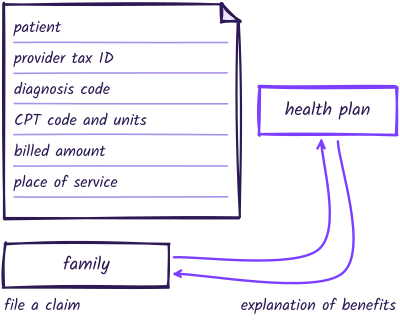
Superbill
A superbill is an itemized receipt from an out-of-network provider that you can send to your health plan to ask for reimbursement.
Definition →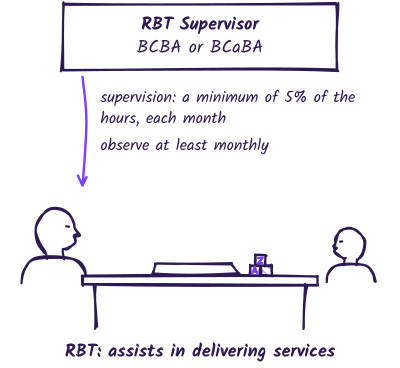
RBT (behavior technician)
An RBT (Registered Behavior Technician) is a certified paraprofessional who delivers day-to-day ABA sessions under close supervision from a BCBA or BCaBA.
Definition →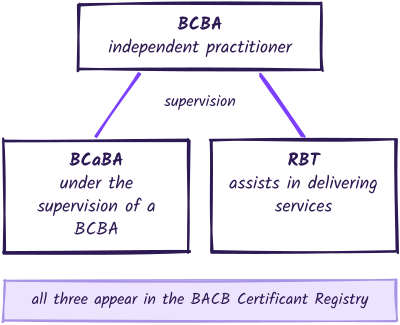
BCBA
A BCBA (Board Certified Behavior Analyst) holds a graduate-level certification and designs and oversees ABA programs, including supervising behavior technicians.
Definition →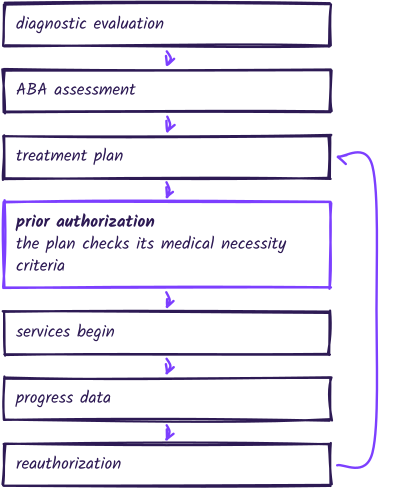
Medical necessity and prior authorization
Medical necessity means care is needed to diagnose or treat a condition, and prior authorization is your plan's approval of a service before it begins.
Definition →