

ABA Therapy Glossaryfor Parents
All termsSuperbill
A superbill is an itemized receipt from an out-of-network provider that you can send to your health plan to ask for reimbursement.
What it means
A superbill is a detailed receipt for care you've already paid for. An out-of-network provider gives it to you, and you send it to your health plan to ask for some or all of the cost back. In-network providers file claims with your plan themselves. A claim is a request for payment for care you think your plan covers.
For each date of service, a superbill lists the patient, the provider's tax ID and the diagnosis codes. It also lists the procedure codes, the units and fee for each code, and a place of service code. Missing details can delay payment or stop it. Some plans also want their own claim form with the superbill attached.
What it looks like for your child
Applied behavior analysis (ABA) is billed in 15-minute units, so an ABA superbill may list several codes, each with its units. Whether your plan pays anything back depends on your out-of-network benefits and deductible. The plan pays based on its allowed amount, which isn't the same as the provider's fee. Its answer comes back as an explanation of benefits (EOB).
What to ask your BCBA
- Ask your plan first: Ask your plan whether you have out-of-network benefits and whether they apply to ABA.
- Ask about claim forms: Ask your plan whether it needs its own claim form and where to send it.
- Ask the provider's billing team: Ask whether each superbill will list codes, units and the place of service for every date.
Weighing in-network ABA against paying out of network?
In-network providers file claims for you, while out-of-network care often means filing your own superbill.

Sources
- University of Maryland, Baltimore, Student Counseling Center (2026), Insurance Explained, pp. 2 to 4.
- UnitedHealthcare, Medical Claim Form, p. 1.
- HealthCare.gov glossary: Claim, UCR and Out-of-network coinsurance.
- Centers for Medicare & Medicaid Services (2026), Medicaid ABA Toolkit, p. 161.
Related terms
In-network vs out-of-network
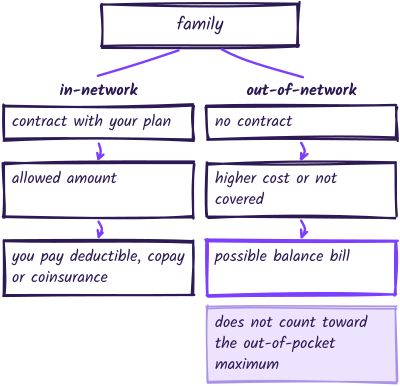
An in-network provider has a contract with your health plan, while an out-of-network provider doesn't, which usually means you pay more.
Definition →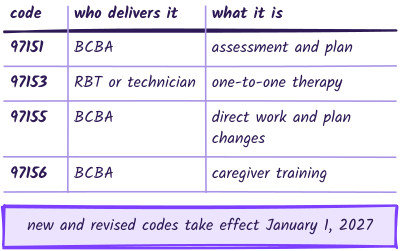
CPT codes for ABA
CPT (Current Procedural Terminology) codes are the billing codes on claims, and ABA uses a set billed in 15-minute units, with changes starting January 2027.
Definition →
Explanation of benefits (EOB)
An explanation of benefits (EOB) is a statement your health plan sends after a claim, showing what it paid and what you may owe.
Definition →
Deductible, copay and out-of-pocket maximum
You pay the deductible before your plan starts paying, then usually a copay or coinsurance, up to a yearly out-of-pocket maximum for covered in-network care.
Definition →