

ABA Therapy Glossaryfor Parents
All termsAssent and neurodiversity-affirming ABA
Assent is a child's own willingness to take part, and neurodiversity-affirming ABA is an approach that sees autism as a difference rather than a deficit.
What it means
Assent is your child's own willingness to take part, shown in words or actions. The Behavior Analyst Certification Board (BACB) says assent can be shown with or without speech. It applies to people who can't give legal consent, such as young children. You give consent as the parent, and assent is your child's ongoing yes or no. The BACB requires assent when it applies, but it sets no fixed steps, and researchers say the term still lacks a full definition.
Neurodiversity-affirming applied behavior analysis (ABA) sees autism as a difference rather than a deficit. It centers your child's values and interests. It also doesn't target stimming by default, since autistic advocates say stimming can help them calm down and focus.
The label has no agreed meaning, and it isn't a credential. People in the field also debate parts of ABA. One group of researchers says honoring assent would end the field's reliance on compliance training. Another defends ABA and also supports neurodiversity.
What it looks like for your child
Signs of assent can include your child coming toward the materials, the space or the therapist. Signs of withdrawal can be a spoken "no," or they can be silent, like turning away or leaving the work area. In assent-based ABA, the team checks assent all through each session rather than once at intake, and it changes the activity when your child pulls away. One research team notes that forcing a child to take part may lead to more challenging behavior.
What to ask your BCBA
- Recognizing assent: When choosing an ABA provider, ask how the team recognizes your child's assent and withdrawal.
- When your child says no: Ask what happens in a session when your child says no or moves away.
- Stimming and interests: Ask whether the plan targets stimming, why, and how your child's interests shape the goals.
Wondering how therapy would respect your child's yes and no?
Ask any BCBA how they recognize your child's assent and what happens when your child says no.

Sources
- Behavior Analyst Certification Board (2020, updated 2024), Ethics Code for Behavior Analysts, pp. 4, 7 and 11.
- Breaux and Smith (2023), Assent in ABA and PBS, International Journal of Developmental Disabilities.
- Mathur, Renz and Tarbox (2024), Affirming neurodiversity within ABA, and Allen et al. (2026), Neurodiversity-affirming ABA, Behavior Analysis in Practice.
- Leaf et al. (2022), Concerns about ABA-based intervention, Journal of Autism and Developmental Disorders.
Related terms
Stimming
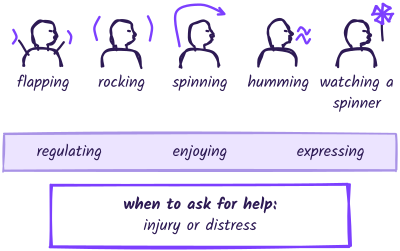
Stimming, short for self-stimulating behavior, is a repeated movement or sound, such as hand flapping, rocking, spinning or humming.
Definition →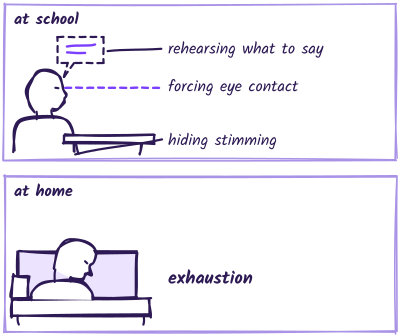
Masking
Masking, also called camouflaging, is when an autistic person hides or makes up for autistic traits, on purpose or not, to appear non-autistic.
Definition →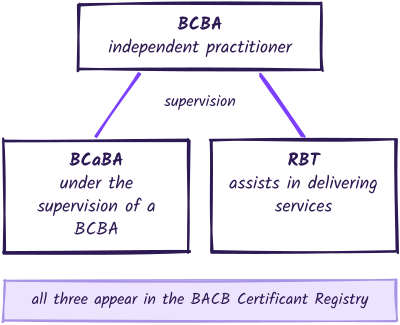
BCBA
A BCBA (Board Certified Behavior Analyst) holds a graduate-level certification and designs and oversees ABA programs, including supervising behavior technicians.
Definition →
Neurodivergent
Neurodivergent describes a person whose brain works differently from what society treats as typical, such as an autistic person or someone with dyslexia.
Definition →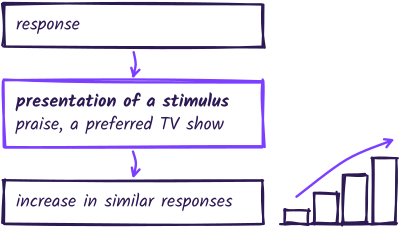
Positive reinforcement
Positive reinforcement happens when something is added after a behavior, like praise or a favorite activity, and the behavior then happens more often.
Definition →