

ABA Therapy Glossaryfor Parents
All termsAdaptive and daily living skills
Adaptive skills are the everyday skills a person needs to get through the day. Daily living skills, like dressing and hygiene, are one part.
What it means
Adaptive skills are the everyday skills a person needs to take care of themselves and get through the day. One expert group sorts them into three kinds: thinking and language skills, social skills, and hands-on skills for daily life. Daily living skills, also called self-help or self-care skills, are that last kind. They include eating, dressing, toileting and hygiene, and later cooking, chores, money and getting around.
Clinicians measure these skills by asking caregivers questions and by using rating scales. One such scale is the Vineland Adaptive Behavior Scales, Third Edition (Vineland-3). The results help set therapy and school goals. Many children with autism have daily living skills below what their thinking skills would predict. So these skills are often a focus of applied behavior analysis (ABA). A 2015 study found they kept growing through childhood and the teen years.
What it looks like for your child
A goal might be using the toilet, washing hands, getting dressed or brushing teeth. The Vineland-3 has a form for parents, so you're one of the main sources of information about these skills. In studies, autistic people have learned hygiene, making food and cleaning through self-management. That means a person tracks their own behavior and rewards themselves.
What to ask your BCBA
- How skills are measured: Ask your Board Certified Behavior Analyst (BCBA) which assessment the team uses and how your answers feed into it.
- Which skills come first: Ask which daily living skills the plan targets first and why.
- Working with other therapists: Ask whether your child's occupational therapist is working on any of the same skills.
Want help teaching dressing, toileting or other daily routines?
A BCBA looks at your child's everyday skills and builds goals for them with you.

Sources
- American Association on Intellectual and Developmental Disabilities, Defining Criteria for Intellectual Disability.
- Centers for Medicare & Medicaid Services (CMS), Medicaid ABA Toolkit, pp. 12 and 23 (August 2026).
- Pearson Assessments, Vineland-3 product page.
- Bal, Kim, Cheong and Lord (2015), daily living skills study, Autism 19(7).
Related terms
Task analysis
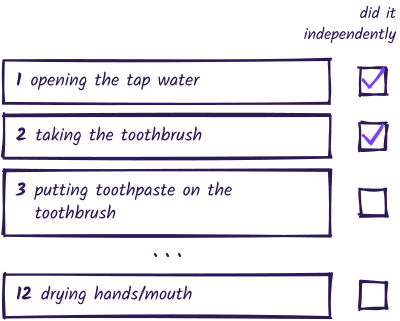
A task analysis breaks a skill or routine into small, manageable steps in order, so your child's team can assess it and teach it.
Definition →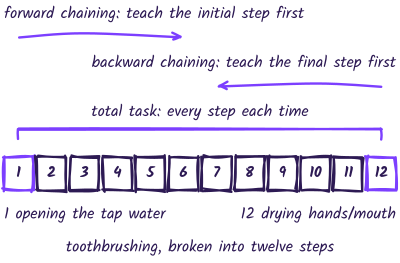
Chaining
Chaining teaches a multi-step skill, like brushing teeth, by breaking it into steps and teaching them until they link into one routine.
Definition →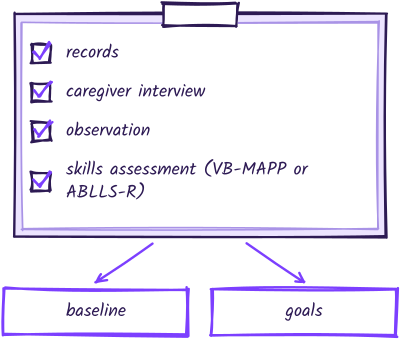
ABA assessment (VB-MAPP, ABLLS-R)
An ABA assessment is how a BCBA measures your child's strengths, missing skills and barriers to learning before writing a treatment plan.
Definition →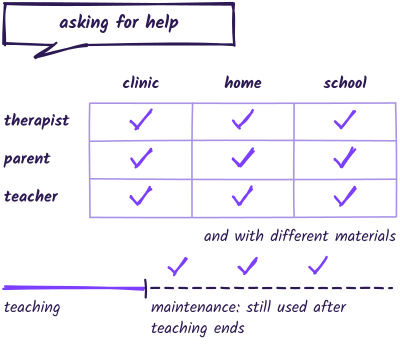
Generalization and maintenance
Generalization means your child uses a skill beyond where it was taught, and maintenance means they keep using it over time after teaching ends.
Definition →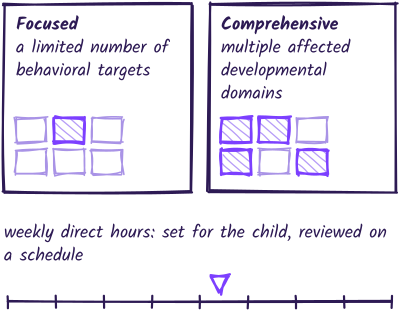
Treatment plan (comprehensive vs focused ABA)
An ABA treatment plan is the written, individualized plan your BCBA builds before services start, setting goals, methods, weekly hours and a review schedule.
Definition →