





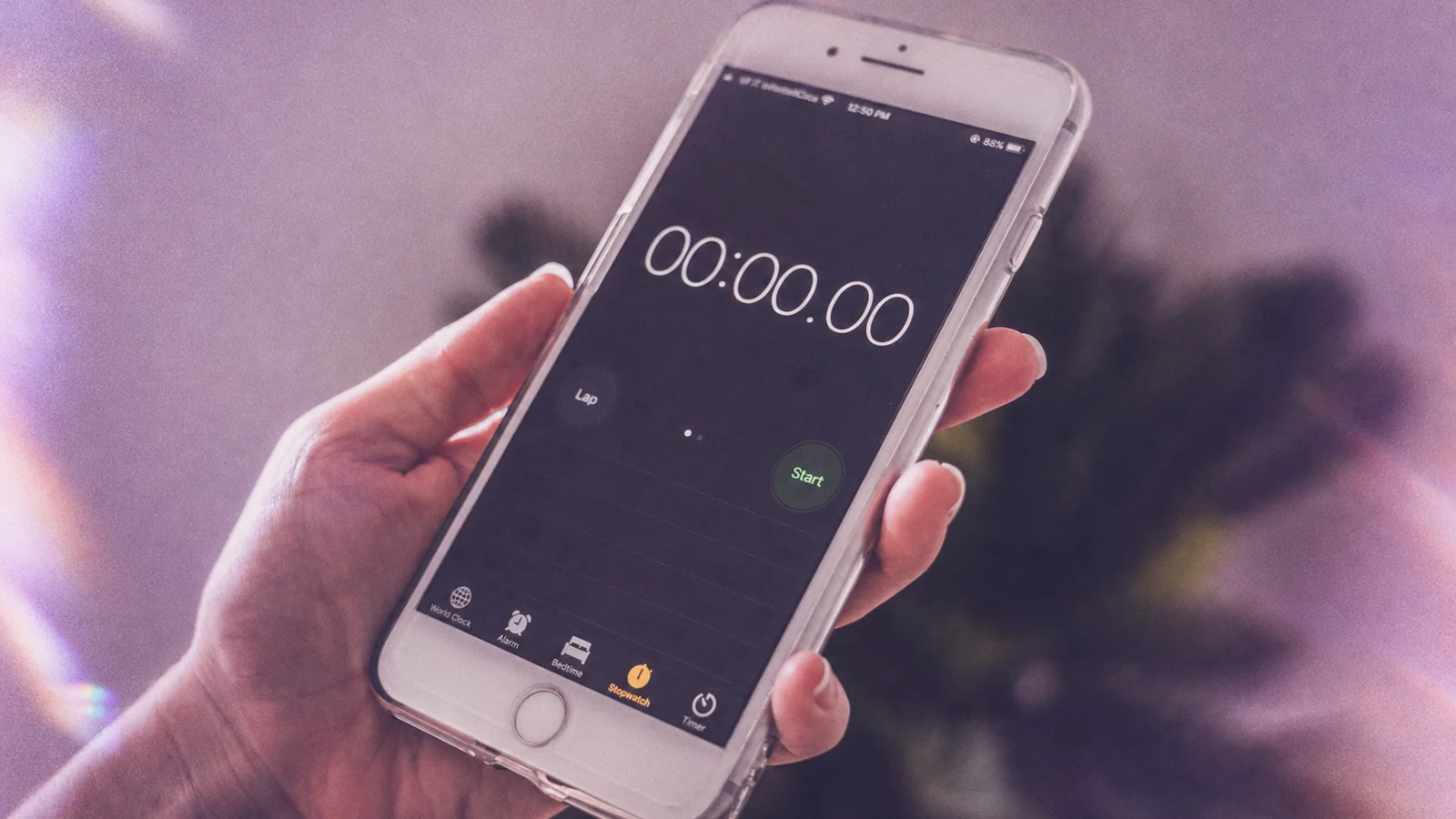
Latency in ABA is the time between a cue and the moment a response starts. A teacher says "Line up," and a learner starts walking 8 seconds later, so the latency is 8 seconds.
This article will help you record latency data and use it to set goals for your ABA practice.
Key takeaways
- Time to start: Latency counts the seconds from a cue to the first movement of a response and stops there.
- Where it helps: Latency shows slow starts to directions or tasks, and answers that begin too fast.
- Typical wait: Report the median and the range, because one slow trial can pull the mean far above a typical trial.
- Help with admin: If you'd like billing and payroll handled, read how Alpaca Health's Practice-In-A-Box supports independent ABA practices.
What is latency in ABA?
Latency in ABA is the time it takes for a behavior to start after a cue, also called the discriminative stimulus (SD). Latency recording means timing that wait on each trial, usually in seconds (LeBlanc and colleagues, 2016). How long the behavior lasts is its duration, and how many times it happens is its frequency.
A cue is anything that signals the learner to act, such as an instruction, a question, or a timer going off. Timing stops at the first movement of the response. For example, an RBT says "Wash your hands," and the learner reaches for the faucet 5 seconds later, so the latency is 5 seconds.
Let Alpaca Health draft your session notes.
Alpaca Health's HIPAA-compliant platform includes AI session notes and data collection, so your team spends less time on paperwork.
See it in action →
Why latency is important in ABA
Latency is important because it shows how quickly a learner starts to respond, which accuracy data cannot show. A learner may follow every instruction but wait 40 seconds before each one. Accuracy data would score every trial correct, while latency data would show the wait. That gives the team a clear target, such as cutting the wait from 40 seconds to 10. In one study, a 19-year-old's parents reported that his slow responding in daily life "limited his independence" (Tiger and colleagues, 2007).
When to measure latency in ABA
Measure latency when the main concern is how quickly a learner starts a response. Latency helps most when a learner is slow to follow directions, slow to start tasks, or starts responding before the cue ends. To count a behavior or time how long it lasts, use other ABA data collection methods.
Following directions
Measure latency when a learner takes a long time to begin following a direction. For example, an RBT asks, "Please put on your shoes," and the learner starts 45 seconds later. Timing each trial shows whether that wait shrinks from 45 seconds to 30, then to 10. The same timing works for any direction, such as "Sit down" or "Come here."
In one study, a token system shortened how long an 8-year-old boy took to follow four of five directions (Fjellstedt and Sulzer-Azaroff, 1973).
Slow starts on tasks
Measure latency when a learner can do a task but is slow to begin it. For example, a student hears "Start your worksheet" and picks up a pencil 2 minutes later. The skill is in place, so the time to start is what to track. Morning routines work the same way, such as the time from "Time to get dressed" to the first step.
Responding too fast
Measure latency when a learner responds before the cue is finished. For example, a learner shouts an answer before the teacher ends the question, so the latency is close to 0 seconds. In this case, the aim is a longer latency, such as a 3-second pause before answering. The data should show the wait rising toward that target.
How latency, duration, and interresponse time differ
Latency measures the wait before a response, and duration measures how long a response lasts. Interresponse time (IRT) measures the gap between two responses. The table below compares latency, duration, and IRT on how each one is timed.
| Latency | Duration | Interresponse time (IRT) | |
|---|---|---|---|
| Timer starts when | A cue is given | A response begins | A response ends |
| Timer stops when | The response begins | The same response ends | The next response begins |
| Question it answers | How long does the learner wait to start? | How long does the response last? | How much time passes between two responses? |
| ABA example | An RBT says "Clean up," and the learner starts 7 seconds later | A learner stays seated for 12 minutes | A learner lowers a hand, then raises it again 45 seconds later |
Choose latency when the start is the concern, duration when the length is the concern, and IRT when the pacing is the concern. Each measure can change on its own. In one study, a student got a series of easy requests before a math assignment. The student started sooner but worked about as long as before (Wehby and Hollahan, 2000).
How to measure latency in ABA
Define the cue and the first move of the response, set a time limit, and time each trial from the cue to that move. You can use paper and a stopwatch, or ABA data collection software with a built-in timer. A latency data sheet has six parts.
- Header: Write the client, date, observer, target behavior, and time limit at the top.
- Cue: Write the exact words or signal used in each trial.
- Time of cue: Note the clock time or timer start for each trial.
- Seconds to response: Record the time from the cue until the response started.
- Prompt: Mark whether the RBT gave a prompt, and which kind.
- Notes: Add anything that may have changed the result, such as noise or illness.
Define the cue and the start of the response
Write down the exact cue and the exact first move that counts as the start. For example, the cue is "Touch your nose," said once, and the start is the hand leaving the table. A written definition lets every observer stop the timer at the same moment. Say the cue the same way each trial, since "Touch nose" and "Can you touch your nose?" may get different wait times.
Also write down whether the timer starts when the cue begins or when it ends, because published studies do both. For spoken instructions, starting when the cue ends keeps a long instruction from adding seconds. Tiger and colleagues (2007) timed that way.
Set a time limit for each trial
Set a time limit, such as 30 seconds, and end the trial when it passes. Without a limit, one trial could run for minutes and delay the rest of the ABA therapy session. If the learner has not started by then, record "no response" and the limit, such as 30+. If the RBT then prompts, mark the prompt in that row so the response isn't counted as independent. Pick the limit before you begin and use the same one in every trial. Set the limit above the learner's usual wait, or most trials will end as "no response."
Time and record each trial
Start the timer when the cue begins or ends, whichever your definition says, and stop it at the first movement of the response. Write the seconds in the row for that trial right away. Add the prompt and any notes at the same time. Repeat until you have recorded every planned trial.
Cut admin time in your ABA practice.
Alpaca Health handles credentialing, authorizations, claims, and payroll for BCBAs who own an ABA practice. You keep full clinical control.
See how it works →
How to summarize latency data in ABA
Summarize each ABA therapy session's latency data with the median and the range. Then plot the median as one point per session on a line graph. In one sample ABA therapy session, an RBT said "Clean up the blocks" eight times, with a 30-second limit.
| Trial | Seconds to start |
|---|---|
| 1 | 3 |
| 2 | 4 |
| 3 | 2 |
| 4 | 5 |
| 5 | 3 |
| 6 | 22 |
| 7 | 4 |
| 8 | 30+ (limit reached, no response) |
The eight times add up to 73 seconds, so the mean is 73 ÷ 8 = 9.1 seconds. Trial 8 counts as 30 seconds, its limit, so the true mean is at least 9.1. To find the median, put the times in order: 2, 3, 3, 4, 4, 5, 22, 30+. The middle two values are both 4, so the median is 4 seconds. The range is 2 to 30+ seconds.
Six of the eight trials took 5 seconds or less, so the mean of 9.1 seconds overstates a typical trial. Trials 6 and 8 pull it up. The median of 4 seconds shows a typical trial. If no trial sits far from the rest, the mean and median will be close. Latency data are usually summarized as the mean for each session (LeBlanc and colleagues, 2016). So label the graph as the median and use it every ABA therapy session.
Report the median, the range, and the number of trials that hit the limit. Then plot 4 seconds as one point for this ABA therapy session, with dates along the bottom and seconds up the side. Note the 30-second limit on the graph.
How to write a latency goal in ABA
A latency goal names the learner, the cue, the target time, how many trials must meet it, and the deadline. For example, Maya will start within 5 seconds of "Clean up" in 4 of 5 trials across 3 ABA therapy sessions within 12 weeks.
Use the baseline median to set the first target. If the median is 20 seconds, aim for 15 or 10 first, and move to 5 when that is met. Review the graph each week, and change the target only when the median stays at or below it for several ABA therapy sessions. For a learner who answers too fast, write the goal the other way, such as waiting at least 3 seconds before answering.
Lowering the target in small steps is a form of shaping. Tiger and colleagues (2007) timed each trial to the finished answer. They set each session's target 10% below the mean time of the session before. Rewarding answers that beat each target cut a 19-year-old's mean time from 19.9 seconds to under 5 seconds by the third session.
Common latency recording mistakes to avoid
Common latency recording mistakes are stopping the timer late and starting it at different points. Others are averaging cues together and skipping accuracy and agreement checks.
- Stopping when the response ends: Stop the timer at the first move of the response. Stopping at the end adds the response's duration to the latency.
- Starting at different points: Start every trial at the same point of the cue, so a long instruction does not add seconds to some trials.
- Averaging different cues into one number: A 2-second wait for "Touch nose" and a 20-second wait for "Clean up" average to 11 seconds, which describes neither. Keep a separate line on the graph for each cue.
- Not checking accuracy: Score accuracy on the same trials, because a learner who is praised for speed may answer fast and be wrong. In one part of Tiger and colleagues' (2007) study, only speed earned tokens. The 19-year-old then gave a quick "I do not know" on 67% of the math problems he could solve with time.
- Skipping agreement checks: Have two observers time the same trials. For each trial, divide the shorter time by the longer and multiply by 100, so 4 seconds and 5 seconds give 80%. Average the results to score interobserver agreement.
How Alpaca Health helps your ABA practice use latency data
Alpaca Health helps your ABA practice use latency data by handling the admin work, which leaves you more time to review each learner's graph. It credentials you under the insurance contracts it already holds. After that, its team takes over the insurance and admin work, from authorizations and claims to payroll and compliance. A single clinic success lead helps you get your ABA practice launched.
Data collection, progress tracking, AI session notes and scheduling all sit on one platform. Your payouts are guaranteed every two weeks, even if an insurer delays, denies, or claws back a payment. If you'd like a walkthrough of the admin side for your ABA practice, book a demo.
See what your ABA practice could look like on Alpaca Health.
A demo walks you through AI session notes, billing, credentialing, and payroll on Alpaca Health.
Book a demo →
Frequently asked questions about latency in ABA
What is an example of latency in ABA?
An RBT says "Touch your nose," and the learner's hand starts moving toward the nose 6 seconds later, so the latency is 6 seconds. In discrete trial training, the time from each instruction to the start of the learner's response is also a latency.
Is latency on the RBT exam?
Yes. The BACB's RBT Test Content Outline, 3rd edition, lists latency under continuous measurement in task A.1. Frequency, duration, and interresponse time are listed with it. The outline applies to exams beginning in 2026. The 6th edition BCBA Test Content Outline lists latency under task C.4.
What is a latency-based functional analysis?
A latency-based functional analysis ends each test at the first problem behavior and records how long the behavior took to start. Like any functional analysis, it tests what keeps a problem behavior going. Sessions stop sooner, so the learner has fewer chances to repeat risky behavior. Thomason-Sassi and colleagues (2011) found that the latency and standard analyses agreed in 9 of 10 cases. The authors add that latency analyses may be more likely to flag a function that isn't really there.
How do you decrease latency in ABA?
Reinforce faster starts and fade any prompts over time to decrease latency in ABA. An RBT might give praise or a preferred item when a learner starts within 5 seconds, then lower the target to 3 seconds. A series of easy requests right before a harder one can also shorten the wait to comply (Mace and colleagues, 1988). You can write the target times into each learner's treatment plan. If you'd like Alpaca Health to handle billing while you work on faster starts, book a demo.
Looking for a change?
Start an ABA practice today — with none of the admin burden.