

ABA Therapy Glossaryfor Parents
All termsShaping
Shaping teaches a new behavior by reinforcing small steps that get closer and closer to the goal.
What it means
Shaping teaches a new behavior by reinforcing small steps that get closer and closer to the goal. At first, a rough version of the skill earns a reward. Later, only closer versions do, until your child reaches the target. It's related to prompting, which adds help, and to chaining, which links the steps of a routine, but it isn't the same as either.
Registered Behavior Technicians (RBTs) carry out shaping, and Board Certified Behavior Analysts (BCBAs) plan it. In research studies, the steps are often planned ahead of time. Cihon and colleagues also describe flexible shaping, where the clinician moves the bar up or down in the moment. They say it may be common in practice. If a step is too big and your child struggles, the team can go back to an easier one.
What it looks like for your child
In one study, a child with autism was afraid of certain figures. Lines of tape on the floor marked each step, and the child earned rewards for moving a little closer each time. Shaping has also been used to help children with autism accept more foods, and to build simple requests into more complex ones. Each small improvement earns a reward until your child reaches the next step, so progress counts along the way.
What to ask your BCBA
- The goal and the steps: Ask your BCBA what the target skill is and what the first few steps look like.
- When a step is too hard: Ask what the team does if your child gets stuck or upset at a step.
- Practicing at home: Ask which step your child is on, so you reward the same version at home.
Want each small step toward a new skill to count?
A BCBA sets the steps for your child and adjusts them when a step is too big.

Sources
- American Psychological Association, APA Dictionary of Psychology, "shaping" and "method of successive approximations."
- Behavior Analyst Certification Board (BACB), RBT Test Content Outline (3rd ed.), C.10, and BCBA Test Content Outline (6th ed.), G.11.
- Ricciardi, Luiselli and Camare (2006), shaping approach responses, Journal of Applied Behavior Analysis 39(4).
- Cihon et al. (2019), flexible shaping study, Behavior Analysis in Practice 12(1).
Related terms
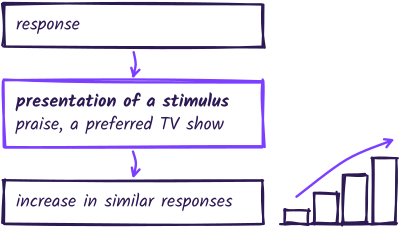
Positive reinforcement
Positive reinforcement happens when something is added after a behavior, like praise or a favorite activity, and the behavior then happens more often.
Definition →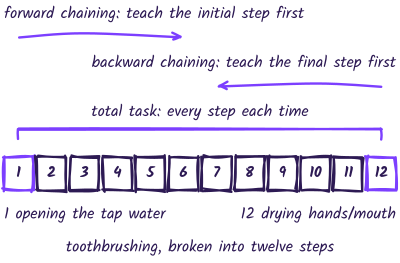
Chaining
Chaining teaches a multi-step skill, like brushing teeth, by breaking it into steps and teaching them until they link into one routine.
Definition →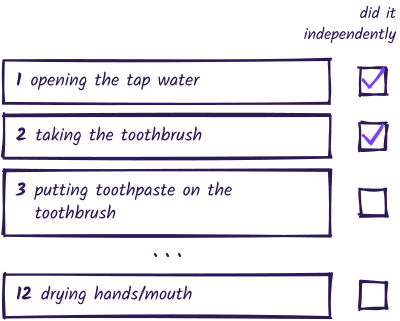
Task analysis
A task analysis breaks a skill or routine into small, manageable steps in order, so your child's team can assess it and teach it.
Definition →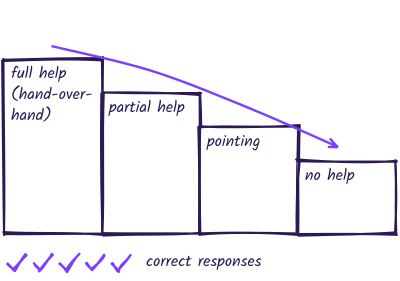
Errorless learning
Errorless learning is a way of teaching that gives a child enough help to answer correctly, then fades that help step by step.
Definition →
Differential reinforcement
Differential reinforcement means giving positive consequences for a chosen behavior, or for not doing a problem behavior, so the better behavior grows.
Definition →