






ABA data collection is the process of recording a client's behavior and skills during ABA therapy sessions to assess whether treatment is working.
This article will help you choose the right data collection method, set up a system, and use the data to make treatment decisions for your ABA practice.
Key takeaways
- The method should fit the behavior: Counting works for brief behaviors, timing works for longer ones, and interval methods help when continuous recording isn't possible.
- Digital systems save time and reduce errors: Data entered on a phone or tablet can be graphed automatically and added to the session note.
- Graphed data guides treatment decisions: Reading a graph's level, trend, and variability tells you whether a program is working.
- Alpaca Health keeps data, notes, and billing together: BCBAs who own an ABA practice get provider apps, data collection, and AI session notes that draft the documentation, and Alpaca Health's team handles the billing. If you'd like that in your ABA practice, see how Alpaca Health works.
What is ABA data collection?
ABA data collection is the systematic recording of a client's target behaviors and skills. This includes how often a behavior happens, how long it lasts, or how many trials a client gets right. RBTs usually collect the data during the ABA therapy session. The BCBA reviews it to guide the treatment plan.
Some targets are behaviors you want to decrease, such as hitting. Others are skills you want to increase, such as asking for help. Data you collect before treatment starts is called baseline data. It shows where the client is now, so you can compare later data against it.
Good data starts with an operational definition. It's a description of the behavior clear enough that two people watching would agree on whether it happened. The BACB's RBT Test Content Outline asks RBTs to describe behavior in observable and measurable terms. It also lists continuous, discontinuous, and permanent-product recording as RBT tasks.
Let Alpaca Health draft your session notes.
Alpaca Health's HIPAA-compliant platform includes AI session notes and data collection, so your team spends less time on paperwork.
See it in action →
Why is data collection important in ABA?
Data collection is important in ABA because it objectively shows whether an intervention is working.
The BACB Ethics Code (2.17) asks behavior analysts to collect and graph data. They then use the data to decide whether to continue, change, or end services. Under code 2.18, if the data shows a client isn't making progress, you look into why and correct the plan.
Insurers also use data to decide on reauthorization. Reauthorization means approving another period of services. The Centers for Medicare & Medicaid Services (CMS) is the federal agency that oversees Medicaid. Its 2026 ABA toolkit for state Medicaid programs says a reauthorization request can include progress graphs or data summaries. It recommends that states base reauthorization decisions on objective progress data, such as goals mastered and behaviors reduced.
Data also helps you keep families informed. Code 2.08 asks you to explain assessment and intervention results to clients and families once you have them.
Types of ABA data collection methods
Most ABA data collection methods are either continuous or discontinuous. Continuous methods record every instance of a behavior, while discontinuous methods sample the behavior during set intervals. The table below compares each method on whether it's continuous, what it records, the targets it fits, and its main limit.
| Method | Continuous or discontinuous | What it records | Targets it fits | Main limit |
|---|---|---|---|---|
| Frequency and rate | Continuous | Count of a behavior, or count per minute or hour | Brief behaviors with a clear start and end | Hard with very fast behaviors |
| Duration | Continuous | How long a behavior lasts | Tantrums, time on task | Needs a timer and full attention |
| Latency | Continuous | Time from an instruction to the response | Following directions | Needs a clear starting cue |
| Interresponse time (IRT) | Continuous | Time between responses | Behaviors you want faster or slower | Needs precise timing |
| Partial interval | Discontinuous | Whether the behavior happened at any point in each interval | Behaviors to decrease | Tends to overestimate |
| Whole interval | Discontinuous | Whether the behavior lasted the whole interval | Behaviors to increase | Tends to underestimate |
| Momentary time sampling | Discontinuous | Whether the behavior is happening at the end of each interval | Ongoing, high-rate behaviors | Misses brief behaviors |
| Permanent product | Neither (after the fact) | Lasting results of a behavior | Worksheets, chores | Can't show who did it or how |
| Trial-by-trial and probe | Trial-by-trial is continuous, probes are discontinuous | Correct or incorrect on each trial or first trial | Skill acquisition | Probes show less detail |
| ABC | Continuous, descriptive | Antecedent, behavior, and consequence | Finding a behavior's function | Time-consuming to record |
| Scatterplot | Discontinuous | When a behavior happens across the day | Spotting time-of-day patterns | Doesn't show the cause |
| Task analysis | Continuous within the chain | Independence on each step of a skill | Multistep skills | Depends on well-written steps |
A computer simulation in the Journal of Applied Behavior Analysis found that each interval method carries its own measurement error. So the method you pick should fit the behavior you're measuring.
Frequency and rate recording
Frequency recording counts how many times a behavior happens during an observation. Rate is that count divided by the time you observed. For example, 6 hits in 2 hours is a rate of 3 hits per hour. You need to write down how long you observed, because you can't work out a rate without it. Rate lets you compare observations of different lengths.
Some behaviors can only happen after an instruction, such as refusing a task. For these, you can record the percentage of instructions that led to the behavior.
Duration recording
Duration recording measures how long a behavior lasts, from the moment it starts until it stops. You can report the total time or the average length of each episode. For example, three tantrums of 4, 6, and 8 minutes are 18 minutes in total, or 6 minutes on average. Duration recording fits behaviors that vary in length, such as tantrums or time on task. Timing each episode also gives you a count, but the RBT needs a timer and has to watch the whole time.
Latency recording
Latency recording measures how long a client takes to start a response after an instruction or other cue. It's usually timed in seconds and reported as an average. For example, you could time how long a client takes to start putting toys away after you ask. Latency recording fits goals about following directions, and the RBT needs a timer and a cue with a clear start.
Interresponse time (IRT)
Interresponse time (IRT) is the time between one response and the next. You can work it out from frequency data if the RBT notes the time of each response. For example, if responses happen at 10:00, 10:04, and 10:10, the IRTs are 4 and 6 minutes.
IRT helps when you want a client's responses to come faster or slower. BCBAs also use IRT data to pick the starting interval for noncontingent reinforcement. Noncontingent reinforcement means giving reinforcement on a time schedule, whatever the client is doing.
Partial interval recording
Partial interval recording scores an interval if the behavior happens at any point during it. You split the observation into equal intervals and then report the percentage of intervals scored. For example, a behavior scored in 12 of 60 intervals is 20%. A 2012 guide for practitioners in Behavior Analysis in Practice says 10 seconds is the most common interval length in research.
Partial interval recording overestimates how much the behavior happens. For behaviors you want to decrease, the overestimate makes it a strict measure. The data only shows a big drop once the behavior is nearly gone. The same guide suggests it when you want a behavior to stop completely, such as eye gouging, because it scores even a brief instance.
Whole interval recording
Whole interval recording scores an interval only if the behavior lasts the entire interval. A short break anywhere in the interval means no score, so this method underestimates the behavior. You can use it for behaviors you want to increase, such as staying on task. It's a poor fit for behaviors you want to decrease. Even a behavior that lasts 9 seconds of every 10-second interval would never be scored.
Momentary time sampling
Momentary time sampling records whether the behavior is happening at the moment each interval ends. You report the percentage of intervals scored. The 2012 guide says studies have generally found it the most accurate of the three interval methods. One person can also use it to watch several behaviors or clients.
Momentary time sampling stays fairly accurate with longer intervals. According to the 2012 guide, one study found the results changed little between 5-second and 2-minute intervals. The method can miss brief or rare behaviors, so it fits ongoing behaviors, such as engagement or stereotypy. Stereotypy means repeated movements or sounds, such as hand flapping.
Permanent product recording
Permanent product recording measures the result a behavior leaves behind, such as a finished worksheet or toys put away. You check the product after the behavior happens, so no one has to watch the behavior. That helps with behaviors that happen when no one is around. For example, you can measure skin damage to track self-injury. This method only works if the behavior reliably leaves the product and nothing else usually causes that product.
Trial-by-trial and probe data
Trial-by-trial data records whether the client responded correctly on every teaching trial. Probe data records only the first trial of the target in each ABA therapy session, which saves time.
In a 2011 study of 11 autistic children, first-trial data often showed mastery too early. It was also slow to show early progress. Data from the first three trials matched the every-trial data fairly well.
If you use probes, the authors suggest scoring a few trials and noting the prompt level on each. The prompt level is how much help the client needed. The authors also suggest basing mastery on at least three ABA therapy sessions.
ABC data
ABC data records what happened right before a behavior (the antecedent), the behavior itself, and what happened right after it (the consequence). The RBT writes one entry each time the behavior occurs. A simple ABC form has columns for the date, start and stop time, antecedent, behavior, and consequence.
Over several entries, patterns can point to the behavior's function. The function is the reason the behavior keeps happening. For example, a client might scream when asked to clean up and then not have to clean up. If that keeps happening, the screaming may be a way to escape the task.
Scatterplot data
Scatterplot data shows when a behavior happens across the day. You split the day into time blocks and note the activity in each. Then you mark each block where the behavior occurred. Over several days, you can see whether the behavior clusters at certain times or activities.
A scatterplot doesn't show the cause of the behavior. Still, the patterns can hint at its function and show the times of day when an intervention might help most.
Task analysis data
Task analysis data records whether the client did each step of a skill on their own or needed a prompt. You score every step, then graph the percentage of steps the client did alone. For example, 6 of 8 handwashing steps done alone is 75%. The step scores also show you which step needs more teaching.
How to choose an ABA data collection method
The right ABA data collection method depends on the behavior and your goal for it. It also depends on how much attention the person recording can give.
- Whether you can see it: A 2016 decision model for problem behavior asks this first. If you can't watch the behavior happen, permanent product recording may be the only option.
- Whether it has a clear start and end: Clear, brief behaviors suit frequency or rate, while longer ones suit duration.
- How much attention the RBT can give: If the RBT is also teaching, momentary time sampling or another interval method may be more realistic than continuous counting.
- What you most need to know: Frequency shows how often, duration how long, latency how quickly it starts, and IRT the gap between responses.
- Whether the goal is a new skill: Trial-by-trial, probe, or task analysis data fit skill acquisition.
- Whether you need the function: ABC and scatterplot data help you see patterns before you plan an intervention.
Write the chosen method into the treatment plan, so every RBT records the target the same way.
Paper vs digital ABA data collection systems
Paper data sheets cost nothing to start, while digital systems save time once your caseload grows. The table below compares them on setup, data entry errors, graphing, sharing with the team, and privacy.
| Paper data sheets | Digital systems | |
|---|---|---|
| Setup | Quick and free | Needs software setup and training |
| Data entry errors | More, from handwriting and retyping | Fewer, with built-in prompts and checks |
| Graphing | Done by hand or in a spreadsheet | Updates automatically |
| Sharing with the team | Paper has to be scanned or passed around | Available to the team right away |
| Privacy | Sheets can be lost or seen by others | Access controls and a signed HIPAA agreement with the software company |
Paper data sheets
Paper data sheets are printed forms the RBT fills in by hand during the ABA therapy session. They work for a solo BCBA with a few clients or as a backup when a device fails.
The sheets hold protected health information, so keep them in a locked cabinet. Under HIPAA, you also can't throw them in a trash bin the public can reach. The Department of Health and Human Services (HHS) lists shredding them so no one can read them as one proper disposal method.
You may want to scan sheets and then destroy the paper. The BACB Ethics Code (2.05) says you can do that only when the laws and contracts that apply to you permit it.
Digital and cloud-based platforms
Digital and cloud-based platforms store data online, graph it automatically, and often link it to session notes and billing. When you compare ABA data collection software, check whether it works offline, whether it connects to billing, and what it costs. Some tools only collect data, while all-in-one ABA software also handles scheduling and billing.
Mobile apps for data entry in ABA therapy sessions
Mobile apps let RBTs record data on a phone or tablet during the ABA therapy session. Apps that work offline suit in-home and community work, where the internet can drop.
Look for an app that encrypts the data it stores on the device. Encrypted data can't be read without a key. Under HIPAA's breach rules, you usually have to notify clients if their unsecured health data is lost or exposed. Data that's properly encrypted counts as secured. So if an encrypted device is lost, you may not have to send those notices.
How to set up an ABA data collection system
To set up an ABA data collection system, you assess your needs, check HIPAA compliance, build your data sheets, and fit the system into your daily workflow.
Assess your ABA practice's needs
You assess your needs by listing your clients and the settings you work in, such as clinic, home, school, or community. You can add the problems you want to fix, such as late notes or hand-drawn graphs. Then you sort the features you want into must-haves and nice-to-haves. For example, offline data entry is a must-have if your RBTs work in homes with weak internet.
Check HIPAA compliance and ease of use
Any company that stores client data needs to sign a business associate agreement with you under HIPAA. This agreement requires the company to protect your clients' data. HHS also says the agreement shouldn't block your access to your own client data. A short trial with one RBT shows whether the app is easy to use during an ABA therapy session.
Build data sheets for each target
Each target needs its own data sheet, or its own program in a digital system. The sheet lists the operational definition, the measurement method, prompt levels, and mastery criteria. Mastery criteria are the level the client has to reach before the target counts as learned. For example, the client might need a set percentage correct across three ABA therapy sessions in a row.
Each sheet also needs the client's name, the date, the start and stop time, and who recorded the data. The start and stop time gives you the observation time, which you need to turn a count into a rate.
Fit the system into your daily workflow
To fit the system into your daily workflow, you decide who enters the data and when you review it. Starting with one or two clients lets you fix problems early. You can also keep staff from entering the same information twice by linking data to ABA session notes and scheduling.
Grow your ABA practice with Alpaca Health.
Alpaca Health helps independent BCBAs connect with families looking for care and handles the admin work as you grow. Payouts are guaranteed every two weeks.
Book a call →
Best practices for ABA data collection
Reliable ABA data comes from clear definitions, regular agreement checks, and recording in the moment.
Set clear measurement criteria
Clear criteria define exactly what counts as the behavior, what doesn't, and how to record it. "Hits others with an open or closed hand" is easier to score the same way than "aggression," because it names the exact action. For a behavior you time, the definition also needs a clear start and end. The RBT has to know when to start and stop the timer.
Check interobserver agreement
Interobserver agreement (IOA) compares data from two people who record the same client at the same time. For counts, you divide the smaller count by the larger one. If you count 10 hits and the RBT counts 9, agreement is 90%. For interval data, you divide the intervals you agree on by the total number of intervals. The What Works Clearinghouse's standards for single-case research cite 80% to 90% agreement as the lowest acceptable range.
According to the same standards, you should also check IOA in at least 20% of ABA therapy sessions. That applies to each phase, such as baseline and treatment. These standards are written for research, but you can use them as a guide. When agreement is low, you can tighten the definition or retrain the RBT, then check IOA again.
Record data during the ABA therapy session
RBTs should record each response when it happens. Frequency, duration, and latency recording all depend on marking each instance as it occurs. Momentary time sampling also has to be scored at the exact moment each interval ends. Keeping the data sheet or device within reach lets the RBT record without stopping the teaching.
How to train your team on ABA data collection
Training your team on ABA data collection works best through practice and feedback. That way, every RBT records the same behavior the same way.
Give hands-on training and ongoing feedback
In hands-on training, each RBT practices recording data while you watch and give feedback. You can teach data collection with behavioral skills training. It's an evidence-based approach to staff training.
You describe the data collection method and give the RBT a written description of it. Then you show the RBT how to do it, have the RBT practice, and give feedback until they record correctly. A short video can work as the demonstration. Training then continues on the job, which helps the skill carry over to real ABA therapy sessions.
The BACB's RBT Handbook lists reviewing data sheets and giving feedback as part of RBT supervision. The supervisor must also watch each RBT provide services at least once a month. That visit is a good time to record data alongside the RBT and check IOA.
The BACB expects RBTs to show competence before they provide services, so build this training into onboarding when you're hiring new RBTs.
Solve common data collection challenges
Data collection gets harder in busy community settings and with very fast behaviors. It also gets harder when an RBT tracks several targets at once or records while teaching. Any of these can make continuous counting less accurate.
In those cases, a simpler method, such as momentary time sampling, can help. Fewer targets per ABA therapy session also help RBTs keep accurate data without losing focus on the client. Rare behaviors are easy to miss in a short observation, so observe them for longer when you can.
How to use ABA data to make treatment decisions
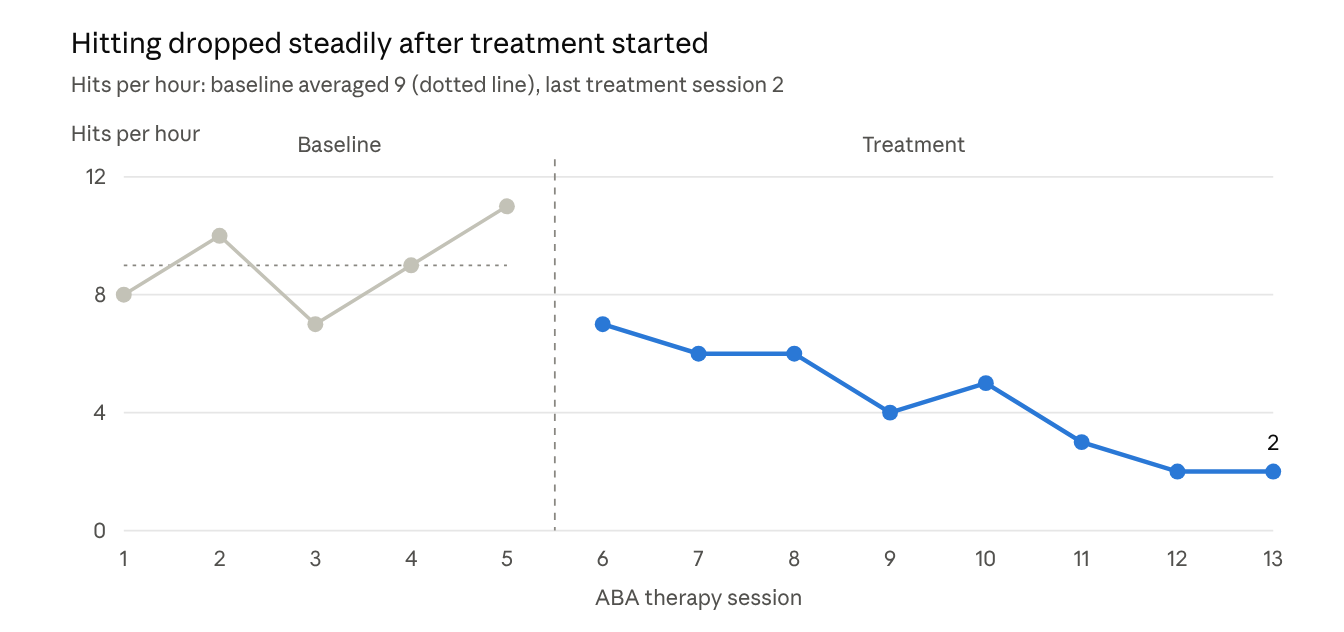
You use ABA data to make treatment decisions by graphing it and reading the graph for level, trend, and variability. The graph below shows hits per hour for one client before treatment (the baseline phase) and during treatment (the treatment phase).
Graph ABA data
To graph ABA data, you plot a point for each ABA therapy session on a line graph. The ABA therapy sessions run in order along the bottom. The measure, such as hits per hour, runs up the side. A dashed vertical line marks each phase change, such as the start of treatment. BCBAs then judge progress by looking at the graph, which is called visual analysis.
Read level, trend, and variability
Level is the average value in a phase. Trend is the direction the data is heading, and variability is how much the points bounce around. In the example, hitting averaged 9 per hour in baseline. In treatment, it trended down to 2 per hour, with less bounce from one ABA therapy session to the next.
Baseline also shows what you'd expect if nothing changed. Here, baseline ranged from 7 to 11 hits per hour and wasn't going down on its own. Only the first treatment point, 7, falls inside that range. The other seven treatment points are lower than anything in baseline, which makes the drop more convincing.
As a guide, the What Works Clearinghouse standards count a phase only if it has at least 3 data points. They ask for 5 to fully meet the standards, but they allow a shorter baseline for dangerous behavior such as self-injury.
Decide to continue, change, or end a program
You decide what to do with a program by comparing its trend with the client's goal. A clear improving trend, like the one in the example, supports continuing the program until the client meets the goal. A flat or worsening trend after several ABA therapy sessions suggests changing the intervention. A target that holds at its goal can end or move to maintenance. Maintenance means checking now and then that the result lasts.
Before you change an intervention because the graph is flat, check the measurement. Partial interval data on a frequent behavior, or momentary time sampling on a rare one, can miss small changes. In that case, the 2012 guide for practitioners in Behavior Analysis in Practice suggests observing for longer before you decide.
How is AI used in ABA data collection?
AI is used in ABA data collection to cut paperwork. Researchers are also testing it for reading graphs and planning treatment.
- Session notes: AI session notes can turn ABA therapy session data into a draft note for the RBT or BCBA to review.
- Graph reading: In a 2020 study, computer models trained on single-case graphs agreed with visual analysts more often than a standard rule-based method did.
- Treatment goals: In a small 2022 study of 29 young autistic children, a computer model suggested treatment goals with 81% to 84% accuracy against the goals clinicians chose. Two of the authors are shareholders in the company that received the grant financing.
Both studies were early research, so AI tools still need a BCBA's review. Any tool that handles client data needs a signed business associate agreement.
How Alpaca Health helps you track client progress in your ABA practice
Alpaca Health helps you track client progress on one platform. Your team gets provider apps, data collection, and progress tracking, and AI session notes draft the documentation. A family mobile app helps you communicate with caregivers. Your ABA practice keeps full ownership of its client records, treatment plans, and ABA therapy session data.
Alpaca Health is a Practice-In-A-Box partnership for BCBAs who own an ABA practice or want to open their own. Its team handles credentialing, billing, payroll, and compliance. You get paid every two weeks, even if a claim is delayed or denied. There are no software fees, and you keep full clinical control.
If you'd like to see how your programs and data would look on the platform, book a demo with the Alpaca Health team.
See what your ABA practice could look like on Alpaca Health.
A demo walks you through AI session notes, billing, credentialing, and payroll on Alpaca Health.
Book a demo →
Frequently asked questions about ABA data collection
What kind of data do RBTs collect?
RBTs collect frequency, duration, interval, trial-by-trial, task analysis, and ABC data, depending on what the BCBA assigns for each target. They also enter the data and update graphs, and they calculate rates and percentages. Data collection and graphing is one of six areas on the BACB's RBT Test Content Outline. It makes up 13 of the 75 scored questions on the RBT exam. The BCBA chooses the method and reviews the graphs, which is one of the main differences between RBT and BCBA duties.
How do you prepare for data collection in ABA?
You prepare by reviewing the client's targets, definitions, and data sheets before the ABA therapy session. Your materials and timer should be ready, along with a charged tablet or phone. It also helps to check for any program changes the BCBA made since the last ABA therapy session.
Do ABA treatment plans require data collection?
Yes, ABA treatment plans rely on data to set baselines, track progress, and justify hours to insurers. The CMS toolkit says a treatment plan should have measurable goals with mastery criteria. It also says baselines should be set at the first assessment.
Federal audits of Medicaid ABA billing have also found many claims weren't backed by proper documentation. In the 2026 Colorado audit, auditors sampled 100 months of ABA billing, each for one child. In 93 of them, session notes or visit records didn't meet documentation requirements.
Is a digital data system worth it for a solo BCBA?
Yes, a digital system is usually worth it for a solo BCBA once you have more than a few clients. Automatic graphs and linked notes save time every week. Many tools charge a monthly fee for each client, and practice management software can add scheduling and billing. If you'd rather have data, notes, and billing in one place, book a demo with the Alpaca Health team.
Looking for a change?
Start an ABA practice today — with none of the admin burden.

