

ABA Therapy Glossaryfor Parents
All termsTheory of mind
Theory of mind is understanding that other people have their own thoughts, beliefs and feelings, which can differ from yours.
What it means
Theory of mind is knowing that other people have their own thoughts, beliefs, feelings and intentions. Theirs can differ from yours. People use this to explain or predict what others will do. A classic test tells a puppet story and then asks the child, "Where will Sally look for her marble?"
The National Institute of Mental Health (NIMH) lists trouble seeing others' points of view as a possible autism sign, while a 2019 paper calls the claim that autistic people lack theory of mind questionable and harmful. Another idea, called double empathy, says the mix-ups go both ways between autistic and non-autistic people. In one study, autistic people passed a story to each other as well as non-autistic people did. Rapport was lower in mixed groups.
What it looks like for your child
Your child might find it hard to guess what someone else is thinking or to predict how they'll react. That's a possible sign of autism, and not every autistic child shows it. Your child may also connect more easily with people who communicate the way they do. If you notice this, you can ask about screening, and a screening isn't a diagnosis. An autism diagnosis checklist can help you track what you see.
What to ask your BCBA
- How goals are framed: Ask your Board Certified Behavior Analyst (BCBA) whether any social goal assumes your child can't take another person's view, and what that is based on.
- Understanding both ways: Ask how the team will help the people around your child understand how your child communicates, too.
- Stories and reading: Theory of mind plays a part in reading, so ask whether tools like social stories could help your child make sense of what others think and do.
Wondering how your child understands other people?
The screener can help you decide whether to ask your child's doctor about an evaluation.

Sources
- National Institute of Mental Health (2025), Autism Spectrum Disorder.
- American Speech-Language-Hearing Association, Autism Practice Portal, Signs and Symptoms and Treatment.
- Gernsbacher and Yergeau (2019), Failures of the theory-of-mind claim, Archives of Scientific Psychology 7(1).
- Crompton et al. (2020), Autistic peer-to-peer information transfer, Autism 24(7).
Related terms
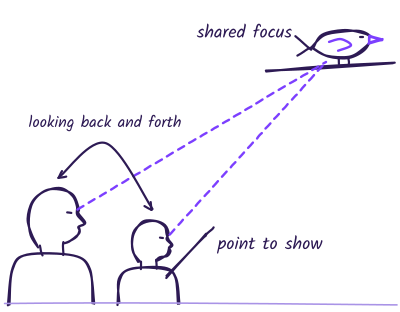
Joint attention
Joint attention is two people sharing focus on the same thing, like a child following a parent's point or pointing to show something.
Definition →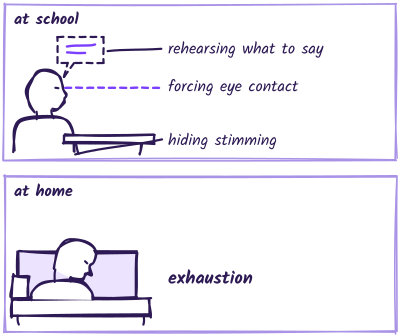
Masking
Masking, also called camouflaging, is when an autistic person hides or makes up for autistic traits, on purpose or not, to appear non-autistic.
Definition →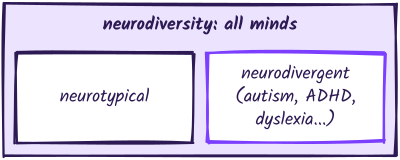
Neurotypical
Neurotypical describes a person whose brain develops and works the way most people's do; it's the counterpart of neurodivergent, not a diagnosis.
Definition →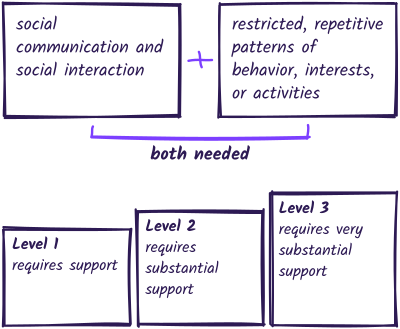
Autism spectrum disorder (ASD)
Autism spectrum disorder (ASD) is a neurological and developmental condition that affects how people communicate, interact with others, learn and behave.
Definition →