

ABA Therapy Glossaryfor Parents
All termsABC data
ABC (antecedent, behavior, consequence) data is a record of what happened just before a behavior, the behavior itself, and what came right after.
What it means
ABC data is a running record kept each time a behavior happens. The A is the antecedent, meaning what happened right before. The B is the behavior, described in plain terms anyone watching could see. The C is the consequence, meaning what happened right after, including what adults did. People watch and write things down without changing anything, which makes ABC data a descriptive assessment.
ABC notes feed into a functional behavior assessment (FBA), which works out why a behavior happens. On their own, they show what tends to go along with a behavior, not what causes it. And since notes are made only when the behavior happens, they can't show how often the same triggers come up without it. Your child's behavior analyst designs and reads these records, and behavior technicians help collect them.
What it looks like for your child
You or your child's teacher may be asked to jot down ABCs at home or school. A note might read: "Asked to put on shoes, threw a shoe and cried, adult put the shoes away." Write what you saw and heard, not why you think it happened. Your child's behavior analyst then uses the notes as a starting point.
What to ask your BCBA
- What to write down: Ask your Board Certified Behavior Analyst (BCBA) for a simple form, an example of how to describe the behavior and whether to log meltdowns the same way.
- How the notes get used: Ask how your notes fit into the FBA, what else the team will look at and whether you'll go over them in parent training.
- What the notes show: Ask what patterns the team found and how sure they are about the cause.
Writing down behaviors and not sure what they add up to?
A BCBA reads your notes alongside other data and explains the patterns they see.

Sources
- Behavior Analyst Certification Board (BACB), RBT Test Content Outline, 3rd ed., tasks A.5 and B.3.
- BACB, BCBA Test Content Outline, 6th ed., task F.5.
- Pence, Roscoe, Bourret and Ahearn (2009), three descriptive assessment methods, Journal of Applied Behavior Analysis 42(2).
- Hanley (2012), functional assessment of problem behavior, Behavior Analysis in Practice 5(1).
Related terms
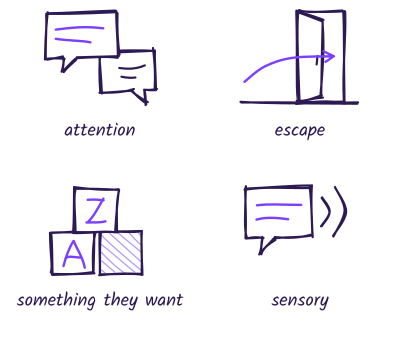
Functions of behavior
A behavior's function is the payoff that keeps it going, like attention, escape from a demand, an item, or a reward the behavior creates itself.
Definition →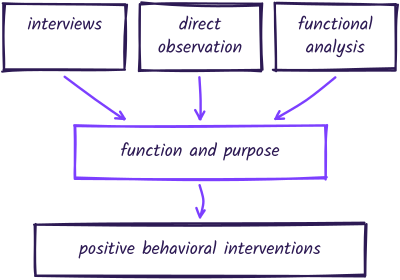
Functional behavior assessment (FBA)
A functional behavior assessment (FBA) is a structured process for working out why a specific behavior happens, so the team can plan better alternatives.
Definition →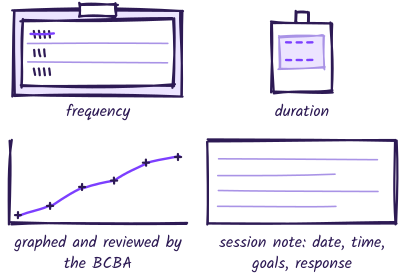
Data collection and session notes
In ABA, data collection is the steady, measurable record of what happens each session, and a session note is the written record of that session.
Definition →