

ABA Therapy Glossaryfor Parents
All termsReplacement behavior
A replacement behavior is a safer, more useful action taught in place of a challenging behavior, chosen to meet the same need.
What it means
A replacement behavior is a safer action your child learns to use instead of a challenging behavior. It's picked to meet the same need, so it gets your child the same thing the old behavior did. Choosing one starts with a functional behavior assessment (FBA). It works out what the old behavior gets your child. Behavior analysts may call it an alternative behavior, and schools use the term in behavior plans.
Many of these new skills are ways to ask for something, like help, a break, attention or a favorite item. Wisconsin's school guidance notes the term has also been used for swaps that only look more acceptable. It warns against replacing anything that meets a child's need for safety, calm or communication. Most harmless stimming falls in that group, so not everything needs a replacement.
What it looks like for your child
If your child bites to get out of a loud room, the new skill might be handing over a picture card for a break. Pointing to headphones is another option. The same guidance gives the example of a student who uses a break card to step away from a task. The new skill has to work, and work fast, especially at first. So the adults around your child respond to it every time early on.
What to ask your BCBA
- What the behavior gets: Ask your Board Certified Behavior Analyst (BCBA) what the FBA found and how the new behavior gets your child the same thing.
- What your child will do instead: Ask how the team will teach and reward the new behavior, and whether parent training covers your part.
- What stays: Ask which behaviors the team won't try to replace, such as ones that help your child stay calm.
Not sure what your child could do instead of a hard behavior?
A BCBA picks a safer skill that meets the same need and shows you how to respond to it.

Sources
- Behavior Analyst Certification Board (BACB), BCBA Test Content Outline (6th ed.), H.3.
- Tiger, Hanley and Bruzek (2008), FCT review and guide, Behavior Analysis in Practice 1(1).
- Wisconsin Department of Public Instruction, functional behavioral assessment guidance, Introduction and Overview, pp. 1 and 3.
- Steinbrenner et al. (2020), UNC Frank Porter Graham Institute (NCAEP), autism practices report, differential reinforcement and FCT fact sheets, pp. 75 and 89.
Related terms
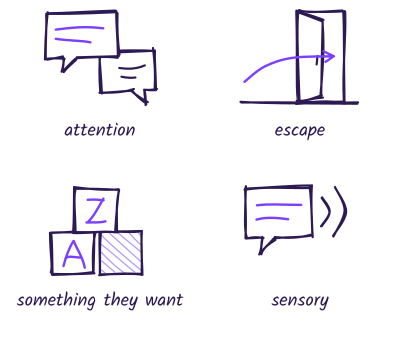
Functions of behavior
A behavior's function is the payoff that keeps it going, like attention, escape from a demand, an item, or a reward the behavior creates itself.
Definition →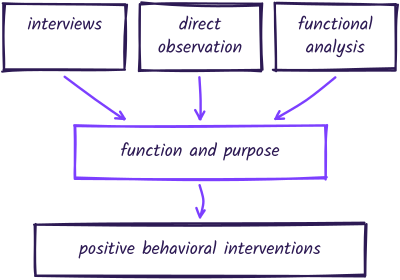
Functional behavior assessment (FBA)
A functional behavior assessment (FBA) is a structured process for working out why a specific behavior happens, so the team can plan better alternatives.
Definition →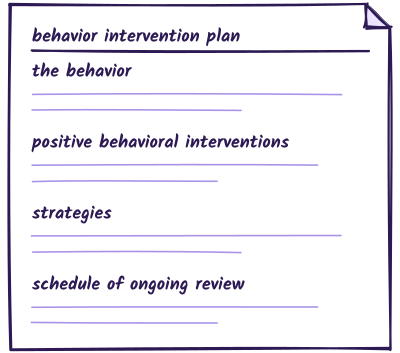
Behavior intervention plan (BIP)
A behavior intervention plan (BIP) is a written plan that names a behavior of concern and the positive strategies used to address it.
Definition →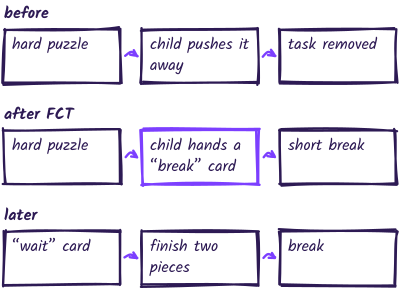
Functional communication training (FCT)
Functional communication training (FCT) teaches a child a clear way to ask for what a challenging behavior was getting them.
Definition →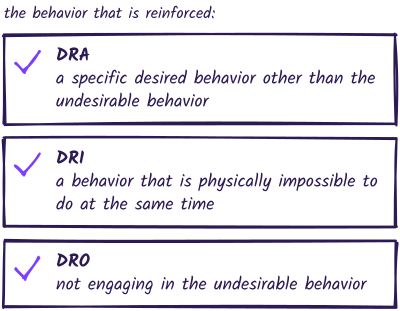
Differential reinforcement
Differential reinforcement means giving positive consequences for a chosen behavior, or for not doing a problem behavior, so the better behavior grows.
Definition →