

ABA Therapy Glossaryfor Parents
All termsDSM-5-TR autism criteria
The DSM-5-TR autism criteria are the rules clinicians use to diagnose autism, covering social communication plus repetitive behaviors, interests or sensory responses.
What it means
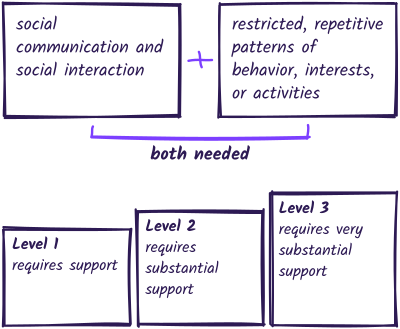
The DSM-5-TR (Diagnostic and Statistical Manual of Mental Disorders, Fifth Edition, Text Revision) is the American Psychiatric Association's 2022 manual. Clinicians use it to diagnose autism. First, a child must have lasting challenges in all three social areas. These are back-and-forth social exchange, nonverbal communication and relationships. The child must also show at least two of four kinds of repeated behaviors, interests or sensory responses.
These signs must start in early childhood, though they may not be clear until social demands grow. They must cause real trouble in daily life. They also can't be better explained by intellectual disability or global developmental delay. Next, clinicians give a support level from 1 to 3 for each of the two areas. The 2022 update mostly made clear that all three social areas are needed. Researchers said that's unlikely to change how clinicians diagnose.
What it looks like for your child
No single test or checklist makes the diagnosis. Clinicians use two main sources. One is what you tell them about your child's growth, and the other is what they see themselves. Reacting too much or too little to sensory input counts as one of the four repeated behavior areas. Autism can usually be diagnosed reliably by age 2. A short screener can show whether a specialist should take a closer look, but it isn't a diagnosis.
What to ask your BCBA
- Ask the evaluating clinician: Ask which tools and sources of information they'll use, since no single tool should decide the diagnosis.
- Ask about support levels: Ask which support level your child has in each area and how it shows up in daily life.
- Prepare for the visit: Ask what history to bring, and track what you notice with an autism diagnosis checklist.
Noticing signs and wondering what clinicians look for?
A short screener can show whether a specialist should take a closer look, though it isn't a diagnosis.

Sources
- American Psychiatric Association (2022), DSM-5-TR autism fact sheet.
- Centers for Disease Control and Prevention, Clinical Testing and Diagnosis (reproduces the 2013 DSM-5 criteria).
- National Institute of Mental Health (2025), Autism Spectrum Disorder.
- Hess (2022), DSM-5 revision tweaks autism entry, Spectrum.
Related terms
Autism spectrum disorder (ASD)
Autism spectrum disorder (ASD) is a neurological and developmental condition that affects how people communicate, interact with others, learn and behave.
Definition →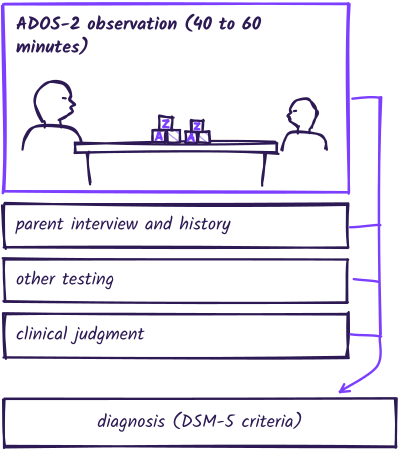
ADOS-2
The Autism Diagnostic Observation Schedule, Second Edition (ADOS-2) is a standardized observation that clinicians use as one part of an autism evaluation.
Definition →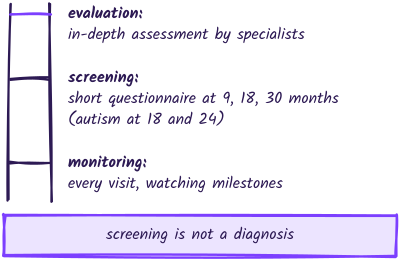
Developmental screening
Developmental screening is a short, standard check, often a parent questionnaire, that shows whether a child's development is on track or needs a closer look.
Definition →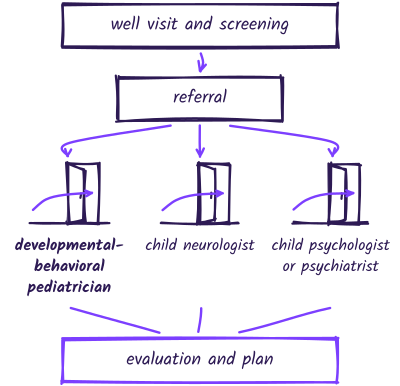
Developmental pediatrician
A developmental pediatrician is a children's doctor with three more years of specialty training who evaluates development, learning and behavior, including autism.
Definition →