

ABA Therapy Glossaryfor Parents
All termsHyperlexia
Hyperlexia is when a child reads words far above their age level while their understanding of what they read lags behind.
What it means
Hyperlexia is when a child reads words far above their age level but understands less of what they read. Ostrolenk and colleagues describe three parts: the child reads better than they understand, learns to read early without being taught, and is drawn to written words. There's no specific test for it. Instead, a speech-language pathologist (SLP) or psychologist looks at how your child reads, talks and understands.
It's most often described in autistic children, but only a minority of them have it. Early reading on its own isn't a sign of autism. Some early readers with autism-like traits need to be told apart from autism, too. Researchers differ on how to see it. Some call it a strength or another path into language, while others call the gap in understanding a reading disorder.
What it looks like for your child
Your child might read signs, books or letter magnets well before other kids their age. Still, they may not follow what a sentence means or what you say. Many autistic children have an intense interest in letters, even those who speak few or no words. Because of the link with autism, a clinician may suggest an autism evaluation. Therapists may use that interest in letters as a way in to build language.
What to ask your BCBA
- Reading and understanding: Ask your Board Certified Behavior Analyst (BCBA) how the team will check what your child understands, beyond what they can read aloud.
- Using the interest: Ask whether your child's love of letters can be built into language goals.
- Working with other specialists: Ask how your BCBA and your child's speech therapy team will share what they see.
Is your child reading early but missing what the words mean?
A short screener can help you decide whether to ask your pediatrician about an evaluation.

Sources
- Cleveland Clinic (2024), Hyperlexia.
- Ostrolenk et al. (2017), Hyperlexia: systematic review, Neuroscience and Biobehavioral Reviews 79, abstract.
- Solazzo, Kojovic, Robain and Schaer (2021), early hyperlexic traits in autism, Brain Sciences 11(6).
- Ostrolenk, Boisvert and Mottron (2025), interest in letters and numbers, International Journal of Qualitative Studies on Health and Well-being 20(1).
Related terms
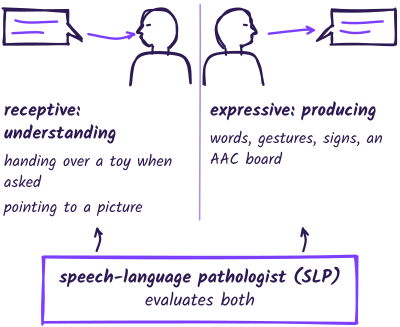
Receptive and expressive language
Receptive language is understanding what others say, and expressive language is sharing thoughts and needs through words, gestures, signs or writing.
Definition →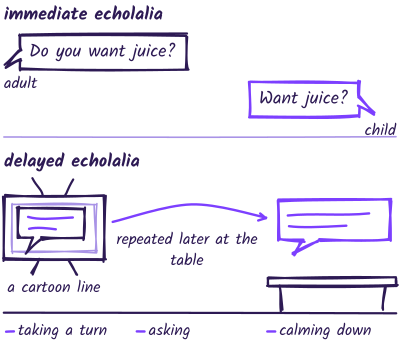
Echolalia
Echolalia is repeating words or phrases that someone else said, either right after hearing them or much later.
Definition →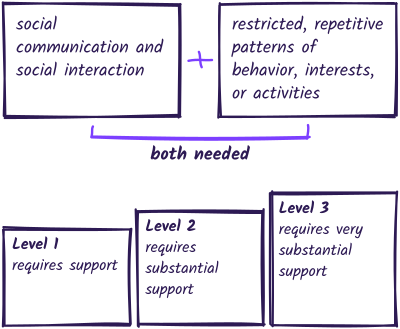
Autism spectrum disorder (ASD)
Autism spectrum disorder (ASD) is a neurological and developmental condition that affects how people communicate, interact with others, learn and behave.
Definition →