






You can start getting help for your autistic child in El Paso this week. The first call depends on your child's age, and the office you reach can tell you where to go next. You don't need every answer on day one.
Some of the help has a long wait, and two different offices hold the waiting lists. Join those lists first, while you set up the evaluation and the school request. Several of the local groups work in Spanish as well as English.
Key Takeaways
- A baby or toddler starts with the El Paso early intervention referral line, and a child of preschool age or older starts with a written request to your own school district.
- The Medicaid waivers have long waiting lists, and Emergence Health Network holds two of them while a state phone line holds the other three.
- The free El Paso checklist on this page keeps every number in one place, and if you're ready for ABA therapy too, you can start your intake.
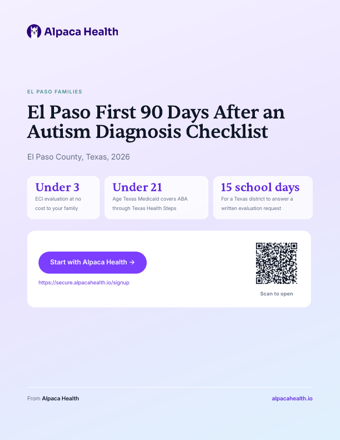
Every El Paso number you need in your first 90 days, in English and Spanish.
We also sent the link to your email.
Who to call first, based on your child's age
Early Childhood Intervention (ECI) is the Texas program for babies and toddlers who are behind in how they move, talk, play or learn. Two local programs split El Paso and Hudspeth counties by ZIP code, and both take referrals on one line. Anyone can make the referral, and your child does not need an autism diagnosis. The evaluation costs nothing, services after that use a sliding fee based on family size and income, and no family is turned away because it can't pay, according to the El Paso ECI site.
- The El Paso ECI referral line for children under 3 is (915) 534-4324.
- Texas Parent to Parent answers calls from parents on the day of a diagnosis, and the people who pick up are parents of children with disabilities. Its site is in English and Spanish. Call 866-896-6001 or start on the Texas Parent to Parent site.
- The PEN Project, part of Partners Resource Network, gives El Paso parents free one-on-one help and workshops on special education rights. Its Region 19 coordinator speaks Spanish at (915) 494-3925, and the toll-free line on the PEN page is 1-833-847-2686.
- The Children's Disabilities Information Coalition is El Paso's parent resource center, with ARD and IEP help and workshops in English or Spanish for families of children from birth to 25. Call (915) 217-2747 or visit the coalition's site.
When you call about ECI, staff ask about your child's growth and health before they set up an evaluation. Have your child's birth date, your doctor's name and a short list of what worries you in front of you. ECI ends on your child's third birthday. The program plans the move to school services before then, and our guide to early intervention for autism explains what those first visits look like.
If your child is already 3, the school district takes the first call. A doctor or psychologist can evaluate for an autism diagnosis at the same time. You can start both in the same week, so help can begin at school and at home sooner.
Where to get a medical autism diagnosis
If you're not sure yet, the free M-CHAT-R screener takes about two minutes and is made for toddlers 16 to 30 months old. Bring the result to your pediatrician and ask for a referral to a developmental pediatrician, and ask how long the wait is.
Alpaca Health offers autism evaluations with the ADOS-2 (a standard autism test done with a clinician) and checks your coverage before you book. You can ask more than one clinic for a spot. The first appointment you get can lead to the diagnosis. When you call, ask which forms to send ahead.
El Paso Children's Hospital runs speech, occupational, physical and feeding therapy for children from birth to 18 at 1223 Lee Trevino Drive, and a speech and hearing check is part of most autism workups. Call 915-298-5445 or see its rehabilitation services page.
Before the visit, write down how your child talks and plays, and what happens when a plan changes. Our autism diagnosis checklist lists what to bring. Keep the diagnosis report in one folder afterward, since health plans, the school and grant programs all ask for a copy.
You don't have to figure this out alone.
Alpaca Health matches your family with an independent BCBA in Texas and handles the insurance paperwork and scheduling so you can focus on your child.
Get matched with a BCBA →
Parent support in El Paso, in English and Spanish
Other parents can tell you which form to fill out first and what to ask at each meeting. Two of the El Paso groups meet in Spanish, and the statewide helpers answer in Spanish too.
- The Autism Society of Texas runs three free monthly groups in El Paso, one for caregivers, a social group for autistic adults and a Spanish-language support group, and you RSVP to get the time and place. Call 915-284-8201, extension 6684, email elpaso@texasautismsociety.org, or see the El Paso chapter page.
- The Arc of El Paso is a local nonprofit for people with intellectual and developmental disabilities and their families. It hosts a weekly Sunday Supper Club and other social events, and its site lists (915) 564-4978 and info@thearcofelpaso.org.
- Disability Rights Texas has an El Paso office at 915-542-0585, listed on Navigate Life Texas, and its statewide intake line is 1-800-252-9108. It gives legal help on school and health care rights, and it does not handle Social Security applications.
- Navigate Life Texas is the state's information site for families of children with disabilities, fully in Spanish and English, at Navigate Life Texas. Call 2-1-1 through 2-1-1 Texas when you don't know which office to start with.
A parent from Texas Parent to Parent or a local group can tell you what worked for their child and what they wish they had known. At a first meeting it's fine to listen and take notes. If the meeting time doesn't work for you, ask whether the group meets online.
School help in El Paso
Your child can get a school evaluation even if a doctor already gave a diagnosis, because the school team makes its own decision about special education. Put your request in writing so you have a dated record, and copy the principal on the email. Three districts cover most El Paso families.
- El Paso ISD evaluates children from 3 to 21 who may have a disability at no cost, and its Child Find line on the special education page is (915) 230-2825.
- Socorro ISD serves students from their third birthday through 21, answers a written evaluation request within 15 school days, and finishes the evaluation within 45 school days of your consent, according to its special education page. Call 915-937-1800.
- Ysleta ISD runs Child Find for children 3 through 21 and publishes its ARD guides in English and Spanish on its Child Find page. Its special education line is (915) 434-0900.
- SPEDTex is the state's special education information center, and it answers questions in English and Spanish by phone, email and chat at 1-855-773-3839 through SPEDTex.
- Parent-Directed Special Education Services (PDSES) gives a one-time $1,500 online account to Texas public school students with an IEP who haven't had it before, according to the PDSES page, and our PDSES guide explains the application.
After you ask, a school team meets with you about your concerns. In Texas that team is called the ARD committee (admission, review and dismissal). If the team thinks your child may have a disability, it asks for your written OK before testing. If your child qualifies, the team writes an Individualized Education Program (IEP). That plan lists your child's services and goals, and a child who doesn't qualify may still get a 504 plan.
The IEP meeting checklist helps you bring the right questions to that first meeting. Keep every email and report in one folder. You'll want them at the next meeting. If you and the school disagree, the PEN Project or the Children's Disabilities Information Coalition can explain your options before you meet again.
Every El Paso number you need in your first 90 days, in English and Spanish.
We also sent the link to your email.
Paying for therapy and care
Texas Medicaid covers ABA therapy for members age 20 and younger who have an autism diagnosis. The benefit started on February 1, 2022, according to the state's Medicaid notice. The health plan approves therapy before it starts. Read our guide to Medicaid ABA coverage before you choose a provider.
Children on Medicaid also have EPSDT, the part of Medicaid that pays for a child's checkups and needed care. Children with disabilities usually get their Medicaid through a STAR Kids plan. The plan's member line is where you ask what it covers.
- Two STAR Kids plans serve El Paso and Hudspeth counties, according to the state's El Paso plan chart. Superior HealthPlan is at 844-590-4883 and Wellpoint at 844-756-4600.
- Emergence Health Network is the local authority for intellectual and developmental disabilities (IDD) in El Paso County. Its IDD services office at 915-242-0555 decides eligibility and puts your child on the interest lists for the HCS and Texas Home Living waivers, at 915-599-6645.
- The state takes the calls for the CLASS, MDCP and DBMD interest lists at 877-438-5658, and you do not have to prove your child qualifies to join a list, according to Navigate Life Texas. Some lists have waits of more than 15 years.
- The Children's Autism Program is a separate state program that pays for short-term ABA for children ages 3 to 15, up to 180 hours in 12 months, according to Texas HHS. Call 2-1-1 to find the program near you.
- Medicaid Buy-In for Children covers children with a disability whose families earn too much for regular Medicaid, and our Medicaid Buy-In guide explains the monthly payment.
Once your child is on a list, write down the date you applied and the office you called. Check in once a year to make sure your phone number and address are still current. Our Texas waivers guide explains what each waiver pays for.
If your child has private insurance, the rules depend on the plan. Texas law requires state-regulated group plans to cover autism treatment, including ABA, when the child was diagnosed before age 10. Once a child turns 10, a plan can cap ABA at $36,000 a year, according to the Texas Insurance Code. Plans that an employer pays for directly follow federal rules instead, so ask your HR office which kind you have.
Call the member number on the card. Ask what the plan pays for autism evaluations and ABA therapy, and whether it has to approve therapy first. Write down the date and the name of the person you spoke with.
What if the plan says no? Ask for the reason in writing and keep the letter. Disability Rights Texas can tell you whether the denial breaks a rule.
Paying for ABA therapy
Alpaca Health accepts Texas Medicaid and many private plans, and verifies your benefits before therapy starts so you know what your plan covers.
Check your coverage →
Respite, weekends and sensory-friendly outings
El Paso's zoo, museums and library have published sensory supports, and the state runs a search for respite care. A team or a weekly class gives your child a steady routine outside the house.
- The El Paso Zoo lends sensory bags at the gift shop after you buy tickets and has quiet areas and headphone zones, according to its sensory inclusion page. Call (915) 212-0966 to ask about its next sensory day.
- La Nube, the STEAM museum, lends sensory backpacks and noise-canceling headphones with an ID, has sensory corners, and holds weekend sensory hours listed on its accessibility page. The museum's number is 915-290-4111.
- The El Paso Public Library's Sensory Zone meets on Mondays from 10 to 11 am at the Esperanza Acosta Moreno Library, 12480 Pebble Hills Boulevard, with dim lighting and a cap of 15 people, according to the city's event listing.
- The El Paso Museum of Art, the Museum of History, the Mexican American Cultural Center and the Main Library keep sensory kits at the front desk and have quiet spaces, according to the city's sensory-friendly page. The Museum of Art is free, and its number is 915-212-0300.
- Special Olympics Texas Area 19 runs year-round sports training and competition in El Paso, listed on the Area 19 page.
- Take Time Texas is the state's search for respite providers, and the Aging and Disability Resource Centers help with the search at 855-937-2372, according to its Navigate Life Texas listing.
For a first visit anywhere new, pick a short trip at a slow time of day, bring whatever helps your child settle, and plan a way to leave early if you need to.
Crisis help in El Paso County
Save these numbers in your phone while things are calm. Emergence Health Network runs the county's 24-hour crisis line and crisis services for people with IDD, according to its site.
| Who to Call | When to Call | How to Reach Them |
|---|---|---|
| 988 Lifeline | Any mental health crisis, day or night | Call or text 988 |
| Emergence Health Network crisis line | A mental health or IDD crisis in El Paso County | 915-779-1800 or 1-877-562-6467, 24 hours a day |
| 911 | A life-threatening emergency | Call 911 |
If you call 911, tell the dispatcher that your child is autistic and what helps calm them. It also helps to keep a short note with your child's diagnosis, medicines, doctor's name and what calms them in your phone or by the door.
Support for autistic teens and adults
In Texas the ARD committee has to start planning for life after high school by age 14. Ask for work and college goals in the IEP at that meeting.
- Workforce Solutions Borderplex is the local front door for the state's vocational rehabilitation program, with job exploration, career counseling and work-based learning for youth and adults with disabilities at no charge. Its vocational rehabilitation contact is 915-887-2159, listed on its disabilities page. The state program's own page is at Texas Workforce Solutions.
- Volar Center for Independent Living offers independent living skills training, peer counseling and help moving from school to adult life for people with disabilities in El Paso and five nearby counties. Call 915-591-0800 or visit Volar.
- Emergence Health Network runs a day habilitation learning center for adults with IDD, and a teen on the HCS list keeps their place after 18. The Autism Society of Texas El Paso social group is for autistic adults.
How Alpaca Health helps El Paso families
Alpaca Health matches Texas families with independent BCBAs. A BCBA (board certified behavior analyst) is the clinician who plans and leads your child's ABA therapy. Therapy can happen at home or by video, depending on where you live. Alpaca Health checks in-home availability for your address during the intake.
Alpaca Health checks your Texas Medicaid or private insurance before therapy starts. Your BCBA builds the plan around the skills your family cares about, such as talking or getting through a trip to the store. You can see the cities Alpaca Health serves on the Texas page, and the Texas resources guide lists the statewide programs. When you're ready to begin ABA while the school and waiver steps move forward, you can start your intake.
Every El Paso number you need in your first 90 days, in English and Spanish.
We also sent the link to your email.
Frequently asked questions about autism resources in El Paso
Where can I find early intervention for autism in El Paso?
Call the El Paso ECI referral line at (915) 534-4324 for a child under 3. Two local programs split the county by ZIP code, the evaluation costs nothing, and your child does not need a diagnosis to be seen.
How do I get an autism evaluation in El Paso?
Ask your pediatrician for a referral to a developmental pediatrician, and ask your school district for a special education evaluation at the same time. An evaluation with the ADOS-2, billed to your plan, is also available through the intake on this page.
Are there services for adults with autism in El Paso?
Yes, the Autism Society of Texas runs a monthly social group for autistic adults in El Paso, Volar helps with independent living and the move from school to adult life, and Workforce Solutions Borderplex runs the state's job program. Emergence Health Network handles adult IDD services and the waiver lists.
Is ABA covered by Medicaid in El Paso?
Yes, Texas Medicaid covers ABA for members age 20 and younger who have an autism diagnosis, and your child doesn't need a waiver slot to begin. Alpaca Health checks your Texas Medicaid or private insurance before therapy starts, and you can begin your intake today.
Support for the hard days.
When you are ready for expert support, Alpaca Health matches your family with a BCBA who can help with the hardest moments, at home, in a clinic, or by telehealth.
Get matched with a BCBA →
RELATED ARTICLES