






Many parents are balancing therapy appointments, communication with teachers, and the everyday work of keeping family life moving. When school staff mention a 504 plan, it is common to have questions.
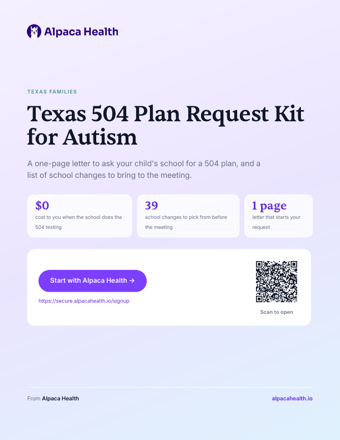
Ask for a 504 plan and know which school changes to request.
We also sent the link to your email.
A Texas 504 plan can help remove barriers that make school harder for a child with autism. It is designed to support equal access to education in the general education setting. For some children, that might mean sensory supports, visual schedules, or extra time. For others, it may mean structured accommodations that make transitions, testing, or classroom participation more manageable. Knowing how eligibility works and which accommodations may help makes it easier to request a plan that fits your child.
Key Takeaways
- A 504 plan helps students with disabilities access education more equally in general education classrooms.
- Your child may qualify if autism substantially limits a major life activity such as learning, reading, concentrating, thinking, communicating, or interacting with others at school.
- Common accommodations include sensory supports, extended time, visual schedules, movement breaks, and calm-down spaces.
- To request a 504 plan in Texas, you can submit a written request to your school’s 504 coordinator or principal and ask the school to evaluate your child.
- ABA therapy and 504 plans can work together. Therapy helps build skills, while school accommodations help a child use those skills more consistently during the school day. This is often especially helpful for communication, transitions, self-regulation, and attention.
What Is a 504 Plan in Texas?
A 504 plan is a legal document that outlines accommodations for a student with a disability so they can access school more fully. It comes from Section 504 of the Rehabilitation Act of 1973, a federal civil rights law that protects students from disability-based discrimination in schools that receive federal funding. Texas public schools are required to follow Section 504 and provide eligible students with appropriate accommodations at no cost to families.
In short, a 504 plan is about removing barriers. It gives the school a formal framework for support that helps your child participate more successfully in the classroom and school environment.
For a child with autism, those barriers are not always about academics alone. A student may understand the lesson but struggle with noise, transitions, group work, unpredictable routines, or the pace of testing. A 504 plan can help with accommodations such as sensory breaks, extended time, visual schedules, preferential seating, or access to a quieter workspace.
Some days are hard. We can help.
When you're ready for expert support, Alpaca Health matches your family with a caring BCBA who can help with the moments that feel impossible, at home, in clinic, or online.
Get matched with a BCBA →
504 Plan vs. IEP: Key Differences in Texas
Parents often hear about both 504 plans and IEPs, and the two can sound very similar at first. Both support children with disabilities, but they are not the same thing.
Legal basis and purpose
A 504 plan is based on Section 504 of the Rehabilitation Act. Its purpose is to make sure a student with a disability has equal access to education through accommodations and support.
An IEP, or Individualized Education Program, is based on the Individuals with Disabilities Education Act (IDEA). Its purpose is broader. An IEP provides specialized instruction, related services, measurable annual goals, and progress monitoring for students who qualify for special education.
Eligibility
A child may qualify for a 504 plan if they have a physical or mental impairment that substantially limits a major life activity.
A child may qualify for an IEP if they meet eligibility under IDEA and need special education services that go beyond accommodations.
What each plan provides
A 504 plan usually focuses on accommodations like extended time, sensory tools, visual supports, or environmental adjustments that help a child access the general education environment.
An IEP may include specialized instruction, speech therapy, occupational therapy, behavioral goals, academic goals, and service minutes. It is a more detailed document.
Which one is right for my child?
A 504 plan may be the better fit when your child is doing reasonably well in the general education setting, but needs accommodations to access learning more fully.
An IEP may be the better fit when your child needs specialized teaching, more intensive support, or school-based related services.
Schools typically use the IEP instead of a separate 504 plan when a child qualifies for special education, because the IEP already addresses accommodations and services more fully.
A student with an IEP does not usually need a separate 504 plan, because the IEP already includes the changes a 504 plan would provide. Eligibility also differs: a 504 plan turns on whether a disability substantially limits a major life activity, while an IEP requires a child to meet one of the 13 disability categories under IDEA and to need special education. The paperwork cycle is heavier for an IEP too. Beyond the annual review it shares with a 504 plan, an IEP calls for a full reevaluation at least every three years.
Does My Child Qualify for a Texas 504 Plan?
The three-part eligibility test
To qualify for a Texas 504 plan, a student generally needs to meet three conditions.
- First, the child must have a physical or mental impairment. Autism can qualify here.
- Second, that impairment must substantially limit one or more major life activities. These may include learning, reading, concentrating, thinking, communicating, or interacting with others.
- Third, the child must need accommodations so they can access education as fully as their peers.
Those three conditions are the route to services, and they are the ones most families are working through. Section 504 also protects two other groups: children who have a record of such an impairment, and children who are regarded as having one. Those students are protected from discrimination even when they do not need accommodations, so a school cannot treat a child differently because of a past diagnosis or an assumption about one.
What a school cannot use to turn your child down
A school cannot decide your child is ineligible simply because the report card looks fine: the Office for Civil Rights is explicit that a student may be eligible for Section 504 services even if that student earns good grades. A school also cannot count the help your child already receives when it judges how much autism limits them. Under the ADA Amendments Act, the school must judge the limit without counting help that eases it, such as medication or coping skills your child has learned, so that help cannot be the reason a child is found not to qualify. If your child is doing well because those supports are working, that is evidence the supports are needed.
How autism may qualify under Section 504
For autism, the key issue is not how “severe” a diagnosis sounds on paper. The more important question is how autism affects your child’s functioning at school.
A child may qualify because sensory sensitivities make the classroom overwhelming. Another may qualify because executive functioning challenges make it hard to start tasks, or complete work on time. Another may need support because social communication differences make group activities, transitions, or asking for help more difficult.
Schools are looking at the functional impact of the disability in the school setting.
Documentation that helps
Schools can review existing information when deciding eligibility. Helpful documentation may include:
- A medical or psychological diagnosis.
- ABA therapy reports or progress notes.
- Teacher observations.
- Parent input.
- Classroom records or outside evaluations.
Bringing documentation that clearly shows how your child is struggling at school can make the process smoother.
Common 504 Accommodations for Children with Autism
Accommodations should always be individualized, but some supports come up often for autistic students.
Classroom supports
Common classroom accommodations include preferential seating, visual schedules, written instructions, movement breaks, fidget tools, noise-canceling headphones, and extended time for classwork. These supports can reduce overload and make it easier for a child to stay engaged throughout the day.
Testing accommodations
Some students need testing accommodations more than day-to-day classroom supports. These might include extended time, testing in a quieter space, breaks during longer tests, or directions read aloud when appropriate. For many children with autism, the environment is what gets in the way, and the material itself is fine.
Social and behavioral supports
A 504 plan can also include supports for communication and regulation. Examples include visual cue cards for requesting a break, access to a calm-down area, or recess options, and clear behavior expectations with visual reminders. These types of accommodations can make school feel more predictable and less stressful.
Environmental modifications
Some children also benefit from environmental changes such as modified PE participation, a quieter lunch schedule, or transportation accommodations. The right support depends on the specific barrier your child is facing.
Ask for a 504 plan and know which school changes to request.
We also sent the link to your email.
How to Request a 504 Plan in Texas
Step 1: Submit a written request
If you are wondering how to get a 504 plan in Texas, start by making your request in writing. You can send it to the school principal, the campus 504 coordinator, or another administrator responsible for student support. Keep the request simple and direct. State that your child has autism, describe the concerns you are seeing at school, and ask for an evaluation for a 504 plan.
Step 2: Evaluation process
After the school receives your request, it reviews available information. That may include grades, attendance, observations, teacher input, parent input, discipline records, and therapy reports. TEA guidance says students must be individually evaluated before eligibility is determined under Section 504.
Step 3: The 504 meeting
If the data suggests a 504 plan may be appropriate, the school will hold a meeting. Parents, teachers, administrators, and other relevant staff may attend. This is where the team discusses eligibility and, if appropriate, chooses accommodations.
Bring documentation, a list of school barriers, and specific ideas. It helps to say something concrete, such as, “My child shuts down during loud transitions,” instead of something broad like, “School is hard.” Specific examples make it easier to match needs to supports.
Step 4: Implementation
Once the plan is finalized, the school should share it with the staff responsible for carrying it out. It is reasonable to ask how accommodations will look in practice. You can also ask for follow-up after a few weeks to see what is working and what may need adjustment. Section 504 plans are reviewed periodically, and some districts review them every year, so ask how often yours does. Parents can request changes when concerns come up.
What if the school says no?
If the school decides your child does not qualify, ask for the decision in writing. You can provide more documentation, ask for further review, and use district complaint procedures if needed. Families can also learn more about Section 504 rights through the Texas Education Agency Section 504 page and the U.S. Department of Education’s Section 504 resource guide.
Preparing for Your 504 Meeting
Before the meeting
Gather therapy reports, teacher feedback, evaluations, and your own notes about school challenges. It can also help to make a short list of accommodations you believe would help. If your child receives therapy, ask what strategies are already working well. Families exploring support can learn more about ABA therapy services and ABA therapy in Texas.
During the meeting
Use real examples. You might say, “In loud environments, my child becomes overwhelmed and stops participating,” or “A visual timer would help with transitions because verbal reminders are not enough.” Take notes, ask questions, and do not feel pressured to sign right away if you want time to review the plan.
After the meeting
Ask for a copy of the final plan, make sure the teachers who need it have access to it, and set a check-in point. Even a strong plan needs follow-through, and early communication can help catch problems before they become patterns.
What Happens to an IEP When a Child Transfers Schools in Texas?
Section 504 covers accommodations, but many autistic students move under an IEP, and transfers have their own timeline. When a student with an IEP enrolls in a new Texas district, the new district must provide comparable services immediately rather than pausing support while paperwork is reviewed. The district then has 20 school days to either adopt the previous IEP or hold an ARD committee meeting to write a new one. In Texas, the IEP team is called the Admission, Review, and Dismissal (ARD) committee.
The same protection applies to a student moving in from another state. Texas must still begin comparable services on enrollment. If the district decides a new evaluation is needed to establish eligibility under Texas standards, that can involve a Full and Individual Initial Evaluation (FIIE), which must be completed within 45 school days. A few steps keep the transition smooth: bring the current IEP, recent evaluations, and progress reports; ask when comparable services begin; confirm whether the district will adopt the old plan or schedule an ARD meeting; and track the 20-school-day and 45-school-day timelines. If the district does not follow the rules, you can review the Texas complaint process.
How Texas 504 Plans and ABA Therapy Work Together
The school plan and the therapy plan do different jobs, so each one adds something the other cannot. ABA therapy teaches skills, and a 504 plan helps create the school conditions where those skills can be used.
For example, a child may learn in therapy how to request a break before becoming overwhelmed. A 504 plan can formalize a break card, visual cue, or calm-down space at school so that skill becomes usable during the school day. ABA therapists can also provide observations, progress notes, and strategy ideas that may help during school meetings.
When home, school, and therapy are using similar supports, children often have an easier time generalizing skills across settings. For broader support, families can explore Alpaca Health’s guide to autism resources and support in Texas.
Ask for a 504 plan and know which school changes to request.
We also sent the link to your email.
More Texas Autism Resources
If you are building a fuller support plan, these guides may help.
- Texas Autism Resources & Support.
- Autism Insurance Coverage in Texas.
- ABA Therapy Costs in Texas.
- Texas Autism Grants.
- Texas Medicaid Buy-Ins.
- Texas Medicaid Waivers.
How Alpaca Health Supports Families From the Start
Alpaca Health connects families with local, independent ABA providers. Care can happen at home, in school, at daycare, in clinic, or through telehealth, depending on what fits your child best. Alpaca Health also emphasizes care that works alongside school supports, so families are not left trying to coordinate everything on their own.
If you are ready to explore next steps, you can start intake here.
You don't have to figure this out alone.
Alpaca Health matches your family with a vetted, in-network BCBA. We handle the insurance paperwork so you can focus on your child.
Get matched with a BCBA →
RELATED ARTICLES