






You can start getting help for your autistic child in Texas this week. The first call depends on your child's age, and the office you reach can tell you where to go next. You don't need every answer on day one.
Some of the help has a very long wait, and each waiting list is joined through a different phone number. Join those lists first, while you set up the evaluation and the school request.
Key Takeaways
- A baby or toddler starts with Early Childhood Intervention, and a child of preschool age or older starts with a written request to the school district.
- The Medicaid waivers have waits that can run many years, and three of the five lists are joined by one state phone number while the other two go through your local disability office.
- The free Texas checklist on this page keeps every number in one place, and if you're ready for ABA therapy too, you can start your intake.
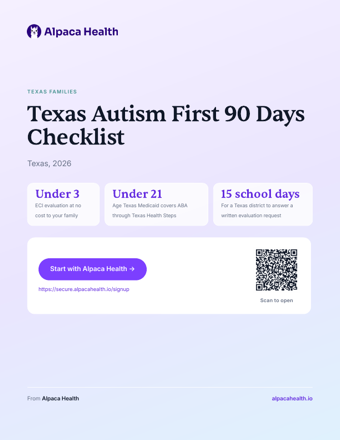
Every Texas number you need in your first 90 days after a diagnosis.
We also sent the link to your email.
Who to call first, based on your child's age
Early Childhood Intervention (ECI) is the Texas program for babies and toddlers from birth to 36 months who have delays or disabilities. Your child does not need an autism diagnosis to qualify. The evaluation, the service coordinator and the family plan cost nothing, and therapy visits use a sliding fee based on family size and income, according to the Texas HHS ECI page. No family is turned away because it can't pay.
- Find your local ECI program with the program search on the Texas HHS ECI page, or call the HHS Office of the Ombudsman at 877-787-8999, choose a language and then option 3, according to the Ombudsman page.
- Texas Parent to Parent answers calls from parents on the day of a diagnosis, and the people who pick up are parents of children with disabilities. Call 866-896-6001 or start on the Texas Parent to Parent site.
- Partners Resource Network runs the four parent centers that help Texas families with special education rights at no cost, in English and Spanish. PATH covers the Houston region at 1-800-866-4726, PACT covers Dallas and Fort Worth at 1-855-974-1368, PEN covers West Texas and the Panhandle at 1-833-847-2686, and TEAM covers Austin, San Antonio and the Valley at 1-877-832-8945, according to the Partners Resource Network site.
When you call about ECI, staff ask about your child's growth and health before they set up an evaluation. Have your child's birth date, your doctor's name and a short list of what worries you in front of you. ECI ends on your child's third birthday, so the program plans the move to school services before then.
If your child is already 3, the school district takes the first call. A doctor or psychologist can evaluate for an autism diagnosis at the same time. You can start both in the same week, so help can begin at school and at home sooner.
Where to get a medical autism diagnosis
If you're not sure yet, the free M-CHAT-R screener takes about two minutes and is made for toddlers 16 to 30 months old. Bring the result to your pediatrician and ask about a full evaluation.
- The Meyer Center for Developmental Pediatrics and Autism at Texas Children's in Houston evaluates children with developmental pediatricians and psychologists, and its department page lists 832-822-3400. It describes itself as a diagnostic center and does not offer ongoing therapy.
- The UT Southwestern and Children's Health Center for Autism Care in Dallas evaluates children and plans their care. Your pediatrician faxes a referral to 214-867-5389, according to the center's page.
- The UTHealth Houston Lifespan Autism Clinic evaluates teens and adults who were never diagnosed as children, at 713-486-2500 through its clinic page.
- The Baylor Autism Resource Clinic in Waco offers assessments and counseling for children and teens, run by supervised doctoral students at Baylor University. Details are on the clinic page.
- CHRISTUS Health does autism evaluations for children and teens, and its pediatric autism page says waits can reach six months or more.
Alpaca Health also offers autism evaluations with the ADOS-2 (a standard autism test done with a clinician) and checks your coverage before you book. You can ask more than one clinic for a spot. The first appointment you get can lead to the diagnosis. When you call, ask how long the wait is and which forms to send ahead.
Before the visit, write down how your child talks and plays, and what happens when a plan changes. Bring those notes with any school or therapy reports. Keep the diagnosis report in one folder afterward, since health plans, the school and grant programs all ask for a copy.
You don't have to figure this out alone.
Alpaca Health matches your family with an independent BCBA in Texas and handles the insurance paperwork and scheduling so you can focus on your child.
Get matched with a BCBA →
School help in Texas
Your child can get a school evaluation even if a doctor already gave a diagnosis, because the school team makes its own decision about special education. Put your request in writing so you have a dated record, and copy the principal on the email. In Texas the team that meets with you is called the ARD committee (admission, review and dismissal), and it writes the Individualized Education Program (IEP) if your child qualifies.
- Texas rules list eleven strategies the ARD committee must consider each year for an autistic student, including extended school year, daily schedules with little unstructured time, in-home and community training, parent training, and the staff-to-student ratio, according to the Texas Education Agency. If the committee decides your child doesn't need one, the IEP has to say so and explain why.
- SPEDTex is the state's special education information center, and it answers questions by phone, email and chat at 1-855-773-3839 through SPEDTex.
- Parent-Directed Special Education Services (PDSES) gives a one-time $1,500 online account for materials, technology and services such as extra speech therapy to Texas public school students with an IEP who haven't had it before, according to the PDSES page. The next window opens in spring 2027.
- Navigate Life Texas is the state's information hub for families of children with disabilities, with plain guides on diagnosis, school and insurance, at Navigate Life Texas.
The IEP meeting checklist helps you bring the right questions to that first meeting. Read our PDSES guide before the spring window opens. Keep every email and report in one folder. You'll want them at the next meeting. If you and the school disagree, your parent center can explain your options before you meet again.
Every Texas number you need in your first 90 days after a diagnosis.
We also sent the link to your email.
Paying for therapy and care
Texas Medicaid covers ABA therapy for members age 20 and younger who have an autism diagnosis. The benefit started on February 1, 2022, according to the state's Medicaid notice. It is part of Medicaid, so a child on CHIP does not have it, and those families can ask about Medicaid or Medicaid Buy-In instead. Read our guide to Medicaid ABA coverage before you choose a provider.
- Children who get SSI or a Medicaid waiver are usually in STAR Kids, a Medicaid plan that gives each child a service coordinator and a yearly needs assessment, according to the STAR Kids page. The plan's member line is where you ask what it covers.
- Texas Health Steps is the Medicaid checkup program for children from birth through 20, and its case managers help families find services at 877-847-8377 through the Texas Health Steps page.
- You apply for Medicaid, CHIP and Medicaid Buy-In through Your Texas Benefits. Medicaid Buy-In for Children covers children 18 and younger with a disability whose family earns too much for regular Medicaid, for a monthly payment of $0 to $230, according to the Texas HHS page.
- The Children's Autism Program is a separate state program that pays for short-term ABA for children ages 3 to 15, up to 180 hours in 12 months. Families pay a monthly share based on income, and openings depend on state funding, according to Texas HHS. Call 2-1-1 to find the program near you.
- The HHS Office of the Ombudsman helps when a Medicaid plan, ECI or a disability service isn't working and talking to the provider didn't fix it, at 877-787-8999. Its Managed Care Help line for plan problems is 866-566-8989, according to the Ombudsman page.
If your child has private insurance, the rules depend on the plan. Texas law requires state-regulated group plans to cover autism treatment, including ABA, when the child was diagnosed before age 10. Once a child turns 10, a plan can cap ABA at $36,000 a year, according to the Texas Insurance Code. Plans that an employer pays for directly follow federal rules instead, so ask your HR office which kind you have.
Call the member number on the card. Ask what the plan pays for autism evaluations and ABA therapy, and whether it has to approve therapy first. Write down the date and the name of the person you spoke with.
What if the plan says no? Ask for the reason in writing and keep the letter. Medicaid families can bring that letter to the Ombudsman.
Paying for ABA therapy
Alpaca Health accepts Texas Medicaid and many private plans, and verifies your benefits before therapy starts so you know what your plan covers.
Check your coverage →
Medicaid waiver waiting lists and help while you wait
Texas has five Medicaid waivers that pay for care at home and in the community, and every one of them has a waiting list. Join every list on the same day. You do not have to prove your child is eligible to join, according to The Arc of Texas, and eligibility is checked when a spot opens. The Arc also says the wait can be as much as 16 years for some waivers.
- Call Texas HHS at 877-438-5658 to join the CLASS, MDCP and DBMD lists, according to the state's interest list page. Your local disability office does not handle these three.
- Call your local intellectual and developmental disability authority (LIDDA) to join the HCS and Texas Home Living lists. Find yours by county in the LIDDA directory.
- The YES Waiver serves children 3 through 18 with serious mental health needs who are at risk of being placed outside the home, and families ask their local mental health authority for its inquiry list, according to the YES Waiver page.
- Community First Choice pays for attendant care and help learning daily living skills with no waiting list, for Medicaid recipients who meet an institutional level of care, according to the state's IDD services guide. Ask your LIDDA or your Medicaid plan about it.
Once your child is on a list, write down the date you applied and the office you called. Check in once a year to make sure your phone number and address are still current. Our Texas waivers guide explains what each waiver pays for.
Grants and savings
Grants are one-time awards, so they help with a camp, a device or a therapy bill rather than ongoing care. Most ask for the diagnosis report and a quote from the provider.
- ACT Today! is a national charity that gives grants of up to $5,000 for autism treatment, equipment and safety items, and Texas families can apply through the ACT Today! site.
- The Hunter Hinze Fund at the Autism Society of Texas gives grants of up to $500, paid to the provider, for services that build independence for Texas adults 18 and older with autism. The 2026 cycle is closed, and the fund page lists the next one.
- Variety of Texas funds adaptive equipment, therapy and inclusive programs for children and young adults with disabilities across the state, through the Variety of Texas site.
- The Huck Helps Fund at The People Project pays vendors for therapies, evaluations, communication and safety devices, recreation and swim lessons for Texas families, according to the Huck Helps page.
- Texas Elks Special Grants help with needs that insurance, agencies and other grants don't fully cover, for Texas children up to 18, or 21 if still in school. Applications start at a local lodge, according to the Texas Elks page.
- A Texas ABLE account lets a Texan whose disability began before age 46 save money without losing benefits, according to the Texas ABLE site.
Our Texas autism grants guide has the documents each program asks for and a checklist you can print.
Parent support and advocacy groups
Other parents can tell you which form to fill out first and what to ask at each meeting. Some of these groups can also step in when a school or health plan says no.
- The Autism Society of Texas offers information and referral, support meetings, recreation and advocacy across the state. Call (512) 479-4199 or visit the society's site.
- The Arc of Texas has advocated for Texans with intellectual and developmental disabilities since 1953 and publishes plain guides to the waivers. Call 512-454-6694 or visit The Arc of Texas.
- Disability Rights Texas gives free legal help on disability rights issues such as special education and health care services. It does not handle Social Security applications or appeals, and it is taking fewer cases because of funding cuts, so apply with your documents ready through the Disability Rights Texas site.
- 2-1-1 Texas is the state's referral line for any service, day or night, and its site searches by ZIP code. Call 2-1-1 when you don't know which office to start with.
A parent from Texas Parent to Parent or a support meeting can tell you what worked for their child and what they wish they had known. At a first meeting it's fine to listen and take notes. If the meeting time doesn't work for you, ask whether the group meets online. Call Disability Rights Texas when you think a school or agency broke a disability law.
Respite, recreation and crisis help
Respite means someone looks after your child so you can take a break, and Texas runs a statewide search for it. Sports programs give your child a steady routine and give you time with other families.
- Take Time Texas is the state's search for respite providers for a person of any age with any disability, at Take Time Texas. The Aging and Disability Resource Centers help with the search in every county at 855-937-2372.
- Special Olympics Texas offers year-round sports training and competition, with Young Athletes for ages 2 to 7, training from age 6 and competition from age 8. Call 512-835-9873 or visit Special Olympics Texas.
Save these numbers in your phone while things are calm. Every county has a local mental health authority with a 24-hour crisis line, and Texas HHS lists each county's number on its crisis services page.
| Who to Call | When to Call | How to Reach Them |
|---|---|---|
| 988 Lifeline | Any mental health crisis, day or night | Call or text 988 |
| Your county crisis line | A mental health crisis, with a face-to-face assessment if needed | The number for your county on the Texas HHS crisis page |
| Your LIDDA crisis line | A crisis involving a person with an intellectual or developmental disability | The crisis number listed with your LIDDA in the directory |
| 911 | A life-threatening emergency | Call 911 |
If you call 911, tell the dispatcher that your child is autistic and what helps calm them. It also helps to keep a short note with your child's diagnosis, medicines, doctor's name and what calms them in your phone or by the door.
Support for autistic teens and adults
In Texas the ARD committee has to start planning for life after high school by age 14, two years earlier than federal law requires, according to the Texas Education Agency. Ask for work and college goals in the IEP at that meeting.
- Texas Workforce Solutions Vocational Rehabilitation offers job and college counseling, internships and workplace readiness training for students with disabilities ages 14 to 22, through its youth program. Call 800-628-5115 to find your local office.
- The HCS waiver serves adults as well as children, so a teen on the list keeps their place after 18. Adults can also get state-funded services through their LIDDA without a waiver, according to the IDD services guide.
- An adult who was never diagnosed can ask the UTHealth Houston Lifespan Autism Clinic for an evaluation, and the Hunter Hinze Fund pays for services that build independence.
Help close to home
Most of the calls above go to an office in your own county, and the numbers differ from one part of Texas to another. Alpaca Health keeps a separate page for six Texas cities with the early intervention office, the school district contacts, the local disability authority, the diagnosis clinics and the parent groups for that area. Start with the one closest to you, and use this statewide page for the programs that work the same everywhere.
- The Houston and Harris County page lists the two ECI programs, the Harris Center, Texas Children's and the county's own grant programs.
- The Plano and Collin County page lists LifePath Systems, the Collin County school districts and the Dallas-area diagnosis clinics.
- The Arlington and Tarrant County page lists MHMR of Tarrant County, Arlington and Mansfield ISD and Cook Children's.
- The El Paso, Lubbock and Laredo pages have the same sections with the local numbers for each city.
How Alpaca Health helps Texas families
Alpaca Health matches Texas families with independent BCBAs. A BCBA (board certified behavior analyst) is the clinician who plans and leads your child's ABA therapy. Therapy can happen at home or by video anywhere in Texas.
Alpaca Health checks your Texas Medicaid or private insurance before therapy starts. Your BCBA builds the plan around the skills your family cares about, such as talking or getting through a trip to the store. You can see the cities Alpaca Health serves on the Texas page. When you're ready to begin ABA while the school and waiver steps move forward, you can start your intake.
Every Texas number you need in your first 90 days after a diagnosis.
We also sent the link to your email.
Frequently asked questions about autism resources in Texas
What state-funded autism services are available for families in Texas?
Texas pays for Early Childhood Intervention for babies and toddlers, special education through the school district from age 3, ABA through Medicaid for members 20 and younger, and the Children's Autism Program for ages 3 to 15. The five Medicaid waivers pay for care at home, and the state's job program helps students from 14 to 22.
How does the Children's Autism Program work?
The program pays for short-term ABA focused on one or two goals for children ages 3 to 15, up to 180 hours in a year. Families pay a monthly share based on income, a parent takes part in training, and openings depend on state funding. Call 2-1-1 to find the program near you.
Can my child start ABA therapy while we wait for a waiver?
Yes, Texas Medicaid covers ABA for members age 20 and younger who have an autism diagnosis, and your child doesn't need a waiver slot to begin. Alpaca Health checks your Texas Medicaid or private insurance before therapy starts, and you can begin your intake today.
How long is the wait for a Texas Medicaid waiver?
The Arc of Texas says the wait can be as much as 16 years for some waivers, and the person who has waited longest is served first. Join every list now, and ask your Medicaid plan or LIDDA about Community First Choice, which has no waiting list.
Support for the hard days.
When you are ready for expert support, Alpaca Health matches your family with a BCBA who can help with the hardest moments, at home, in a clinic, or by telehealth.
Get matched with a BCBA →
RELATED ARTICLES








NEW TO THE TERMS?
ABA glossary for parents →The words you will hear from your child's care team, explained in plain language.