





When you start looking for a school for your autistic child, the search can get confusing fast. You see district programs, special classrooms, private schools, charter schools, and program names you've never heard before.
As both a nurse and the parent of an autistic child, I know the real question is simpler. Where will your child feel safe and able to learn?
Colorado Springs has several options for autistic students, and no single school is the best fit for every child. Some children do well in their neighborhood school with an individualized education program (IEP). That's the legal plan that lists your child's school services. But others need a more specialized classroom or a different setting.
So below, you'll find how each option works, what it may cost, and what to ask before you decide.
Key Takeaways
- Public school support is free: Colorado Springs area districts give special education services at no cost to children who qualify.
- Each district sets up support its own way: Some districts run classrooms built around autism and social communication, while others build support around each child's plan.
- The plan decides the placement: Your child's school team, which includes you, decides the setting. Ask what your child would get before you pick a house or a school.
- You can get help with therapy alongside school: If you want to add ABA therapy outside the school day or at school, you can start your intake with Alpaca Health.
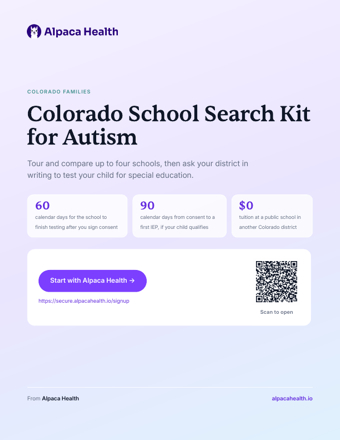
Compare up to four Colorado schools and ask your district to test your child.
We also sent the link to your email.
What school options do autistic children have in Colorado Springs?
Families here can choose a district school, a regional program, a charter or online school, or a private school. Each route works a little differently, and the table below compares them side by side.
| School option | Who it may fit | Cost to family | How your child gets in |
|---|---|---|---|
| Neighborhood public school | Children who can get the right support in general or special education | Free | Enroll in your district; the IEP sets services |
| District specialized program | Children who need more intensive autism, communication, behavior, or academic support | Free | Placement through the IEP team |
| Pikes Peak BOCES School of Excellence | Students with social, emotional, and behavioral needs who need a more specialized setting | Public program; confirm with your district | Ask your district's special education office how referrals work |
| Public charter school | Children whose needs fit within the charter's school model | Tuition free | Apply through the school's enrollment process |
| Public online school | Students who may learn better from home or in a flexible setting | Public school; confirm any costs with the school | Contact the online school directly |
| Private school | Families choosing a smaller or specialized setting outside the public system | Family pays, unless the district places your child there | Apply directly to the school |
Sources: Colorado Department of Education; Individuals with Disabilities Education Act (IDEA); Pikes Peak BOCES. School and district details checked against each organization's own website in October 2026.
The word "autism" in a program name isn't what makes a school a good fit. Pay more attention to how the staff support communication, sensory needs, behavior, and independence.
You don't have to figure this out alone.
Alpaca Health matches your family with a vetted, in-network BCBA, often within days and with no waitlist. We handle the insurance paperwork so you can focus on your child.
Get matched with a BCBA →
Autism programs in El Paso County school districts
Autism services differ by district, and your child's IEP decides placement more than the diagnosis alone. The table shows what each district lists on its own website.
| District | Autism and special education options | Where offered | Special education contact |
|---|---|---|---|
| Colorado Springs School District 11 | IEP-based special education and related services, with a focus on serving students in neighborhood schools | District schools, based on student need | Individualized Education Office: 719-520-2153 |
| Academy District 20 | Communication Social Development program, plus other special education supports | Communication Social Development at selected elementary and middle schools | Special Education: 719-234-1331 |
| Fountain-Fort Carson District 8 | Center-based autism program, Significant Support Needs, and Affective Needs programs | Autism programs at selected elementary schools, both middle schools, and Fountain-Fort Carson High School | District contact: 719-382-1318 |
| Cheyenne Mountain District 12 | A range of IEP-based services for ages 3 to 21 | Across district schools | Special Education: 719-327-2823 |
| District 49 | Special education, related services, and individual programming | Based on your child's school and needs | Special Education Office: 719-494-8932 |
| Harrison School District 2 | Special education, Child Find, occupational and physical therapy, speech and language | District schools, based on the IEP | Director of Special Programs: 719-579-2566 |
Phone numbers checked on each district's special education page in October 2026.
Colorado Springs School District 11
District 11 gives special education and related services to eligible students from age 3 through 21. Its special education department says students with IEPs learn best in their neighborhood schools alongside typical peers. So the district brings support into those schools instead of running separate ones.
That doesn't mean every autistic child stays in a general education classroom all day. Your child's IEP team decides what services and setting your child needs.
Academy District 20
Academy District 20 describes its autism-related program in more detail than most districts in the area. Its Communication Social Development program helps students build social communication, emotional regulation, and coping skills. The district says it was designed for needs related to autism, though students don't need an autism eligibility to join.
The program runs at six elementary schools and two middle schools. In high school, the same kind of support comes through each student's IEP instead of a separate classroom.
Fountain-Fort Carson School District 8
District 8 runs a center-based autism program, meaning a classroom set up for students who need more structure. The district says these classrooms build on each student's strengths while cutting down what gets in the way of learning. Teachers still aim to include students in general education as much as is right for each child.
Autism programs are offered at four elementary schools, Carson and Fountain middle schools, and Fountain-Fort Carson High School.
Cheyenne Mountain School District 12
Cheyenne Mountain's special education page describes a range of services based on each child's needs, with no separate autism center listed. Its staff includes speech-language pathologists, school psychologists, and occupational and physical therapists.
So instead of asking whether the district has an autism classroom, ask this: "What services and setting could my child's IEP give them here?" The answer depends on the IEP goals your team writes.
Falcon, Harrison, and other El Paso County districts
District 49 asks families to contact their school of attendance about programming for their child. Its special education office can also help families find services.
Harrison School District 2 offers special education, Child Find, occupational and physical therapy, and speech and language services. It also has a written form for parents asking a private provider to observe or give medically necessary treatment during school.
Programs can move between schools or change from year to year. Call the district before you choose a house or school based on an old program list.
What is the Pikes Peak BOCES School of Excellence?
The Pikes Peak Board of Cooperative Educational Services (BOCES) is a group of school districts that share services. Its School of Excellence houses the LIBERTY, COLA, and Pathways programs. They serve students in the Pikes Peak region with diverse social, emotional, and behavioral needs.
The BOCES site doesn't describe it as a school for autism. An autistic child could attend if the program meets their needs. That usually happens when the IEP team decides your child needs a more specialized setting.
If BOCES comes up at an IEP meeting, ask what need is driving the recommendation. Then ask what the program can give your child that the current school can't. The School of Excellence lists a district liaison at 719-380-6207 for questions about the program.
Is there a private autism school Colorado Springs families can enroll in?
Yes, though Colorado Springs has fewer autism-focused private schools than the Denver area, which you'll see in our list of autism schools across Colorado.
Kishami Academy is an independent private school in Colorado Springs for autistic and special-needs students in grades 3 through high school. It gives each new student an intake assessment and a customized curriculum. As an independent school, it says it isn't limited by what an IEP states. Your child's IEP doesn't carry over there the way it would in a public school.
Families apply directly to the school. The steps are reading the school's website, visiting and interviewing with the teachers, and returning an enrollment packet in person.
Kishami is a tuition-based school. Its admissions page lists an early-enrollment rate of $1,500 a month for the 2026 to 2027 school year. The school says that's $500 a month off its standard rate. Confirm the current tuition with the school before you plan around it.
The school also says it isn't equipped for one-on-one care, for children who run, or for students who need constant supervision. That's the kind of detail to know before you visit, so ask about it early.
Charter, online, and open enrollment options
Colorado families aren't limited to their neighborhood school. Colorado's Public Schools of Choice law lets students apply to schools outside the one they're zoned for, including schools in another district. A district can say no only for reasons the law allows. Two examples are no space or no program that fits your child.
Charter schools are an option too. In Colorado, a charter school is a tuition-free public school that must follow IDEA and can't turn a student away because they need special education. Before you apply, compare the other Colorado school options too.
Online public schools can work for some autistic students, especially when a regular building brings heavy sensory, social, medical, or emotional strain. The state keeps a list of online schools, and some accept students from anywhere in Colorado.
A quieter or more flexible school can still miss what your child needs. Before you switch, ask:
- How will the school carry out my child's IEP?
- Who provides speech, OT, or other related services?
- What happens if my child needs direct adult support?
- How are social and communication goals handled?
- What help is there when my child struggles to take part online?
How your child gets a place in a district autism program
Most parents can't pick a specialized autism classroom from a list. Placement comes through the special education process and your child's IEP.
If your child does not have an IEP yet
If you think autism or another disability is affecting your child's learning, you can ask the district in writing for a special education evaluation. Colorado's rule gives the district 60 calendar days to finish it once the school has your written request and your signed consent.
The evaluation looks at your child's needs at school. A school's autism finding is separate from a medical diagnosis, and your child doesn't need a diagnosis for the school to evaluate them. If your child qualifies, the team writes goals, services, accommodations, and a placement. An IEP meeting checklist can help you prepare.
Academy District 20, for example, says its Child Find screening and evaluation are free for families who live in the district.
If your child has an IEP from another Colorado district
Say your child moves to a new Colorado district during the school year. The new district must give services comparable to the old IEP. That lasts until the district adopts the old IEP or writes a new one with you.
If your family is moving from another state
The rules are close to the in-state ones. The new Colorado district must give comparable services first, and it may do a new evaluation if it decides one is needed. Then it writes a Colorado IEP.
If you're moving, bring your own copy of the IEP, evaluations, behavior plans, therapy reports, and any assistive technology details. Records don't always arrive before your child's first day.
When your district can't meet your child's needs
Sometimes you've tried the neighborhood school, added supports, and changed the IEP, and your child still isn't getting an appropriate education. That's an exhausting place to be as a parent, and it doesn't mean you or your child did anything wrong.
Under IDEA, your child has a right to a free appropriate public education (FAPE). That means school services that fit your child's needs, at no cost to you. If the current placement can't give that, the IEP team may need to look at a more specialized program or school.
A district can place a child in a private or specialized program. When it does, the district stays responsible for the IEP. That's different from a parent deciding alone to enroll a child in private school.
Maybe you're thinking of pulling your child from public school because the district isn't providing FAPE. If so, talk with a special education advocate or attorney first. IDEA has notice rules that can affect tuition reimbursement, including written notice to the district at least 10 business days before you remove your child.
Wondering how you'll pay for ABA?
Alpaca Health is in-network with 100+ plans, including Medicaid in the states we serve, and we verify your coverage for free before anything starts.
Check your coverage →
What autism schools cost and who pays
Who pays depends on who made the placement, and that also decides whether your child keeps full IEP rights.
| Placement | Who usually pays? | What happens to IEP rights? |
|---|---|---|
| Public district school | The school district | Full IEP rights apply |
| District specialized program | The school district | Full IEP rights apply |
| Public BOCES placement | The public school system | The IEP stays in place |
| Public charter school | Public funds | IEP rights apply |
| Public online school | Public funds | IEP rights apply |
| Private school chosen by the parent | The family | No individual right to full IEP services |
| Private school placed by the district | The district | The district stays responsible for the IEP |
Sources: 34 CFR 300.137, 300.146, 300.148, and 300.325; Colorado Department of Education charter school FAQ.
If you choose a private school because you prefer it, the district generally doesn't have to pay tuition when it had offered your child FAPE. A child placed in private school by a parent also has no individual right to the full set of IEP services. So ask the district in writing what help it would still give.
When the district places your child in a private program because that's what FAPE requires, the special education there comes at no cost to you.
School policies for outside therapy during the school day
Your child may already see an ABA provider, a speech therapist, or an occupational therapist (OT). You may wonder whether that provider can come into the classroom. A 2022 Colorado law requires each district to have a written policy on this. It explains how a student with a doctor's order for medically needed care gets that care at school. The district must post it online.
A policy doesn't give every outside therapist open access to the classroom. Schools may have steps around medical paperwork, scheduling, visitor rules, safety, and the IEP or Section 504 plan.
For example, Harrison District 2 has a form for families asking that a private provider observe or give medically necessary services at school. If outside therapy during school hours matters to your family, ask about this before you choose a school. Some families arrange ABA during the school day this way.
Compare up to four Colorado schools and ask your district to test your child.
We also sent the link to your email.
Questions to ask when you visit a school or program
Asking "Do you work with autistic children?" won't tell you much, because every school will say yes. You want to know what that support looks like on a real school day.
Ask:
- What does support look like when my child is overwhelmed?
- How do you handle sensory needs?
- How much time would my child spend in general education?
- What is the student-to-staff ratio in the program?
- How do you support communication if my child has trouble expressing needs?
- Who provides speech, OT, behavior, or social-emotional support?
- How do you handle running off or other safety concerns?
- What happens during lunch, recess, assemblies, and transitions?
- How do you keep in touch with parents?
- Can I see the classroom my child would attend?
- How do you handle behaviors that come from my child's disability?
- Can an outside therapist observe or give medically necessary treatment at school?
- What would tell us that this placement is or isn't working?
Pay attention to how people talk about the students. Listen for staff who talk about what children can do and what they're working toward. Good staff also explain how they change the room to help.
How Alpaca Health helps Colorado Springs families alongside school
School services and medical ABA can work side by side. Your child's IEP covers what they need to learn at school, while ABA through private insurance or Health First Colorado pays for medically necessary behavior treatment. Many children use both.
Alpaca Health matches families with independent Board Certified Behavior Analysts (BCBAs) who work with families in Colorado Springs. After you fill out the intake form, Alpaca Health checks your insurance and introduces you to a provider. If you want sessions at school, your provider works with you and the school on site access and a schedule.
If you're trying to fit ABA alongside your child's school services, start your intake with Alpaca Health.
Compare up to four Colorado schools and ask your district to test your child.
We also sent the link to your email.
Frequently asked questions about autism schools in Colorado Springs
What type of school is best for a child with autism?
The best school is the one that can meet your child's own academic, communication, sensory, social, and safety needs. Some children thrive in general education with IEP support. Others need a specialized classroom, a smaller school, or more intensive behavior and communication support.
Which Colorado Springs school district is best for autism?
No single district is best for every autistic student. Academy District 20 and Fountain-Fort Carson District 8 publish details about autism-related programs, while other districts build services around each child's IEP. Ask each district what program would be open to your child, and compare the answers.
Should a child with autism go to a regular school?
Many autistic children do well in their neighborhood public school with the right supports. IDEA requires schools to teach children with disabilities in the least restrictive environment. That means with nondisabled peers as much as is right for each child. So the right setting is an IEP team decision, and you're on that team.
Can my preschooler get autism services from the school district?
Yes. Districts must find and evaluate children with disabilities through Child Find. Eligible children ages 3 to 5 can get an IEP and preschool special education at no cost. For a child under 3, Cheyenne Mountain's page sends families to The Resource Exchange at 719-380-1100 for early intervention. If you'd also like to look at ABA for your young child, you can begin your intake with Alpaca Health.
RELATED ARTICLES